
Find Your Fish

Showing posts with label Knifefish. Show all posts

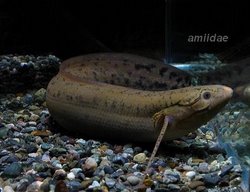
Black African Knifefish (Xenomystus nigri)

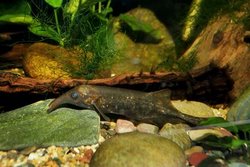
The Black African Knifefish or Xenomystus nigri is an odd looking fish with no dorsal or caudal fins. Instead, like other species of Knifefish they have an elongated anal fin that they use to maneuver around. They have a long slender bodies that can reach lengths of about 12" (30cm). As their name states they are gray, black or brown in coloration with a knife shaped body.  You can check out their rather unique way of swimming in the video below...

This species of Knifefish is found in many coastal river basins in Africa including the Congo, Nile, Chad and Niger basins. They go by a couple different names including the African Brown Knife Fish or simply the African Knife Fish. These fish are mostly nocturnal, and will often stay in hiding during the day. Take this into consideration if you are thinking of purchasing a Black African Knifefish for your freshwater aquarium. They get along well with most other species of fish, but shouldn't be kept with fast moving aggressive fish. Black African Knifefish should be fed a variety of food including snails, brine shrimp, worms and other meaty preparations.
One odd fact about the Black African Knifefish is that they are able to produce barking sounds. No one is really sure of the exact purpose of this strange habit.

If you have any additional information about the Black African Knifefish please leave us a comment. 

Glass Knifefish (Eigenmannia virescens)

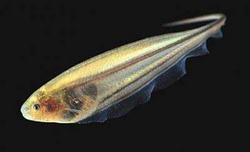
The Glass Knifefish or Eigenmannia virescens is clear freshwater fish that originated from South America.  Even though these fish can grow to about 1-1/2' long, they are still kept in large aquariums.  One over 100 gallons is recommended with the following water conditions, 73-82° F, KH 2-15 and pH 6.0-7.0.  These fish lack dorsal fins and are quite the sight to be seen when swimming.  You can see for yourself in the video below...
     

Glass Knifefish are peaceful fish that prefer a low light aquarium with plenty of hiding places and plants.  Also known as the Green Knifefish, they sometimes have a very slight green tint.  Like other Knifefish, they have the ability to emit a weak electrical signal from one of their organs that helps them maneuver in the dark.  As you can imagine, this means that they are very active during the night more so than the daylight hours.  They also use this weak electrical current during courtship.    
You can keep mulitple Glass Knifefish in the same tank, they will get along just fine and will even breed in an aquarium setting.  These fish will often lay their eggs on plants.  Once the fry hatches you should switch them into another tank.  


The Glass Knifefish is an omnivore that can be fed tubifex, pellets, flakes, shrimp and other live and frozen foods.
Photo Credit: Kirk, Fortune, Roth, (c) 2007
Eigenmannia virescens


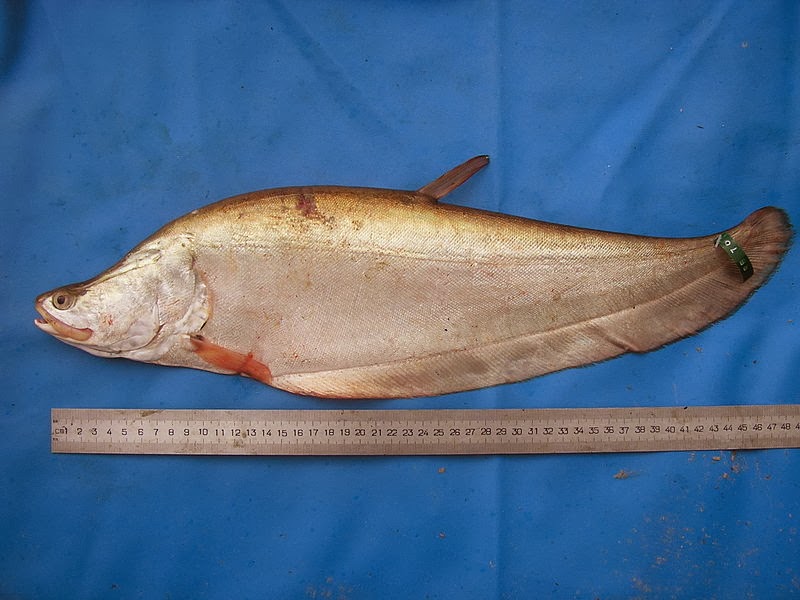
Giant Featherback (Chitala lopis)

The Giant Featherback or Chitala lopis is a fish that is native to the Mekong River basin where you can find many different species of fish, including the massive Mekong Catfish!  This freshwater fish is from the Nototeridae family, which are often referred to as Featherbacks or Knifefishes.

Giant Featherback fish are sometimes called the Indonesian Featherback or Pla Satu.  They have a silver body with a dark back.  Their caudal fin is long and they will often have a silver or white underbelly.  They can grow to about 100cm (39 Inches) and can live up to 50 years old! 


When fishing for Giant Featherbacks you will often find them hiding around submerged rocks or roots in freshwater rivers and lakes.  Like with most fish, live bait always works best, but spinners, spoons and flies will also work.  Once hooked this fish puts up a decent fight and is known for its jumping abilities and stamina.  You can check out this fish in an aquarium setting in the video below...  

If you have any additional information about the Giant Featherback fish please leave us a comment!

Black Ghost Knifefish

The Black Ghost Knifefish or Apteronotus albifrons is one cool looking freshwater fish. Its long slender eel-like body and white rings on its tail make it quite the sight to be seen. This fish is nocturnal so if you have it in an aquarium setting you should provide plenty of plant cover for the fish to hide in. Clear tubes can also be used so you can still appreciate the beauty of the Black Ghost Knifefish. This type of fish is considered to be very peaceful and can even be trained to eat right out of your hand! You can handle this fish after it become accustom to your presence. This fish can easily grow over 1' long so a larger tank is recommended. In South America the Indians believe that the Black Ghost Knifefish carry the spirits of the dead and they will not hunt or eat this type of fish. They have electrical sensors that run along the bottom of their body which they use to detect food. This fish is by no means a picky eater. It will eat live foods, chopped earthworms, as well as frozen and flaked foods.


Pretty good video of feeding the Black Ghost Knifefish in an aquarium. Just look at the way it uses it's bottom fins to move!

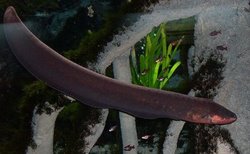
Electric Eel

The Electric Eel or Electrophorus electricus is an amazing fish that has the ability to discharge a burst of over 600 volts when threatened or while hunting its dinner. These freshwater fish is known as Poraque in Brazil and can grow over 8' in length and weigh in at over 45lbs! While human deaths are very rare, they have been reported from this dangerous eel.  Normally, this occurs by heart failure from the extreme shock that the Electric Eel sends out through the water. This fish's eyesight is very weak, but it makes up for this by using a low voltage pulse, almost like sonar to find its prey. They can live up to 15 years and feed on fish and small mammals. Despite its name the Electric Eels in not really an Eel at all. By scientific classification is it closer to a Knifefish! They can be kept in an aquarium as a pet for the die hard fish fan that doesn't mind risking his or her life. In the wild they are found in the Amazon River and other places in South America.

To check out the Electric Eel in action lighting up a Christmas Tree, watch the video below...


Aquarium Fish Of The Month - Spotted Cardinalfish


Still Can't Find The Fish You Are Looking For? Search For It Below Or Send Us An E-Mail!

Fish Index Followers