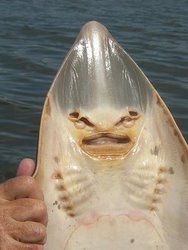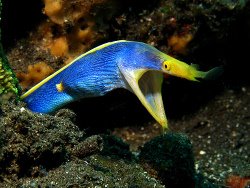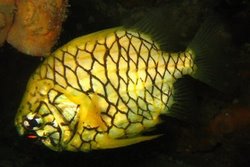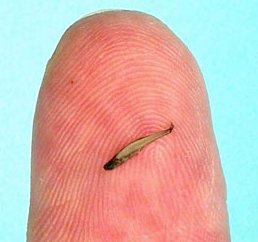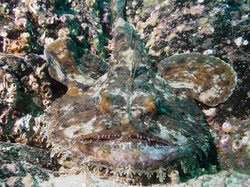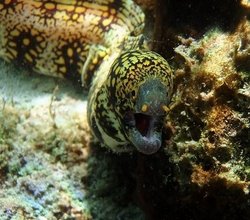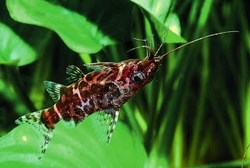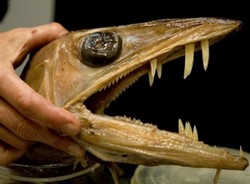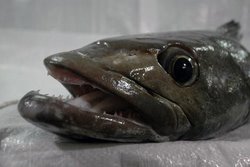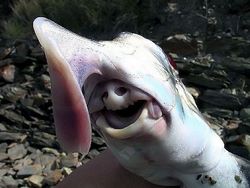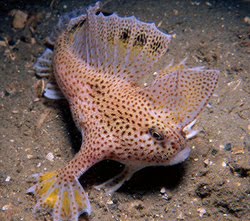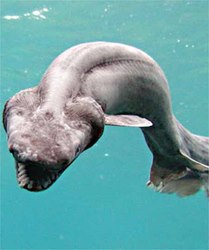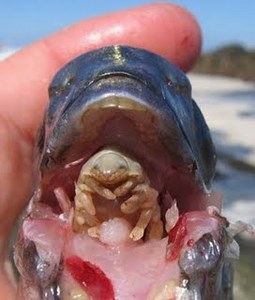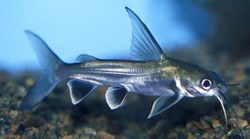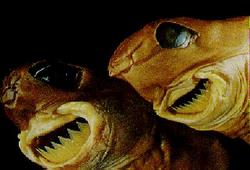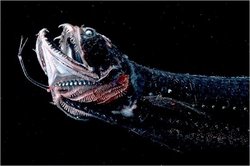






















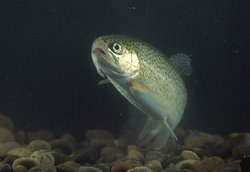
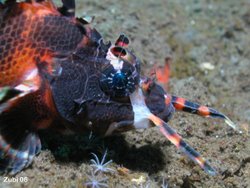
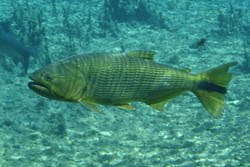

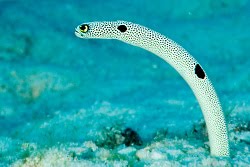
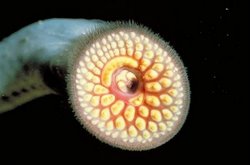






Viper Shark (Trigonognathus kabeyai)


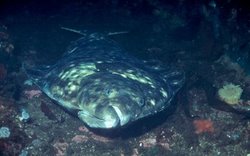
Peacock Flounder (Bothus mancus)

The Peacock Flounder or Bothus mancus is a master of camouflage. These saltwater fish found in the Indo-Pacific have the ability to constantly change colors and patterns to match the sea floor. A recent scientific study has proven that it takes just 8 seconds for their bodies to completely blend into their surroundings! Scientists even used a checker board, which the flounder matched with ease. You can see this amazing transformation for yourself in the video below.
Like other species of Flounder, these fish start their lives with eyes on BOTH sides of their bodies, but as they grow older these eyes actually move to one side to give them the ability to settle down flat on the surface and blend in. When in danger these fish will bury themselves in the sandy bottom with just their eyes exposed. This particular flounder can grow to about 18" (45cm) in length and is quite edible. It is sometimes known as the Flowery Flounder and is a flatfish from the Bothidae (lefteye flounders) family.

If you have any any additional information about the Peacock Flounder please leave us a comment below.

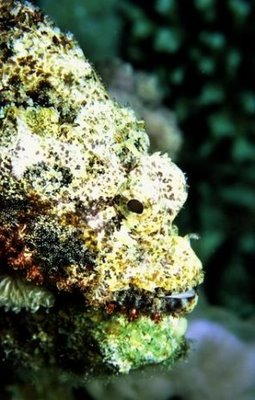
Weedy Scorpionfish (Rhinopias frondosa)

The Weedy Scorpionfish or Rhinopias frondosa is a saltwater fish that is a master of camouflage. This fish has a series of appendages that can easily be mistake for sea weed. As you can imagine, this makes the fish the perfect ambush predator. They will lie in wait until an unsuspecting meal gets too close and then strike with impressive speed.

Belonging to the Scorpaenidae family, these fish can vary greatly in color depending on what best suits their environment. You can learn a bit more about them in the short video below...
Reaching about 9" (23cm) in length, the Weedy Scorpionfish is found in the Indian and Pacific Oceans in depths of up to 295' (90 meters). These fish are sometimes known as Popeyed Scorpionfish, and do occasionally make their way into the aquarium trade, though at a steep price!

If you have any additional information about the Weedy Scorpionfish please leave us a comment below.
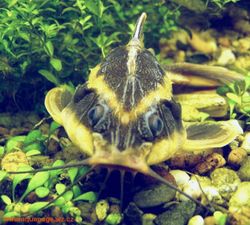
Bearded Catfish (Scleromystax barbatus)

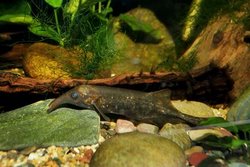
The Bearded Catfish or Scleromystax barbatus is a freshwater subtropical catfish from the Callichthyidae family. This fish was first discovered in the coastal drainage in Brazil. It has since found its way into the aquarium trade, and like other catfish it is a very hardy addition to any community tank. Also known as the Banded Corydoras this fish can grow up to 4" (10cm) in length. The follow water condition are ideal for this species, 6.0–8.0 pH, a water hardness of 2–25 dGH, and a temperature of 83 °F (28 °C). A 20 gallon or more tank is well suited for these fish with plenty of hiding spaces. You can check out the Bearded Catfish in action in the video below...
If you have any additional information about the Bearded Catfish please leave us a comment below.
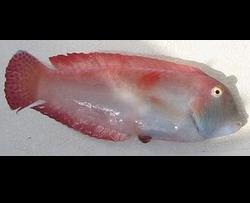
Dwarf Wrymouth (Cryptacanthodes aleutensis)
.jpg)
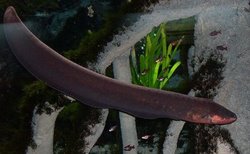
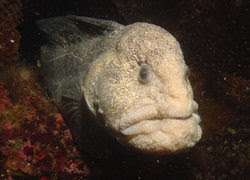
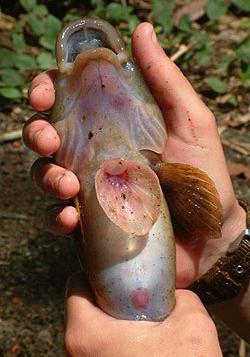
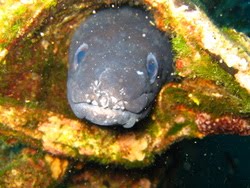
The Dwarf Wrymouth or Cryptacanthodes aleutensis is one of the four species of Wrymouth found in the Atlantic and Pacific Oceans. This particular species is found in the Pugent Sound area. These saltwater fish have an eel-like elongated body that lacks any scales. They have a pinkish or reddish coloration with long dorsal and anal fins that on at the base of the tale. Dwarf Wrymouth grow to about 1' in length and are often seen buried in the soft sentiment at the bottom of the ocean with its eyes pointing upwards waiting for potential prey to swim by. Pictured below is an unspecified species of Wrymouth with just it's head sticking out of the sand.

Little more is known about the Dwarf Wrymouth, but if you have any additional information feel free to share in the comments below.
NEXT
PREVIOUS
NEXT
PREVIOUS
Psychedelic Fish (Synchiropus picturatus)

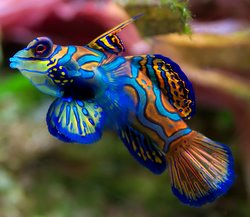
The Psychedelic Fish or Synchiropus picturatus is a rather trippy looking saltwater fish that was first discovered in the Western Pacific Ocean. Also known as the Psychedelic Mandarinfish, Spotted Mandarin, and Picture Dragonet these fish have a psychedelic coloration of blues, oranges, and black spots with a green base.

These fish can be kept as pets, but are considered to be difficult to take care of. They require a tank of 30 gallons or more with live substrate, and of course, many hiding places. Spotted Mandarin fish should be fed a variety of live brine shrimp and live black worms. They will also graze on live rock and live sand. These fish have been known to spawn in an aquarium without too much difficulty. The Psychedelic Fish can grow to about 4" in length and require the following water conditions: 72-78° F, dKH 8-12, pH 8.1-8.4, sg 1.020-1.025. If can check out the Pscychedelic Fish in an aquarium in the video below....
If you have any additional information about the Psychedelic Fish please leave us a comment below.
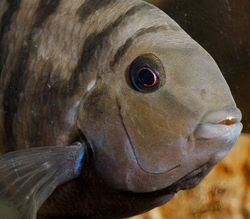
Mozambique Tilapia (Oreochromis mossambicus)

The Mozambique Tilapia or Oreochromis mossambicus is just one of the 100s of different Cichlid species of fish known as Tilapia. This particular species goes by a couple different names including Blue Kurper, Tilapia Kafuensis, Kafue Bream and the Three Spotted Tilapia. This species is native to Southern Africa and is found in many tropical areas around the world, where it is used for aquaculture. Like other Tilapia, they are able to survive in very harsh conditions compared to many other freshwater fish. It can adapt to temperatures below 50 °F (10 °C) and above 100 °F (38 °C), and can also tolerate brackish waters. They also will eat a large variety of foods, which not only makes them a perfect candidate for fish farming, but also difficult to get rid of when introduced to the wrong area. These fish are considered to be an invasive species in parts of the world where they have been introduced to control mosquitoes.
These fish are not particular large, only grow to about 14" (35cm) in length and weighing in at 2-1/2 lbs (1.13KG). They can live for about 11 years. Like other species of Cichlids, these fish are mouth brooders, which means that after the eggs are laid and fertilized the female will then scoop them up into her mouth for protection until they hatch. You can check out the Mozambique Tilapia underwater in the video below.
If you have any additional information about the Mozambique Tilapia please leave us a comment below.
Walking Shark (Hemiscyllium halmahera)

(© CI/photo by Mark Erdmann)
The Walking Shark or Hemiscyllium halmahera is a newly discovered species from Indonesia. Found off the remote eastern Indonesian island of Halmahera, this is the third species of walking shark in the past six years to be discovered in eastern Indonesia. These sharks will use their fins to “walk” across the ocean floor, searching for food in the darkness of night. This species is harmless to humans and can grow to about 30" (76cm) in length. You can check out some underwater footage of this shark walking in the video below.
Little more is know about this new species. If you have any additional information about the Walking Shark please leave us a comment below.

Hawaiian Dascyllus (Dascyllus albisella)

The Hawaiian Dascyllus or Dascyllus albisella is one of the many different salt water fish that is native only to the islands of Hawaii. The species of Damselfish is sometimes called the Hawaiian Domino Damselfish, and is found in the reefs surrounding the Hawaiian islands. When these fish are young they have a much different appearance then once they are older. They start out with a bright white spot on each side of the fish with a black body that fades to grey like the one pictured above. As if that wasn't enough, the males of this species will also turn almost entirely white during the spawning process.


These fish can grow to about 5" (13cm) and feed on crabs, shrimp larvae, copepods and zooplankton. You can check out the Dawaiian Dascyllus underwater around some corals in the video below...
If you have any additional information about the Hawaiian Dascyllus please leave us a comment.
Adolfo's Catfish (Corydoras adolfoi)

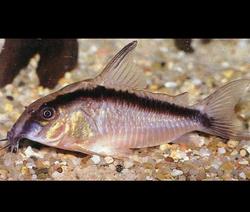
The Adolfo's catfish or Corydoras adolfoi is a species of freshwater fish that often makes its way in the aquarium trade. This tropical catfish is not very large, only growing to lengths of about 2.2" (5.7cm). They are part of the Callichthyidae family, and first originated in South America, specifically Brazil. They have a silver body with a black band near the base of the caudal fin and over the eye.
One of the reasons they are so popular in the aquarium trade is their ability to breed in captivity. Simply provide them with a plant or stone for them to attach their eggs to and wait. It only takes about 4 days after the eggs are laid for the fry to hatch. Like other species of Catfish, they are also good at keeping the bottom of the tank clean. This fish are sometimes called Adolfo's Cory and require a 25 gallon tank with the following water conditions, 70-79F, 6.0-7.5ph. They are a peaceful community fish that is considered to be very easy to take care of. You can check out the Adolfo's Catfish in an aquarium in the video below.
If you have any additional information about the Adolfo's Catfish please leave us a comment below.
Waterfall Climbing Cave Fish (Cryptotora thamicola)

The Waterfall Climbing Cave Fish or Cryptotora thamicola is one of the rarest, and most elusive fish in the world! This species is native only to two caves in Thailand! This freshwater fish has specially developed fins with microscopic hooks that allows it to climb up waterfalls and attach itself to the rock in the fast moving waters! It goes by a couple different names including the Cave Angelfish and the Eyeless Cave Fish. Since this Angelfish spends its entire life in darkness, it has lost its pigmentation, as well as its eyes! You can check out this amazing fish in the videos below...
If you have any additional information about this rare species of fish please leave us a comment below.
California Sheephead (Semicossyphus pulcher)


If you have any additional information about the California Sheephead please leave us a comment below.

Deepest Living Fish The Hadal Snailfish (Pseudoliparis amblystomopsis)

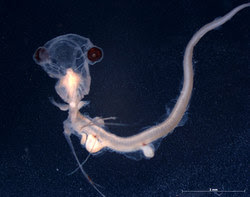
The Hadal Snailfish or Pseudoliparis amblystomopsis is the deepest living fish known in the world, able to survive at depths exceeding 4.8 miles (7.7 kilometers)! Living so far underwater, these species of Snailfish can withstand pressures equal to 1,600 elephants standing on the roof of a Mini Cooper! These fish spend their lives in complete darkness and rely on their bodies to sense food that falls from the ocean above.
This species is just one of the over 360 different kinds of Snailfish on our planet. In 2008 a group in Japan was able to capture these deep sea fish on camera. Here is their amazing footage...
As you can imagine little is known about this saltwater fish due to its nature habitat. If you have any additional information about the deepest living fish please leave us a comment below.
Image courtesy Oceanlab, University of Aberdeen
Salmon Shark (Lamna ditropis)

The Salmon Shark or Lamna ditropis is a species of shark that is found exclusively in the Northern Pacific Ocean. This shark is an apex predator that feeds on Sablefish, Herring, Squid, and of course Salmon. Growing to about 10 ft (3m) and weighing in at almost 1000lbs (450kg) these sharks are sometimes confused with the much more dangerous Great White Shark. They have a white underbelly with the rest of their body a grey to black coloration along with some dark patches. For an in depth look at this species you can watch a 47 minute documentary by National Geographic in the video below.
One characteristic that sets the Salmon Shark apart from other species is their ability to regulate their body temperature. This helps them survive farther north then almost every species of shark with the exception of the Greenland Shark. They have vascular heat ex-changers known as retia mirabilia, that keeps the blood moving toward extremities. When the blood returns it is warmed, which keeps the core of the shark heated.
Salmon Sharks are ovoviviparous, which means the mother carries the eggs in her belly until they are ready to be born. A litter size of 2 to 6 pups is not uncommon. Once hatched they will feed off their embryo until they are ready to feed on their own.

If you have any additional information about the Salmon Shark please leave us a comment below.
Blue Parrotfish (Scarus coeruleus)

The Blue Parrotfish or Scarus coeruleus is just one of the over 90 different species of Parrotfish that inhabit our oceans. As you can see these saltwater fish get their names from their deep blue coloration.

Like other species of Parrot Fish they develop a snout over their lifetime that allows them to feed on coral. They can grow to be quite large, 3' (1m) is about as big as you will find them. You can check out the Blue Parrotfish underwater in the video below.
If you have any additional information about the Blue Parrotfish please leave us a comment below.
Bluespotted Cornetfish (Fistularia commersonii)


Bluespotted Cornetfish are found almost exclusively in and around reefs on the western coast of the Atlantic Ocean, and off the western coast of Africa. They feed on small fish and invertebrates, and can grow to 5-1/4' (1.6 meters). These fish go by several different names including Commerson's Cornetfish, Smooth Flutemouth, Flutefish, Smooth Cornetfish, Reef Cornetfish, Coronet and Arrowshaft. You can check out the Bluespotted Cornetfish underwater in the video below.
If you have any additional information about the Bluespotted Cornetfish please leave us a comment below.
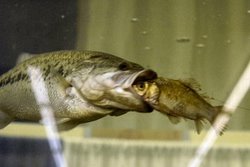
Kelp Bass (Paralabrax clathratus)

Kelp Bass can reach lengths of about 28-1/2" (72cm), and can live to be about 34 years old. These fish are quite edible and are also fun to catch, with a decent fight for their size. This fish will feed on crustaceans, squid and small fish. They will spawn in the warmer summer months in deep water. Once the babies are developed they will take shelter in the kelp. They are known to become quite territorial while spawning and there are even a few storied of these fish biting humans.

Subscribe to:
Posts (Atom)
Aquarium Fish Of The Month - Spotted Cardinalfish