Find Your Fish

Showing posts with label Catshark. Show all posts

Swellshark (Cephaloscyllium ventriosum)

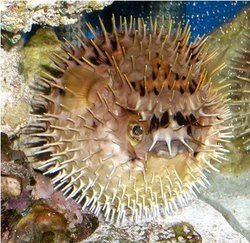
The Swellshark or Cephaloscyllium ventriosum is a Catshark with the amazing ability to inflate its body to twice its size, much like the Pufferfish. This helps them from falling prey to seals and other sharks that want to make a quick meal of these small saltwater fish.
Swellsharks only grow to about 39" (100cm) in length and are one of the smallest sharks in the world. These sharks are from the Scyliorhinidae family, and are normally found in the subtropical waters of the eastern Pacific Ocean. They have been spotted as deep as 460 meter down. The look of the Swellshark makes it easily confused with the Leopard Shark, because they both have distinctive spots, but the Leopard Shark grows much longer to almost 8'. Younger Swellsharks will also tend to be a bit lighter in color then their more mature counterparts.
This species of shark is nocturnal, spending most of the day sleeping in continental shelves. At night they become active and hunt for small bony fish, crustaceans and mollusks. Like many other sharks, the Swellshark is oviparous. The female with lay her egg sacks and attached it to a reef. The embryo will feed on the egg yoke for 7-12 months before hatching! You can see the Swellshark with your own eyes underwater in the video below...

If you have any additional information about the Swellshark please share!

Black Banded Cat Shark (Chiloscyllium punctatum)


The Black Banded Cat Shark or Chiloscyllium punctatum is an aquarium fish that should be only housed in a very large aquarium of at least 180 gallons. These Cat Sharks can grow to about 3' 6" in maximum length and are considered to be an aggressive salt water fish. The Black Banded Cat Shark gets its name from the barbels around its mouth that look just like cat swiskers. Also known as the Brownbanded Bamboo Shark, it has a long stripped body and originates from the indo-pacific area. As this Shark gets older, the stripes will fade on its body. You can check out a rather young Black Banded Cat Shark underwater in this video below...

In an aquarium and in the wild around coral reefs you will normally find this shark close to the bottom where it feeds on crustaceans scampering across the sea floor. If you house this fish in an aquarium be sure to provide it with a sandy bottom so it doesn't hurt this tender bottomed fish. Another thing to note is that is shouldn't ever be exposed to copper-based medicine as this can harm or even kill this species of Cat Shark.
One of the biggest problems with the Black Banded Cat Shark is getting it to eat in the very beginning. If you provide it with live saltwater feeder shrimp or squid this should encourage this beautiful fish to eat. After that you can feed it scallops, pieces of fish and squid, mussels are said to work well too.

A couple interesting facts about the Black Banded Cat Shark is that is can actually survive outside of water for up to 12 hours and it is an egg layer that can take up to four months to hatch! While the Black Banded Cat Shark is not the easiest to care for it is quite fun to watch grow, and a great addition to any large saltwater aquarium.

Filetail Catshark (Parmaturus xaniurus)

The Filetail Catshark or (Parmaturus xaniurus) is a small deep sea fish that is normally found at depths of over 500 meters. This shark gets its name from the toothlike projections on its skin. This fish can only grow to lengths of about 100cm and is found in the Eastern Pacific Ocean. One thing that makes the Filetail Catshark so unique is that it takes all full two years for catsharks to emerge from their egg cases!

The Filetail Catshark is a carnivore that feeds one small fish and squid. It is just one of the over 110 different species of Cat Sharks. Like some other Deep Sea Fish this shark possesses an enlarged gill region which is an adaptation to areas with low dissolved oxygen levels. Due to its tiny appearance and deep depths this type of shark is not considered a danger to humans.  You can check out a Filetail Catshark underwater in the video below.


Aquarium Fish Of The Month - Spotted Cardinalfish


Still Can't Find The Fish You Are Looking For? Search For It Below Or Send Us An E-Mail!

Fish Index Followers