





















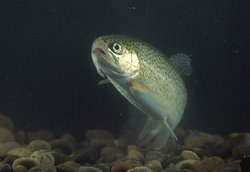
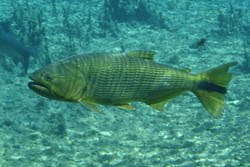





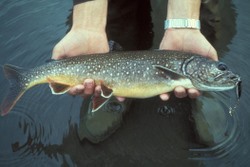

Grayling or Thymallus thymallus is a freshwater fish that is commonly found in Northern Europe, and Russia. Grayling are not very large, growing to about 2' (60 cm) in maximum length and weighing in at no more than 15lbs (6.7 kg). They can live for a maximum of about 14 years.
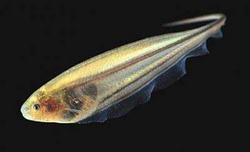
There are two different kinds of Grayling Thymallus thymallus and the Arctic Grayling or T. arcticus arcticus. You can easily tell the two apart by the presence of 5-8 dorsal and 3-4 anal spines that are only found on the traditional Grayling not the Arctic Grayling. In comparison to the body, the dorsal fin is huge! When viewed in water the dorsal fin resembles the sail of a boat.
 Grayling fish are commonly found in cold, clean running waters but can also be caught in lakes. They are omnivores that feed on insects, zooplankton, crustaceans and smaller fish including Perch.
Also known as The Lady of the Stream this fish are often caught fly fishing, often in the winter months in. Grayling are great indicators of water quality, they only thrive in the cleanest of waters. To check out the Grayling in action watch this video!
If you have any fishing tips or Grayling recipes that you would like to share please leave them in the comments below...