
Find Your Fish

Showing posts with label Intermediate Aquarium Fish. Show all posts

Skunk Clownfish (Amphiprion akallopisos)


The Skunk Clownfish or Amphiprion akallopisos is a peaceful saltwater fish that is found in the Indo-Pacific.  This species of Clownfish is also known as the Nosestripe Anemonefish and has a very special relationship with its best friend the anemone.  The Skunk Clownfish has an immunity in their skin which allows them to make their home inside the stinging tentacles of an anemone.  They will actually defend it from other would be dwellers.  The female of this species will not only charge and try to intimidate potential invaders, but will also use sounds to defend the anemone.  They produce a series of pops and chirps that scare off the other fish.  In return for living space the anemone is given fish waste which it feeds on and is kept clean of parasites. 

Skunk Clownfish can grow to about 3" (75mm) in length and are often kept in an aquarium setting.  They are easily identified by a white stripe that runs on the top of their bodies, from their lips to their tail.  Like other species of Clownfish, they are considered to be quite easy to take care of, but this kind does require an anemone to make its home.  In the wild this fish is found in shallow inshore reefs as deep as 15 meters with a moderate to strong current.  They will feed on small crustaceans, live foods, algae and vegetable based foods.  You can learn a little more about the Skunk Clownfish and some other amazing underwater symbiotic relationships in the video below.


If you have any additional information about the Skunk Clownfish please leave us a comment below.


Spotted Drum (Equetus punctatus)

The Spotted Drum or Equetus punctatus is a saltwater fish that has quite the transformation as it grows older. When this fish is a juvenile they have a long dorsal fin and tail that changes as the fish thickens up, and developes spots on their tail and 2nd dorsal fin. Pictured below is a juvenile Spotted Drum, you can really appreciate the amazing transformation this fish undergoes by comparing the two pictures.

Spotted Drum fish occasionally make their way into the aquarium trade and are said to be a great addition to a reef tank. They are healthy eaters and will also hold their own against other potentially aggressive tankmates. These fish can grow to about 10" in length and are found in the Western Atlantic Oceans tropical waters, in and around reefs.  They are nocturnal feeders who hide most of the day and come out to feast during the night hours.  You can watch a Spotted Drum swimming in the video below.


If you have any additional information about the Spotted Drum including tips for keeping them in an aquarium please share in the comments below.

Lyretail Wrasse (Thalassoma lunare)

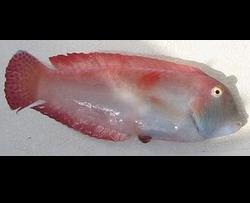
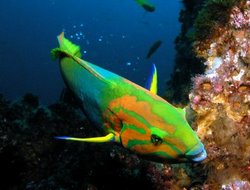
Lyretail Wrasse (Thalassoma lunare) is a colorful saltwater fish that is often kept in an aquarium setting. Also known as the Lunare Wrasse, Crescent Wrasse and the Moon Wrasse, this fish has a green coloration as an adult with the striking facial and fin markings that make Wrasse fish so very popular. As a juvenile the Lyretail Wrasse will be different colors than as an adult. You might not even recognize them as the change from blue, yellow, green and red variations over their lifetimes. You can see just how active the Moon Wrasse are in the video below...


There are over 600 different species of Wrasse fish which makes them one of the largest families of fish in the world! The Lyretail Wrasse requires a large aquarium of 125 gallons or more and should only be kept with other aggressive fish. Watch out this species of fish can even become territorial and attack new tankmates. It is best to add them into the tank last if at all possible. As with other Wrasses, they should be given plenty of hiding spots. They can grow to about 10" in maximum length and should be kept in the following water conditions 72-78° F, dKH 8-12, pH 8.1-8.4, sg 1.020-1.025. Watch out this fish is a carnivore that will eat mantis shrimp and bristleworms, but it will not disturb your corals or live plants. In the aquarium the Lyretail Wrasse can be fed brine shrimp, bloodworms, flakes and marine pellet food.

If you have any additional information about the Lyretail Wrasse please leave us a comment below.
 

Aquarium Fish Of The Month - Spotted Cardinalfish


Still Can't Find The Fish You Are Looking For? Search For It Below Or Send Us An E-Mail!

Fish Index Followers