Welcome To The Fish Index! We Are Maintaining A Growing Encyclopedia Of Fish Species Listed From A-Z! Choose From Our Categories Or Browse The Fish Featured Along The Sides By Clicking Their Pictures. Each Fish Includes Detailed Information, Pictures, Video And User Comments! With Over 30,000 Different Species In The World, Our Team Of Fish Experts Are Constantly Being Challenged To Discover New Species. Sample "The Fish Of The Day" Or Browse Our Impressive Selection Of Aquarium Fish!
Don't forget to Like Us On Facebook!
The Valentini Puffer or Canthigaster valentini is a species of Pufferfish that has the amazing ability to inflate its body to almost twice its size when threatened. This can make it rather difficult when water changes come, but putting the fish in a container to transport seems to do the trick. You can check out the Valentini Puffer in the video below...
Valentini Pufferfish go by a couple different names including the Saddle Valentini Puffer, Saddled Toby, Black Saddle Pufferfish, Valentini Toby and the Black Saddled Toby. They are a beautiful mix of Blacks, Blues, Oranges, Tans and Yellows. Like other Pufferfish, they lack pelvic fins which make them quite interesting to watch swimming. They actually use their pectoral fins to maneuver themselves around. Growing to about 4" maximum, they are not particularly large for a Puffer.
As you can imagine, they are quite popular in an aquarium setting, although they are not the easiest to take care of. An aquarium of 40 gallons or more with the following water conditions is recommended, 72-78° F, dKH 8-12, pH 8.1-8.4 and sg 1.020-1.025. The Saddle Valentini Puffer is an omnivore that should be fed hard shelled shrimp, squid, krill and clams. Watch out, these fish should not be kept with Filefish and Tobies.
The Midnight Arothron Puffer or Arothron sp. is just one of the over 100 different species of Puffer Fish in the world. This version is dark black in color, which makes it quite unique, and extremely hard to find. As with all other Puffer Fish, this species doesn't have any pelvic fins, but instead uses its pectoral fins to swim. This makes the Midnight Arothron and other Puffers quite the sight to be seen in an aquarium, or while scuba diving. You can check them out in action in the video below.
The Midnight Arothron Puffer has the ability to blow up its body to over twice its size, which makes for a fantastic deterrent. Not to mention the fact that when these saltwater fish are inflated they have spines that stick out of their bodies. If that weren't enough, parts of this fish's flesh are poisonous so most fish learn, sometimes the hard way, not to mess with the Midnight Arothron Pufferfish.
Also known simply as the Black Puffer, this fish can grow to just over 12" in length. Like other Puffers these fish have a sharp beak-like mouth that it uses to crush and eat its prey. All of these strange characteristics makes the Midnight Arothron Puffer a great addition to a saltwater aquarium. One at least 100 gallon is recommended with the following water conditions, 72-78° F, dKH 8-12, pH 8.1-8.4 and sg 1.020-1.025. One thing to note about this Puffer and all other species of Puffer Fish in an aquarium is that if the Puffer inflates itself outside of water it can harm or even kill the fish, so always use a container to transfer this fish when cleaning your tank. They should be fed a variety of food to satisfy its carnivorous diet including krill, clams, squid and hard shelled shrimp. These hard shells are needed to wear down this fish's ever growing teeth. These fish also like to have a well lite aquarium and a protein skimmer.
If you have any additional information about the Midnight Arothron Pufferfish that you would like to share please spread your knowledge below...
The Starry Puffer or Arothronstellatus is one of the biggest Puffer Fish in the world, growing to almost 4' in length! Like other Puffer Fish they don't have any pelvic fins, but instead use their pectoral fins to swim around. This makes them quite entertaining to watch. They also have a beak like mouth that needs to be worn down if kept in an aquarium. This can be accomplished by feeding them hard shell shrimp along with their normal diet of squid, krill and clams. Sometimes referred to as the Stellate Puffer, these fish are white with orange tints and dark spots all over their bodies. They can be kept in an large saltwater aquarium of at least 300 gallons with the following water conditions, 72-78° F, dKH 8-12, pH 8.1-8.4 and sg 1.020-1.025. A protein skimmer is also recommended in a tank this size. You can check out the Starry Puffer in its natural habitat in the video below...
Like all Puffer Fish, these creatures have the ability to inflate their body to twice its normal size. This helps scare away or discourage would be predators from making a meal out of them. As if this weren't enough, parts of this fish are considered poisonous, and should never be ingested by humans.
If you have any additional information about the Starry Puffer that you would like to share please do.
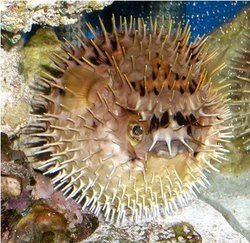
The Porcupine Puffer or Diodon holocanthus is just one of the over 120 different species of Puffer Fish. If you have this saltwater fish in an aquarium you have probably noticed that it almost looks like it's smiling at you.
They have spines that cover their bodies and are normally light gray or tan with darker spots on their bodies. Also known as the Balloon Porcupine Fish, Long-Spine Porcupinefish and the Spiny Puffer, this fish doesn't have any pelvic fins, and instead uses its pectoral fins to swim around. This makes for an interested swimming style to say the least.
Like other Puffer Fish, the Porcupine Puffer can inflate its body when threatened to about twice its normal size. This helps to scare away potential predators or at least make them harder to swallow. Be very careful when you are transferring Puffer Fish as they can inflate themselves with air as well and this can cause damage to the fish. Try to put them into a plastic bag inside the water before removing them when you clean your tank. Don't use a net if you can help it! You can see this Puffer fish puffed in this video...
If you are thinking of buying a Porcupine Puffer make sure that you have a large aquarium of at least 90 gallons. It is recommended that you have a Protein Skimmer as well. The following water conditions are acceptable, 72-78° F, dKH 8-12, pH 8.1-8.4, and sg 1.020-1.025. The Porcupine Puffer is an omnivore that needs a variety of foods including squid, krill, clams, and hard shelled shrimp. Anything with a hard shell is important to help wear down their teeth. They can live to about 5 years old and make good tankmates with Tangs and Wrasses. Please note: Do NOT eat these fish, they are poisonous.
If you have any additional information about the Porcupine Puffer please leave us a comment below.
The Honeycomb Puffer or Canthigaster janthinoptera is just one of the over 100 different species of Puffer Fish! Also known as the Honeycomb Toby these fish are part of the Canthigaster genus and are often kept in a non-reef aquarium of at least 50 gallons.
The Honeycomb Puffer doesn't have any pelvic fins, but instead uses its pectoral fins to swim around. This along with they fact that they can blow themselves up almost twice their size like makes them very entertaining to house in an aquarium. They also have a striking coloration of blue and orange dots and lines all around their bodies. The Honeycomb Puffer has a odd shaped mouth that it uses to feed. Watch out if you house these with other saltwater fish as they can become aggressive and have a tendency to nip other peaceful tankmates.Growing to about 4" in maximum length, the Honeycomb Puffers are omnivores that should be fed krill, shrimp and clams. If you have any additional care tips for the Honeycomb Puffer please share in the comments below.
The Spotted Puffer Fish or Canthigaster jactator is just one of the over 120 different species of Puffer Fish. Also known as the White Spotted Sharpnose Puffer and the White Spot Hawaiian Puffer, this fish has an almost reddish coloration with white spots all over its body. These fish are found in places like Hawaii, usually in pairs around corals and only grow to about 5" long. Strangely enough Spotted Puffers don't have any pelvic fins. They make up for this by using their pectoral fins to maneuver around its habitat.
Like all other Puffer Fish the Spotted Puffer has the amazing ability to inflate its body to twice its regular size! This not only makes it appear bigger to potential predators, but also makes it harder to swallow whole if caught. Not to mention parts of this fish are poisonous. Use caution if handling! As if that weren't enough these fish actually have a built in sunscreen like mucus that protects them from the dangerous ultra violet rays of the sun.
The Spotted Puffer fish is often kept as a pet in an aquarium of at least 55 gallons. This salt water fish prefers the following water conditions 72-78° F, dKH 8-12, pH 8.1-8.4, sg 1.020-1.025. This fish is an omnivore that should be fed krill, clams, squid and even hard shelled shrimp to help keep its teeth from growing out of control! They are not considered to be extremely aggressive, but they will nip the fins of tank mates they don't like.
The Puffer Fish or from the family Tetraodontidae has over 120 different species. A lot like the Porcupine Fish this fish has the ability to transform itself into a ball. They can grow up to 3' in length. This very dangerous creature has enough venom in it to kill over 30 humans. Some kinds can live in both fresh and salt water. To see the Puffer Fish in action just click here or watch this amazing video of a Puffer Fish below!
If you would like to purchase this fish you can do so by clicking the picture directly below...