
Find Your Fish

Showing posts with label Omnivore. Show all posts

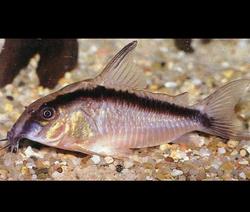
Adolfo's Catfish (Corydoras adolfoi)


The Adolfo's catfish or Corydoras adolfoi is a species of freshwater fish that often makes its way in the aquarium trade. This tropical catfish is not very large, only growing to lengths of about 2.2" (5.7cm). They are part of the Callichthyidae family, and first originated in South America, specifically Brazil.  They have a silver body with a black band near the base of the caudal fin and over the eye.

One of the reasons they are so popular in the aquarium trade is their ability to breed in captivity. Simply provide them with a plant or stone for them to attach their eggs to and wait. It only takes about 4 days after the eggs are laid for the fry to hatch. Like other species of Catfish, they are also good at keeping the bottom of the tank clean.  This fish are sometimes called Adolfo's Cory and require a 25 gallon tank with the following water conditions, 70-79F, 6.0-7.5ph.  They are a peaceful community fish that is considered to be very easy to take care of.  You can check out the Adolfo's Catfish in an aquarium in the video below.

 If you have any additional information about the Adolfo's Catfish please leave us a comment below.


Purple Chromis (Chromis scotti)


The Purple Chromis or Chromis scotti is a popular saltwater aquarium fish found at most local pet shops. This species of Chromis is from the Pomacentridae family, which also includes Damsels and Clownfish. They are found in the Western Atlantic Ocean and can grow to about 4" in length.  These fish are suitable for an aquarium of 30 gallons or more with the following water conditions, Specific Gravity Range 1.020-1.024, pH Range 8.0-8.4 and Temperature Range 75-82F.

Purple Chromis are omivores that should be fed a variety of foods including flakes, pellets, fresh or frozen algae and meaty foods like brine shrimp, mysis shrimp, planktons, krill, shrimp and scallops. They are generally a peaceful fish, but once they become accustomed to an aquarium they can turn out to be quite territorial. You can check out the Purple Chromis as well as some other saltwater aquarium fish in the video below.


If you have any additional information about the Purple Chromis please leave us a comment below.


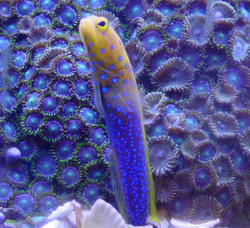
Midas Blenny (Ecsenius midas)

The Midas Blenny or Ecsenius midas is a small saltwater fish found in the Red Sea and Indian Ocean. This species of Blenny is very popular in an aquarium setting and is known to be quite easy to care for.  They are sometimes mistaken for an eel due to their elongated bodies and similar swimming motions. 

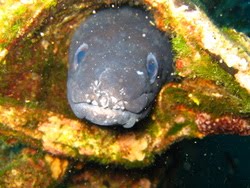
Midas Blenny are omnivores that will eat a variety of foods including frozen, live and flake food. They can grow to about 4" in length and require a tank of 30 gallons or more with the following water conditions, 72-78° F, dKH 8-12, pH 8.1-8.4, sg 1.020-1.025.  Like other Blenny, they should be giving lots of hiding spaces to keep they happy and healthy.  They are known to hide with just their head exposed checking out the rest of the tank.  

You can check out the Midas Blenny feeding along with some tankmates in the video below.


If you have any additional information about the Midas Blenny please leave us a comment below.

Lionhead Cichlid (Steatocranus casuarius)

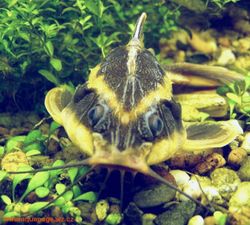
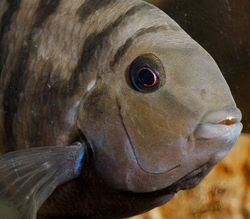
The Lionhead Cichlid or Steatocranus casuarius is a popular freshwater tropical aquarium fish originally found in Pool Malebo and the Congo River in Africa. This species of Cichlid goes by a few different common names including Blockhead Cichlid, African Blockhead, Buffalohead, Humphead Cichlid, Lionhead, Lumphead and Buffalo Cichlid. As you can see in the pictures, they get their nicknames from the large hump on the top of their heads.  The picture below shows a juvenile Lionhead Cichlid, their heads tend to become more prominent as they grow older.  
Male Lionhead Cichlids can grow to about to about 4 1/2" (11 cm) with the females being a bit smaller in size. When in an aquarium they are said to be found on the bottom and have jerky movement much like that of a Goby. They have a smaller swim bladder then most fish which allows them to stay on the bottom with ease.  You can check them out in an aquarium setting in the video below. 

An aquarium with the following conditions is suitable for the Lionhead Cichlid Hardness: 3 - 17° dH, Ph: 6.0 - 8.0, and Temperatures at 73 - 82 ° F (23 - 28 ° C). These fish are omnivores that should be fed a variety of foods including algae, flake, pellet, live foods and frozen foods. A good trick to keep your water clean is to feed them 2 to 3 times a day in smaller amounts instead of a large quantity once a day.  They normally get a long well with other fish and will be happier if they are provided a few good hiding spots.

If you have any additional information about the Lionhead Cichlid please leave us a comment below.

Scat (Scatophagus argus)


The Scat fish or Scatophagus argus is one of only four known species in the Scatophagidae family.  This fish has the ability to survive in saltwater, brackish water and freshwater.  Also known as the Spotted Scat and the Argus Fish, they are often kept in an aquarium setting.  Scats have an oblong body that is laterally compressed.  It has a bunch of dark spots on it that become fainter as they grow older.  This fish is greenish brown with younger fish tending to have some red on their fins.   

Scats are found in the Indian and Pacific Oceans and can grow to about 12" (300mm) in length.  In the wild they are scavengers that will eat whatever they can find.  In fact their scientific name actually means excrement eater!  This helps in an aquarium because they are not picky eaters and will help to keep the tank clean.  This fish will eat pretty much anything including green foods such as spinach, peas, flake foods and lettuce.  Triggerfish are said to be a good tankmate for these fish.  You can check out a Scat swimming in the video below.   

If you have any additional information about the Scat including care tips please leave us a comment below.


Scribbled Angelfish (Chaetodontoplus duboulayi)


The Scribbled Angelfish or Chaetodontoplus duboulayi is a beautiful saltwater fish that is found in the Pacific Ocean in and around reefs.  This species of Angelfish can grow to about 8-1/2" (220mm) in length and is a fairly popular aquarium fish.  Scribbled Angelfish get their name from the dark blue scribbles that cover the majority of their bodies.  A dark bar runs across their eyes and their mouths are yellow.  They also can be identified by the vertical yellow bar behind their gills and a yellow horizontal stripe that runs across the top of their bodies.

Scribbled Angelfish are omnivorous grazers that will feed on crustaceans, algae, coral polyps and a variety of foods.  They are from the Pomacanthidae family of saltwater fishes are are sometimes referred to as Duboulay's Angelfish.  These fish require a large aquarium with plenty of hiding spaces.  They are considered to be fairly shy at first, but once they grow accustom to their new environment they will be quite active and can even learn to feed right out of the owner's hand!  You can check out the Scribbled Angelfish in an aquarium in the video below.

If you have any additional information about the Scribbled Angelfish please leaves us a comment below.


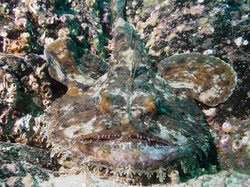
Oyster Toadfish (Opsanus tau)


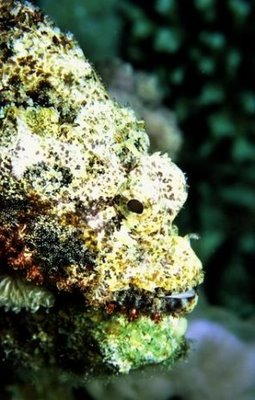
The Oyster Toadfish or Opsanus tau is just one of the many saltwater fish from the family Batrachoididae known as Toadfish. These fish occasionally make it into the aquarium trade and go by a few different names including Mudtoad, Ugly Toad, Oyster Cracker, Dowdies and the Bar Dog. As you can imagine with a nickname like the Ugly Toad this fish is quite odd looking with a yellowish brown coloration and sharp teeth.  They also have sharp venomous dorsal spines so be careful when taking them off the hook! 

Oyster Toadfish are not very long, only growing to about 15" (39cm). The males of this species has the ability to make a foghorn sound that is used during the mating season to attract females. The males will build a nest and then serenade their female counterparts with their lovely croaking.  After courtship the male will stay and guard the eggs and small fry after they hatch.  Both the male and female of this species are known to make a croaking sounds when threatened or caught.  You can check out the Oyster Toadfish in action in the videos below.


Oyster Toadfish are omnivores that will feed on a variety of foods including fish, mollusks, crustaceans and squid. They are ambush predators that will lay motionless until a potential meal comes by and then attack with amazing speed!

If you have any additional information about the Oyster Toadfish please leave us a comment below.

American Flagfish (Jordanella floridae)


The American Flagfish or Jordanella floridae gets its name because the male fish resembles the American flag. It has large blackish-blue dots and alternating red and blue stripes on its body. The female of this species is larger then its male counterpart, and has more of a yellow coloration. You can check out a a male and female Flagfish courting in the video below.

Sometimes simply known as the Flagfish, this species of Killifish is native to Flordia, but often kept in an aquarium setting. They are a small freshwater fish that only grows to about 2-1/2" long, so an aquarium of only 10 gallons is needed to house them. Flagfish are known for their ability to control algae in an aquarium which makes them all the more popular. They will also eat brine shrimp, tubifex and flake foods and are considered to be easy to care for.

If you have any additional information about the American Flagfish please leave us a comment below.

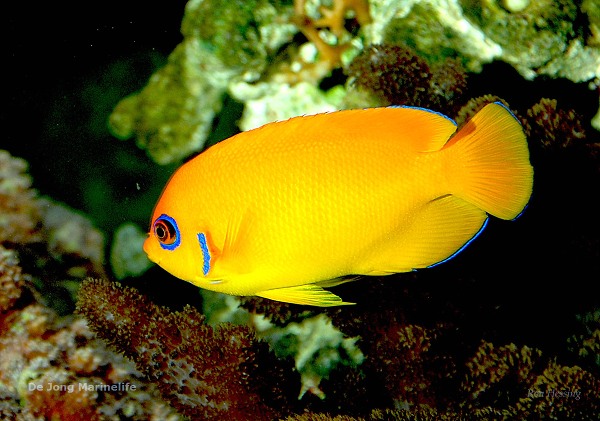
Lemonpeel Angelfish (Centropyge flavissima)

The Lemonpeel Angelfish or Centropyge flavissima is a popular aquarium fish from the Pomacanthidae family of saltwater fish. This species of Angelfish is found in the Indian and Pacific Oceans and can be distinguished from other Angelfish by the blue outlines around its eyes, bottom lip and gill covers.
Lemonpeel Angelfish can grow to about 4" (100cm) in length and are a peaceful aquarium fish that should be fed an omnivorous diet consisting of lots of greens and the occasional meaty snack. Like other Angelfish they are not exactly easy to care for, but their striking appearance still makes them a favorite in the aquarium.

If you check out a Lemonpeel Angelfish in an aquarium in the video below...

If you have any additional information about the Lemonpeel Angelfish including care tips, please leave us a comment below.

Powder Blue Surgeonfish (Acanthurus leucosternon)

The Powder Blue Surgeonfish or Acanthurus leucosternon is a popular aquarium fish from the Acanthuridae family of saltwater fish which includes Tangs and Surgeonfish.  Also known as the Powder Blue Tang, this fish is found in the Indo-pacific area and can grow to about 10" in length with females tending to be a bit larger then their male counterparts.   In the wild they are often found in schools in and around reefs. 

Powder Blue Surgeonfish have an oval shaped body with a black head, blue body and bright yellow dorsal fin and caudal peduncle.  In aquarium they are known to be an aggressive fish and should be kept alone or they will fight each other for territory.  They require a large aquarium and should be fed a omnivorous diet consisting of a variety of vegetable matter and protein foods.    

You can check out these beautiful fish grazing on a reef and in an aquarium setting in the videos below...


If you have any additional information about the Powder Blue Surgeonfish including care tips please leave us a comment.

Skunk Catfish (Corydoras arcuatus)

The Skunk Catfish or Corydoras arcuatus is a hardy scavenger that is often kept in a freshwater aquarium.  Also known as the Arched Catfish, and the Skunk Cory, this species originated in the Amazon river basin in places like Brazil, Ecuador and Peru.

Skunk Catfish have a series of bony plates instead of scales, much like Sturgeon. They are small, only reaching length of about 2" maximum. Their barbels are quite long for their size, almost extend to their gill slits.
These freshwater fish are omnivores that should be fed a variety of foods. While they are scavengers that pick up after what other fish eat, they should also be fed themselves. This scavenger mentality though can help keep your aquarium cleaner for longer, especially when combined will a Pelco or two.  If you would like to buy a Skunk Catfish but want to see them in action first check out the video below...

If you have any additional information about the Skunk Catfish please share.

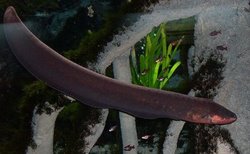
Glass Knifefish (Eigenmannia virescens)

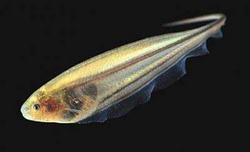
The Glass Knifefish or Eigenmannia virescens is clear freshwater fish that originated from South America.  Even though these fish can grow to about 1-1/2' long, they are still kept in large aquariums.  One over 100 gallons is recommended with the following water conditions, 73-82° F, KH 2-15 and pH 6.0-7.0.  These fish lack dorsal fins and are quite the sight to be seen when swimming.  You can see for yourself in the video below...
     

Glass Knifefish are peaceful fish that prefer a low light aquarium with plenty of hiding places and plants.  Also known as the Green Knifefish, they sometimes have a very slight green tint.  Like other Knifefish, they have the ability to emit a weak electrical signal from one of their organs that helps them maneuver in the dark.  As you can imagine, this means that they are very active during the night more so than the daylight hours.  They also use this weak electrical current during courtship.    
You can keep mulitple Glass Knifefish in the same tank, they will get along just fine and will even breed in an aquarium setting.  These fish will often lay their eggs on plants.  Once the fry hatches you should switch them into another tank.  


The Glass Knifefish is an omnivore that can be fed tubifex, pellets, flakes, shrimp and other live and frozen foods.
Photo Credit: Kirk, Fortune, Roth, (c) 2007
Eigenmannia virescens


Auriga Butterflyfish (Chaetodon auriga)

The Auriga Butterflyfish or Chaetodon auriga is one of the many beautiful species of Butterflyfish.  This fish, also called the Threadfin Butterflyfish, is one of the more popular species to house in an aquarium.  Just one of the many species in the Chaetodontidae family, this saltwater fish is considered to be very hardy and easy to take care with the proper conditions.  Providing this fish with lots of hiding spots and the follow water conditions will keep it happy and healthy, 72-78° F, dKH 8-12, pH 8.2-8.4 and sg 1.021-1.023.
The Auriga Butterflyfish has the typical Butterflyfish shape with a thin body that is somewhat squared off and a tiny pointed mouth.  They have a colorful arrangement of yellows, whites and blacks including a false eyespot on their dorsal fin that keeps potential predators confused about which end is which.  The false eyespot is not always a part of their body depending on what part of the world they are located.  You can have a look at the Threadfin Butterflyfish in the video below...

Auriga Butterflyfish are omnivores that should be fed a variety of foods including flake food and plankton.  If cared for properly these fish can reach lengths of about 8", so a tank of 60 gallons or more is highly recommended.

In the wild these fish are found in shallow waters of up to 30 meters in the Indo-Pacific and Red Sea in places like Japan, Hawaii and South Africa to name a few.  


Aquarium Fish Of The Month - Spotted Cardinalfish


Still Can't Find The Fish You Are Looking For? Search For It Below Or Send Us An E-Mail!

Fish Index Followers