Welcome To The Fish Index! We Are Maintaining A Growing Encyclopedia Of Fish Species Listed From A-Z! Choose From Our Categories Or Browse The Fish Featured Along The Sides By Clicking Their Pictures. Each Fish Includes Detailed Information, Pictures, Video And User Comments! With Over 30,000 Different Species In The World, Our Team Of Fish Experts Are Constantly Being Challenged To Discover New Species. Sample "The Fish Of The Day" Or Browse Our Impressive Selection Of Aquarium Fish!
Don't forget to Like Us On Facebook!
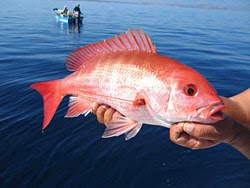
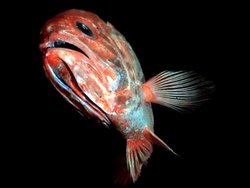
The Opah or Lampris gutatus is a saltwater fish that goes by a couple different names including the Moonfish, Sunfish, Kingfish, Redfin Ccean Pan and the Jerusalem Haddock. This fish is has a circular shape and can grow very large, up to 6 feet in length and weighing up to 700lbs! Their fins are red in color with a body that is less tan twice as long as it is wide. Opah are sometimes confused with other fish, but can be distinguished by its 14 to 17 pectoral rays. These fish have a singular dorsal fin with long pectoral and pelvic fins and a concave caudal fin. There is also a gold band around their eyes.
Often caught for sport, these fish are also a good food source and are often hooked in waters of 200 to 1,200 feet deep in the Pacific Ocean. One of the most common meals for the Opah is squid, but it will also eat smaller fish and invertebrates. This fish tends to travel with Tuna and Billfish in search of food.
As you can image due to its enormous size and strong body these fish are fantastic fighters and will put up a serious challenge for even the most experienced of anglers. The depths that they inhabit also make them extreme difficult to capture.
If you have any additonal information about the Opah fish please leave us a comment below.
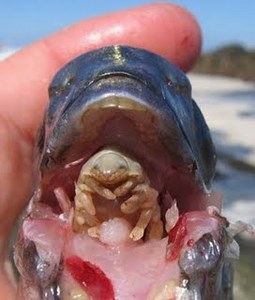
The Cusk fish or Brosme brosme is a long slender saltwater fish from the Lotidae family. Found in the Northern Atlantic this fish goes by a few different names including Tusk, Torsk, Moonfish, Brismak and Brosmius.
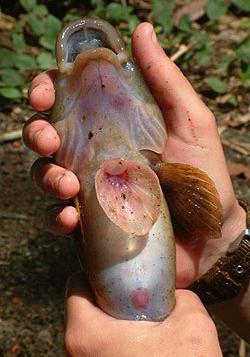
Cusk look a lot like many different species of Cod, but can be distinguished by the fact that they only have one dorsal fin. These fish can grow to about 3' (100cm) in length and can weigh up to 30lbs (14kg). When young they tend to have yellow bands on their side that will fade with age. Older Cusk are often a pale gray in coloration. You can check out a Cusk fish in action in the video below...
Considered to be quite tasty, Cusk are often caught offshore in depths of 60' or more. A rocky bottom is normally a good habitat for these bottom feeders. It will eat crustaceans, invertebrates and mollusks for the most part. Once caught these fish are often sold as fresh or frozen fillets.
Spawning of the Cusk occurs between the months of April and July. A female Cusk can produce more than 2 million eggs in just one season! Once the Cusk is born it will live near the surface until it reaches about 2" then it will make its way towards to rocky bottom.
If you have any additional information about Cusk fish please share.
The Hi Fin Platy is a hybrid version of Xiphophorus maculatus that has an elongated dorsal fin. They go by several different names in the aquarium trade including the Moonfish and the Southern Platyfish. This species of Platyfish only grows to 2-1/2" in length and comes in a ton of different colors including yellow, blue, orange, and red. Males are almost always smaller then females and tend to have brighter coloration.Hi Fin Platy fish are notoriously easy to take care of and only require a small tank, so they are considered to be the prefect freshwater fish for beginners. Like other Platy fish, they enjoy nice aquatic plants and plenty of hiding spots. They are not an aggressive fish and will do very well in a community aquarium with the following water conditions, 64-77° F, KH 10-25 and pH 7.0-8.2. You can check out the Hi Fin Platy in an aquarium in the video below...
This fish are livebearers which means that they give live birth to their fry instead of laying eggs. Hi Fin Platy fish reach sexual maturity at only four months old, so you can imagine how quickly they can fill a tank with new additions. They should be fed an omnivorous diet consisting of flake food, bloodworms, brine shrimp and tubiflex.
The Atlantic Spadefish or Chaetodipterus faber is a sporting fish that is found in the shallow waters of the western Atlantic Ocean. This fish has 2 dorsal fins and 2 anal fins, going by a few different names in the world including Moonfish, Ocean Cobbler, Angelfish, White Angelfish and Three-tailed Porgy. They have a silver flattened body with black vertical lines, that will fade as the fish grows older. This fish will develop trailing anterior lobes as it grows older as well, which gives them the classic Angelfish look. To learn more about the Atlantic Spadefish watch this video!
If you are fishing for the Atlantic Spadefish you will notice that they are much more active in the hot summer months, this makes all the more fun to catch. These fish are not the biggest, only growing to about 20lbs max and 36" in length, but make up for this with their ferocious fighting spirit which makes them a favorite among anglers. Atlantic Spadefish are often found in schools, so if you catch one of these fish, there are often many more in the waters below.Got a fishing tip for the Atlantic Spadefish? Leave us a comment below...
The Threadfin Lookdown or Selene vomer is a very odd looking saltwater fish that can grow to about 1' 8" in length. Sometimes just called the Lookdown, this fish looks like it just got punched in the face by a heavy weight boxer. As you can probably guess from their name, the Threadfin Lookdown's eyes often have the illusion that they are looking down at the bottom at all times.
When these fish are young their dorsal fins will have long filaments attached to them that will fall off as they grow older. They have a thin, flatten body that shimmers as they swim through the water. In the wild, these fish are found in the Atlantic Ocean at depths of up to 53 meters. Also referred to as Moonfish, the Threadfin Lookdown fish can be kept in a very large aquarium of 150 gallons or more. Their blue & silver scales make for a showy display as the light reflects off of them. They are not considered to be aggressive fish, so you can house them with many other non aggressive fish that are not fin nippers. The following water conditions are acceptable for the Threadfin Lookdown, 72-78° F, dKH 8-12, pH 8.1-8.4, and sg 1.020-1.025. These aquarium fish are carnivores that can be fed a variety of meaty food and live foods as well. You can check out the Threadfin Lookdown swimming in the video below...
POP QUIZ: Can you name all the other species in the video above?