Find Your Fish

Showing posts with label Sturgeon. Show all posts

Shovelnose Sturgeon (Scaphirhynchus platorynchus)


The Shovelnose Sturgeon or Scaphirhynchus platorynchus is one of the smallest of the freshwater sturgeons growing to about 30" in length, and weighing about 5 lbs maximum. Also known as the Sand Sturgeon, Hackleback or Switchtail, these fish are sought after not only for their flesh, but for their eggs as well, which are using to make caviar.  As you can see in the picture above, this fish has bony scutes along the sides and back, and four barbels on the underside of the rostrum. These four barbels form a straight line.  You can learn how to tell the difference between a Lake Sturgeon, a Pallid Sturgeon and a Shovelnose Sturgeon in the video below.

Shovelnose Sturgeon are found in the Missouri River and the Mississippi River systems. They use their vacuum-like mouth to suck up its food, which included insect larvae and small fish as well as crustaceans.  Because of its slow growth rate, late sexual maturity and the fact that it doesn't spawn every year, this fish is very vulnerable to overfishing.

If you have any additional information about the Shovelnose Sturgeon please leave us a comment below.


Russian Sturgeon (Acipenser gueldenstaedtii)

The Russian Sturgeon or Acipenser gueldenstaedtii is a species of Sturgeon that is found in Russia, as well as Azerbaijan, Bulgaria, Georgia, Iran, Kazakhstan, Romania, Russia, Turkey, Turkmenistan, and the Ukraine. The Russian Sturgeon is the largest Sturgeon in the world, it reaches a length of 13 ft (396 cm) and a weight of up to a ton (900 kg)! They have a series of dorsal scutes, lateral scutes and ventral scutes that give them the appearance of a prehistoric fish!This fish can also be found in the Black, Caspian and Azov seas basins. They are identified by their short snout that has a rounded tip. Their barbels are not fringed and are located near the top of their snout. These fish will migrate often up the Danube River and occasionally in the Sava River and the Tisa River. You can see the Russian Sturgeon for yourself in the video below...

The Russian Sturgeon is benthic feeder, which simply means that it feed on the bottom. Normal meals include shells, crabe, snails, insect larva, and small fish. Like other Sturgeons, they reach sexual maturity late in their lives, and are highly prized as caviar. It can take this fish as long as 16 years before it reproduces for the first time. After reproduction is complete, they will wait another 5 or 6 years before reproducing again. For this reason the fate of the Russian Sturgeon is in question.

You can learn about all the different types of Sturgeon here!

White Sturgeon (Acipenser transmontanus)

The White Sturgeon or Acipenser transmontanus is the largest freshwater fish in North America growing to over 20' long and weighing in at almost 1,800lbs! Like other Sturgeons, including the Sterlet, this fish has no scales. Instead, its body is covered with large bony scutes that help protect this fish from potential pre-historic predators. Why Pre-Historic you may ask?  That is because this fish has been roaming the freshwaters of the world for over 175 million years!
The underside of this fish is white, hence the name the White Sturgeon. Also known as the Pacific sturgeon, Oregon sturgeon, Columbia sturgeon, and Sacramento sturgeon, it has four barbels on the bottom of its head that are used to sense food. Like other Sturgeon, it has a toothless mouth that acts like a vacuum cleaner to suck up its food. The White Sturgeon's internal bone structure is mostly cartilage, which means that it is actually more similar to a Shark than a fish. You can learn more about these monster fish and see them in action in the video below...

The White Sturgeon has been overfished in recent years for its flesh and its eggs, which are using in making caviar. Today White Sturgeon fishing is highly restricted in many places throughout the world. The continued habitat destruction and pollution makes the survival of the White Sturgeon in question.

If you have any additional information about the White Sturgeon that you would like add please do so in the comments below...

Sterlet (Acipenser ruthenus)

The Sterlet or Acipenser ruthenus is a large prehistoric looking fish. This strange looking fish has rows of heavy plates along its sides and dorsal area. It also has a tale that looks more like a shark! This species of Sturgeon, can grow to about 4' in length and can live over 20 years. Despite its large size this fish is a popular aquarium fish due to its hardiness and very peaceful temperament. Recommended temperatures for this fish are 52-72° F, with a pH level of 7.5-8.0. A tank size of about 300 gallons is also suggested for this large freshwater fish. Like its close relative the Lake Sturgeon (Acipenser fulvescens), the mouth of this fish is actually located on the bottom of the fish. This fish uses its four barbels, located right in front of this strange mouth to find food. The Sterlet can be fed insect larvae, Flake Food, Tubifex Worms and snails. Clean water is a must for this fish and a nice sandy gravel bottom will insure that its sensitive barbels remain intact.


The Lake Sturgeon

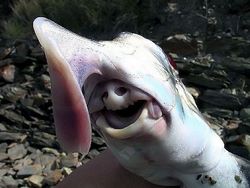
The Lake Sturgeon or Acipenser fulvescens is a massive freshwater fish. It is a bottom feeder that eats insect larvae, worms, crayfish, snails, and other small fishes. As you can see above, they have a very unique mouth which they use like a vacuum for feeding. The Lake Sturgeon averages about 200 to 300lbs, but they have been reported to be over 800lbs and over 8' long! This Sturgeon doesn't have any scales, it is instead covered with five rows of bone like plates on its back sides and stomach. This dinosaur of fish can reach over 150 years old, no wonder it gets so big! They are found only in North American in states like Michigan and Wisconsin. There are over 20 different species of Sturgeon in the world, but this one like many others is protected in most places.

Aquarium Fish Of The Month - Spotted Cardinalfish


Still Can't Find The Fish You Are Looking For? Search For It Below Or Send Us An E-Mail!

Fish Index Followers