
Find Your Fish

Showing posts with label Catfish. Show all posts

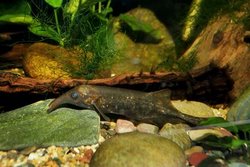
Bearded Catfish (Scleromystax barbatus)


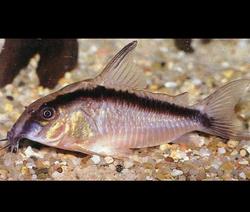
The Bearded Catfish or Scleromystax barbatus is a freshwater subtropical catfish from the Callichthyidae family. This fish was first discovered in the coastal drainage in Brazil. It has since found its way into the aquarium trade, and like other catfish it is a very hardy addition to any community tank. Also known as the Banded Corydoras this fish can grow up to 4" (10cm) in length. The follow water condition are ideal for this species, 6.0–8.0 pH, a water hardness of 2–25 dGH, and a temperature of 83 °F (28 °C).  A 20 gallon or more tank is well suited for these fish with plenty of hiding spaces.  You can check out the Bearded Catfish in action in the video below...


 If you have any additional information about the Bearded Catfish please leave us a comment below.

Adolfo's Catfish (Corydoras adolfoi)


The Adolfo's catfish or Corydoras adolfoi is a species of freshwater fish that often makes its way in the aquarium trade. This tropical catfish is not very large, only growing to lengths of about 2.2" (5.7cm). They are part of the Callichthyidae family, and first originated in South America, specifically Brazil.  They have a silver body with a black band near the base of the caudal fin and over the eye.

One of the reasons they are so popular in the aquarium trade is their ability to breed in captivity. Simply provide them with a plant or stone for them to attach their eggs to and wait. It only takes about 4 days after the eggs are laid for the fry to hatch. Like other species of Catfish, they are also good at keeping the bottom of the tank clean.  This fish are sometimes called Adolfo's Cory and require a 25 gallon tank with the following water conditions, 70-79F, 6.0-7.5ph.  They are a peaceful community fish that is considered to be very easy to take care of.  You can check out the Adolfo's Catfish in an aquarium in the video below.

 If you have any additional information about the Adolfo's Catfish please leave us a comment below.


Kwi Kwi (Hoplosternum littorale)


The Kwi Kwi or Hoplosternum littorale is a species of Armoured Catfish from the Callichthyidae family. This fish features an armor-plated body that protects itself from potential predators. These freshwater fish go by several different names throughout the world including, Tamuatá, Atipa, Hassar, Cascadu, Busco and Currito.

This species of catfish can grow to about 9-1/2" (24cm) in length, with the males tending to be a bit larger then the females. Originally found in South America, this fish has been spotted in Florida and is also becoming more and more popular in an aquarium setting. Believe it or not, this fish can breathe both with gills and through its intestines and is a very lively, entertaining fish! They can grow to about 4 years old and are nocturnal feeders, munching on crustaceans, larvae and aquatic insects.

 Kwi Kwi reproduce after the first year, with spawning normally being triggered by the first rains and occurs in the warm and rainy season. Like other callichthyine, this fish builds a bubble nest. This species is said to have one of the most complex nest structure. This bubble nest is designs to be rich with oxygen which helps the eggs develop even in poor water conditions. It also provides protection from potential predators. You can check out a Kwi Kwi building a bubble nest in the video below.


If you have any additional information about the Kwi Kwi please leave us a comment below.


Striped Eel Catfish (Plotosus lineatus)


The Striped Eel Catfish or Plotosus lineatus is a saltwater fish found in the Indian and Pacific Oceans. These fish have two parallel white lines running down the sides of their bodies. They have long second dorsal and anal fins that merge with their caudal fin to give them the eel like appearance. You can experience what it is like to swim with the Striped Eel Catfish in the video below.


This species is also known as the Saltwater Catfish or Coral Catfish and is from the Plotosidae family of Catfishes. They can be kept in an aquarium, but be warned these fish have venomous spines so please handle with extreme care. These fish can grow to 12" (300mm), so a fairly large aquarium is recommended.

In the wild when the Striped Eel Catfish is young they will form dense schools of fish in a ball shape to make themselves seem larger to potential predators and to feed. As they grow older they lose this community attitude and separate themselves from the pack. Like other catfish, they feed on the bottom with their barbels searching for a meal by sifting through the sand for crustaceans, worms and very small fish.

If you have any additional information about the Striped Eel Catfish please leave us a comment below.


Cuckoo Catfish (Synodontis multipunctatus)

The Cuckoo Catfish or Synodontis multipunctatus at first glance seems like your average freshwater catfish, but they have a very devious side. In the wild this species will attack cichlid's nesting places devouring their eggs. As if that wasn't bad enough, they will also drop some of their own eggs into the nesting place where the unsuspecting mother will take care of them in her mouth along with her remaining eggs. The Cuckoo Catfishes eggs will hatch before the cichlids and then the real terror begins. The much bigger Cuckoo Catfish babies will feast on the other eggs and baby cichlid fish as they hatch inside the mother's mouth! Once they are done feasting they come out of their "mothers" mouth and the unsuspecting cichlid fish actually believe them to be their own!  They will take care of the baby Cuckoo Catfish until they are big enough to fend for themselves. Don't believe me? See it for yourself in the amazing video below from National Geographic!


When the Cuckoo Catfish is not in the wild it is far less sinister. Also known as Cuckoo Synodontis or the Multi-spotted Catfish, they are often kept in a freshwater aquarium and are said to be quite easy to take care of provided they have plenty of places to hide. This species of Catfish can grow to about 10" (25cm), and will accept flakes, pellets and a variety of fresh and frozen foods. If you have any additional information about the Cuckoo Catfish please leave us a comment below.

Stonecat (Noturus flavus)


The Stonecat or Noturus flavus is one of the more common species of Catfish.  It is widely distributed throughout North America in places like the Hudson River, Great Lakes, St. Lawrence River and Mississippi River basin.  This freshwater fish is often found in and around large rocks, hence their name the Stonecat.  Be careful if you catch one of these fish they have poison glands at the base of their pectoral and dorsal fin spines that can cause an unpleasant sting if they puncture the skin.

Stonecats can grow to about 12" in length and will live to about 9 years old.  They are olive in color and often have a white spot on the upper part of their caudal fin.  Like other species of Madtoms, they mainly feed on larvae, fish eggs, worms, minnows, amphipods and the occasional crayfish. 

Spawning of the Stonecat fish occurs in the 3rd or 4th year of life.  The male will guard the nest which is often made under large rocks.  If you have any additional information about the Stonecat please leave us a comment below.


Congo Glass Catfish (Parailia congica)

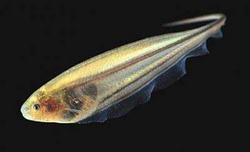
The Congo Glass Catfish or Parailia congica is an amazing fish with a semi-transparent body. You can actually see the internal organs and backbone of this fish right through its skin! This freshwater fish is also known as the African Glass Catfish and can grow to about 3" (8cm) in maximum length. Their odd appearance makes them a favorite in aquariums.  The follow water conditions are acceptable, pH 6.5 to 7.5 (6.9), 2-15 dH (8) and temperatures between 73-79°F (23-26°C). They are considered to be a good community fish and should be in a tank of at least 30 gallons with plenty of hiding places with vegetation if possible. They can be fed flake food, brine shrimp, tubifex and the live food as much as possible to keep them healthy.

Congo Glass Catfish have a scaleless body that lacks pigment and gives them their unusual appearance. They often have small brown spots that cover their bodies. They have a darker brown stripe that runs through the middle of its body to its tail. This species of Catfish has long barbels on its upper jaw and two shorter barbels on its lower jaw. They have no dorsal or adipose fins. You can check out the Congo Glass Catfish underwater in the video below.
If you have any additional information about the Congo Glass Catfish please leave us a comment below.

Giant Lake Biwa Catfish (Silurus biwaensis)


Giant Lake Biwa Catfish (Silurus biwaensis) is a very large Catfish that is found in Japan in Lake Biwa along with the Largemouth Bass and many other species.  Also known as Biwako-ohnamazu this freshwater monster is the largest fish in Lake Biwa, weighing up to 331lbs (150kg) and growing to a length of  106" (270cm).

Tthe Giant Lake Biwa Catfish has barbel that allow them to sense their prey around them.   They are even believed to be able to predict earthquakes as seen on River Monsters.  Giant Lake Biwa Catfish are known to become much more active and therefore caught by commercial fisherman just before earthquakes.

If you have any additional information about the Biwako-ohnamazu please leave us a comment below.  

Black Madtom (Noturus funebris)

The Black Madtom or Noturus funebris is a freshwater fish that is part of the Catfish (lctaluridae) family. Sometimes referred to as the Bullhead Catfish this is just one of the 27 different species of Madtom found in the United States and Canada. They are not large, only growing to about 7" in length and are rather ugly with barbels and a broad tail.  

Black Madtom are found in streams and lakes, normally hiding under rocks and logs during the day in wait for nightfall. For this reason it is not often that an angler will hook one of these bad boys unless they are fish at dusk or at night.
These fish can by distinguished from other Catfish by their unique adipose fin. This fin continues with the caudal fin unlike other Catfish. They will feed mostly in the early dawn or at dusk on insect larvae and crayfish, although they are not picky and will eat pretty much anything that is available to them. Black Madtom fall prey to larger fish such as Bass and Pike, but are also preyed upon by water snakes and birds.

Spawning for the Black Madtom occurs from April to June depending on the water temperature. They will often construct nest under rocks which provides the freshly hatched fry with some beginner protection. Eggs only take about 8-10 days to hatch during which time the male will guard the nest. They are even know to guard the nest an additional 3 weeks after the fry are hatch. That is better then some parents I know.

If you have any additional information or fishing tips about the Black Madtom please leave us a comment below.

Black Bullhead (Ameiurus melas)

The Black Bullhead or Ameiurus melas is a species of Catfish that is found in many places in North America including The Great Lakes, Ontario, New York, Arizona and California just to name a few.  This species of freshwater fish goes by a few different names depending on where you are including Horned Pout, Yellow Belly Bullhead and the Black Catfish.

Despite its name, this fish is actually normally green, olive and even has some yellowish shades.  The only time this fish is black is when the male is spawning or when they are first born.  Their underbellies are white or yellow in coloration.  The barbels of the Black Bullhead are often spotted or just black altogether, and these fish have a rather square tail.
Growing to just over 2' in length, they can live to about 10 years old and reach weighs of over 7lbs.  Black Bullhead are nocturnal and will feed on fish, clams, snails and even some plants.  When they spawn the female will prepare the nest.  Each time the eggs are released both parents will actually fan the eggs until they hatch.  Then they will guard the fry until they leave in groups into the great unknown.

If you have any additional information about the Black Bullhead that you would like to share please drop us a comment.
NEXT

PREVIOUS

Skunk Catfish (Corydoras arcuatus)

The Skunk Catfish or Corydoras arcuatus is a hardy scavenger that is often kept in a freshwater aquarium.  Also known as the Arched Catfish, and the Skunk Cory, this species originated in the Amazon river basin in places like Brazil, Ecuador and Peru.

Skunk Catfish have a series of bony plates instead of scales, much like Sturgeon. They are small, only reaching length of about 2" maximum. Their barbels are quite long for their size, almost extend to their gill slits.
These freshwater fish are omnivores that should be fed a variety of foods. While they are scavengers that pick up after what other fish eat, they should also be fed themselves. This scavenger mentality though can help keep your aquarium cleaner for longer, especially when combined will a Pelco or two.  If you would like to buy a Skunk Catfish but want to see them in action first check out the video below...

If you have any additional information about the Skunk Catfish please share.

Redtail Catfish (Phractocephalus hemioliopterus)

The Redtail Catfish or Phractocephalus hemioliopterus is a large species of Catfish that was first discovered in South America.  This fish has since made its way into the aquarium trade, despite its very large size.  Reaching 4' and almost 100lbs in the wild, these fish should only be kept in a VERY large aquarium.  Due to the lack of space in most aquarium settings, these fish rarely reach over 2' in length in captivity. An aquarium of around 700 gallons minimum is highly recommended. Once established these fish are quite long lived, reaching the ripe old age of 20 or more!  You can check out the Redtail Catfish in the video below... 

Redtail Catfish go by several different names including the South American Red Tail Catfish, Cajaro and Pirarara. These freshwater fish have a very wide mouth and a body that is dark gray with a white band that runs around the lower half of their bodies. They have three pairs of long barbels as well, which is a trait shared by all the Catfish in the Pimelodidae family. As you can see, they get their name from their caudal fin or tail which is red. When this fish is younger its colors tend to be more intense.
Redtail Catfish are omnivores that should be fed a variety of foods including fruits, crustaceans and fish. Watch out, this fish will pretty much eat anything that it can fit into its mouth. Be careful with other tankmates, and even objects in the tank. They will often eat decorations and then regurgitates them. As you can imagine, this is not very healthy for the fish. Be careful not to overfeed them as well, once a week should be fine. 
If you have any additonal information about the Redtail Catfish please share...


Goonch Catfish (Bagarius yarrelli) The Man Eating Catfish

The Goonch Catfish or Bagarius yarrelli is a man eating freshwater fish! That's right, there have been a series of reports of this massive Catfish attacking individuals in three different villages on the banks of the Kali River in India. It is thought that this fish got the taste for human flesh after eating half burnt human remains discarded from funeral pyres on the river banks.As you can imagine the Goonch Catfish is absolutely huge, growing to over 6' long and weighing well over 150lbs! These fish have broad heads with a very wide mouth filled with sharp teeth that are backward shaped to help them swallow their prey, much like many sharks. Their gills openings are wide and the dorsal and pectoral fins have strong spines. They are normally an olive or brown in coloration matching the muddy river. You can check out the Goonch Catfish with your own eyes in the videos below...


These fish are not normally eaten and most people in India will simply kill them or release them back into the waters. They are considered a nuisance by many other anglers though treat them as trophy fish for their amazing size. If you have any additional information about the Goonch Catfish please leave us a comment below.


Candiru asu

The Candiru asu is one of the most vicious scavengers on the planet. This freshwater fish is found in the Amazon River and will devour pretty much anything that has flesh. They are actually a species of Catfish that has a circle shaped mouth that is full of sharp teeth. These teeth tear apart it victim with ease and leave behind a bullet like hole.
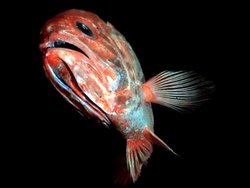
If a school of these fish across a carcass, they will devour it in just a matter of minutes. Just check out the video below to see the Candiru asu in action...

Candiru asu, like the saltwater Hagfish, will literally eat its meals from the inside out. Burrowing into the flesh and chowing down on the organs. There are even reports of human bodies being found in the Amazon River with hundreds of Candiru asu inside! Some believe that this fish will attack, while other insist that it is only a scavenger. Even though they only grow to about 6" in length, they make up for this in numbers much like the Piranha. If you think the Candiru asu is bad, you should check out the plain old Candiru! It will actually swim up a man's penis and attach itself if they are urinating in the water!

If you have any additional information about the Candiru asu please share...

Eel-Tailed Catfish (Tandanus tandanus)

The Eel-Tailed Catfish or Tandanus tandanus is a freshwater fish that is native to eastern Australia, namely the Murray/Darling river system. This fish goes by a few different names including Tandan, Dewfish, Freshwater Catfish and Jewfish. These fish get their names from their tail that looks like an Eel, and its large face, which has the typical Catfish barbels. They have small eyes and tough skin which is quite smooth. Some are brown, while other are more of a olive color with a white underbelly. You can check out a Eel-Tailed Catfish yourself in the video below...

Eel-Tailed Catfish can grow fairly large, weighing in a 13lbs (6kg) and reaching lengths of 36" (91cm). They will live to about 8 years old maximum. Like other catfish, this species is found in lakes, ponds and slow moving streams. They feed on crayfish, mollusks, small fish and insect larvae.


Spawning in the spring or early summer, the Eel Tailed Catfish will build a large nest, about 1 meter in diameter with stones and bits of gravel. After the eggs are laid, one parent will guard the eggs until they hatch into small fry. There have even been reports of both parents sticking around to guard the nest. Be careful if you catch one of these fish because they have very sharp dorsal and pectoral spines that can cause some serious pain.

If you have any additional information about the Eel-Tailed Catfish leave us a comment!

Aquarium Fish Of The Month - Spotted Cardinalfish


Still Can't Find The Fish You Are Looking For? Search For It Below Or Send Us An E-Mail!

Fish Index Followers