Welcome To The Fish Index! We Are Maintaining A Growing Encyclopedia Of Fish Species Listed From A-Z! Choose From Our Categories Or Browse The Fish Featured Along The Sides By Clicking Their Pictures. Each Fish Includes Detailed Information, Pictures, Video And User Comments! With Over 30,000 Different Species In The World, Our Team Of Fish Experts Are Constantly Being Challenged To Discover New Species. Sample "The Fish Of The Day" Or Browse Our Impressive Selection Of Aquarium Fish!
Don't forget to Like Us On Facebook!
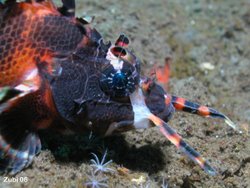
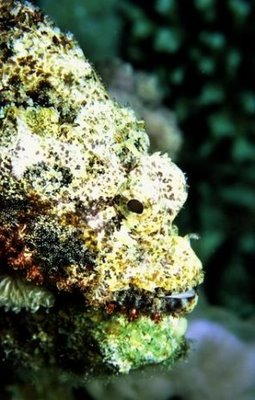
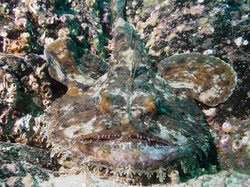
The Weedy Scorpionfish or Rhinopias frondosa is a saltwater fish that is a master of camouflage. This fish has a series of appendages that can easily be mistake for sea weed. As you can imagine, this makes the fish the perfect ambush predator. They will lie in wait until an unsuspecting meal gets too close and then strike with impressive speed.
Belonging to the Scorpaenidae family, these fish can vary greatly in color depending on what best suits their environment. You can learn a bit more about them in the short video below...
Reaching about 9" (23cm) in length, the Weedy Scorpionfish is found in the Indian and Pacific Oceans in depths of up to 295' (90 meters). These fish are sometimes known as Popeyed Scorpionfish, and do occasionally make their way into the aquarium trade, though at a steep price!
If you have any additional information about the Weedy Scorpionfish please leave us a comment below.
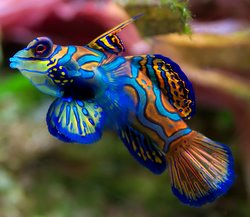
The Psychedelic Fish or Synchiropus picturatus is a rather trippy looking saltwater fish that was first discovered in the Western Pacific Ocean. Also known as the Psychedelic Mandarinfish, Spotted Mandarin, and Picture Dragonet these fish have a psychedelic coloration of blues, oranges, and black spots with a green base.
These fish can be kept as pets, but are considered to be difficult to take care of. They require a tank of 30 gallons or more with live substrate, and of course, many hiding places. Spotted Mandarin fish should be fed a variety of live brine shrimp and live black worms. They will also graze on live rock and live sand. These fish have been known to spawn in an aquarium without too much difficulty. The Psychedelic Fish can grow to about 4" in length and require the following water conditions: 72-78° F, dKH 8-12, pH 8.1-8.4, sg 1.020-1.025. If can check out the Pscychedelic Fish in an aquarium in the video below....
If you have any additional information about the Psychedelic Fish please leave us a comment below.
The Indo-Pacific Tarpon or Megalops cyprinoides is a fish capable of living in freshwater and saltwater. Also known as the Oxeye, Broussonet Tarpon,
Hairen or the Ten Pounder, this fish can grow to about 1 meter (3.3 feet). If you have had the pleasure of hooking one of these fish you probably have noticed that they fight much harder then most fish of the same size. They are also surface jumpers, and will certainly give you a run for your money on light tackle with long runs, and lots of stamina.
This species looks a lot like it close relative, the much bigger Atlantic Tarpon. It's body is covered with large scales with a blue-grey coloration and a silver belly. They have a forked tail and an elongated dorsal fin. These fish have a large mouth compared to their body size with a protruding jaw that is pointing upward, and no real teeth. If you are fishing for Indo-Pacific Tarpon you will generally find them in estuaries and coastal waters, rivers and mangrove forests. The best way to catch these Tarpon are with flies, spinners, sub-surface lures or shrimps.
These fish have made their way into the aquarium trade, but they require a MASSIVE tank so they are only recommended for the advanced aquarium enthusiasts. You can check out one in an aquarium in the video below.
POP QUIZ: Do you know the names of the other fish featured in the video above?
The Sunrise Dottyback or Pseudochromis flavivertex is a saltwater fish with a cobalt blue body that has a bright yellow band from the tip of its nose to its tail. Also known as the Sunrise Pseudochromis or Blue Flavivertex Dottyback, they can be kept in an aquarium setting, but are considered to be only for advanced aquarium enthusiasts. An aquarium of at least 30 gallons with the following water conditions are recommended, 72-78° F, dKH 8-12, pH 8.1-8.4, sg 1.020-1.025. Like most other fish, they like to have a few hiding spots. These fish are ideal for a reef aquarium.
Sunrise Dottybacks are considered to be a semi-aggressive fish and should only be kept with other Dottybacks if introduced at the same time. They can be fed brine shrimp and frozen foods and will not normally take to flake foods.
Sunrise Dottybacks can grow to about 3" in length and originate from the Red Sea. You can watch the Sunrise Dottyback in an aquarium in the video below.
If you have any additional information about the Sunrise Dottyback please leave us a comment below.
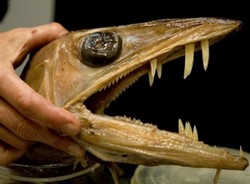
Like something out a fishy nightmare the Vampire Tetra or Hydrolycus scomberoides has extra long sharp teeth that protrude out of its mouth like that of a vampire. They use the two largest fangs to impale their unsuspecting prey with amazing speed! Also know as the Sabertooth Tetra or Payara, this freshwater fish can be kept in an aquarium and can grow to be VERY large. Under the right conditions, these fish can grow to several feet in length and weigh in at over 30lbs! They are not the easiest to care for and require lots of filtration and regular water changes, as well as lots of live foods. Vampire Tetra are of the tropical variety and require a temperature of 75 to 80 degrees in an aquarium of 100 gallons or more. These fish originate from South America where they are caught in the waters of the amazon basin.
Like the Piranha and Snakehead, one of the best parts of owning this type of aggressive carnivorous fish is feeding time! Here is some footage of the Vampire Tetra being fed goldfish.
If you have any additional information about the Vampire Tetra please leave us a comment below.
The Striped Eel Catfish or Plotosus lineatus is a saltwater fish found in the Indian and Pacific Oceans. These fish have two parallel white lines running down the sides of their bodies. They have long second dorsal and anal fins that merge with their caudal fin to give them the eel like appearance. You can experience what it is like to swim with the Striped Eel Catfish in the video below.
This species is also known as the Saltwater Catfish or Coral Catfish and is from the Plotosidae family of Catfishes. They can be kept in an aquarium, but be warned these fish have venomous spines so please handle with extreme care. These fish can grow to 12" (300mm), so a fairly large aquarium is recommended.
In the wild when the Striped Eel Catfish is young they will form dense schools of fish in a ball shape to make themselves seem larger to potential predators and to feed. As they grow older they lose this community attitude and separate themselves from the pack. Like other catfish, they feed on the bottom with their barbels searching for a meal by sifting through the sand for crustaceans, worms and very small fish.
If you have any additional information about the Striped Eel Catfish please leave us a comment below.
The Tompot Blenny or Parablennius gattorugine is a small fish that only grows to about 15cm in length and is found in shallow, rocky areas. This saltwater fish is just one of the over 800 different species of Blennies in the world! The Tompot Blenny can be differentiated from most other Blennies by a pair of tentacles that come out over its eyes, almost like horns. Like other Blennies, this fish has a continuous dorsal fin with the beginning spiny and the remainder soft. Compared to their bodies, the Tompot Blenny has very large pectoral fins which it uses to maneuver around. These fish are normally deep brown or orange.
Tompot Blenny fish feeds on small invertebrates that include sea anemones, hydroids, small gastropods, amphipods, decapod crustaceans and brittle stars. They will breed in the spring time like most other fish. The female Tompot will lay her eggs under stones or in crevices where they are fertilized and guarded by the male fish until hatching occurs. This fish is found in the shallow waters of northwest Europe from the British Isles south to the Mediterranean. It can be kept in an aquarium, but is considered to be much more difficult to care for then other species of Blennies. You can check the Tompot Blenny in a territorial dispute with another Blenny in the video below...
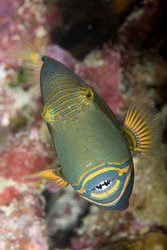
The Huma Huma Trigger or Rhinecanthus aculeatus is just one of many different species of Triggerfish on our planet. In Hawaii this fish is known as "humu-humu-nuku-nuku-a-puaa", where it is the official state fish. In other places in the world it is called the Picasso Triggerfish, Whitebanded Triggerfish or Painted Triggerfish. Like other species of Triggerfish, they have a very unique way of swimming, which makes them a favorite for advanced aquarium enthusiasts. You can watch this fish swimming underwater in this video!
Huma Huma Triggerfish are saltwater fish that have an odd shaped body with striking blue and brown stripes through their eyes. Their strange appearance and unique coloration makes them a favorite among aquarium enthusiasts. Like other Triggerfish though, this fish can be aggressive and should be kept with fish of similar size and temperament. It has even been known to nip a careless finger or two, so be careful when cleaning your tank!Growing to about 30 cm (12 inches), the Huma Huma Trigger should be kept in an aquarium of at least 80 gallons. Temperatures should range from 76-84 in the aquarium with a PH of 8.0 - 8.4 and a specific gravity range of 1.020 - 1.024. They should be fed a variety of foods including shrimp, snails with shells to grind down their ever growing teeth, live foods and meaty frozen foods. This species of Trigger is not a good reef fish.
If you have any additional information about the Picasso Triggerfish please leave us a comment below. POP QUIZ: Can you name the other species of fish in the video featured above?
Red Turquoise Discus Fish are one of several different varieties of Discus with the same scientific name Symphysodonaequifasciatus. The Pigeon Blood Discus for example is considered the same species, but the controlled breeding allows them to be a completely different colors. Red Turquoise Discus are turquoise with red stripes that grace their bodies in a strange pattern. These fish have red eyes and a bit of red on their fins. The coloration of this fish can variety greatly depending on its mood and the health of this freshwater fish. This makes them a favorite among aquarium enthusiasts.
Red Turquoise Discus can grow to about 9" in maximum length, but tend to look much larger because they are as tall as they are long. They are not the easiest fish to care for because they require very clean water, and the following water conditions, 79-86° F, KH 1-3, and pH 6.1-7.5. A water conditioner or reverse osmosis filtration system to soften the water will really help maintain the soft water for these fish to thrive. These fish are carnivores that should be fed foods including bloodworms, tubifex, pellet food, and specially designed Discus flake food. An aquarium of 40 gallons or more is suitable with plenty of hiding spots and plants.
It is quite possible to breed the Red Turquoise Discus fish in captivity. Making the water a bit warmer, and slightly acidic will encourage spawning. The Discus fish needs a flat surface to lay the eggs on, normally a broad leaf will work or they will just use a clean side of the aquarium. After the fry are hatched, make sure to keep them the same tank as their parents. The fry will actually feed off of the parent mucus that secretes out of their bodies like something out of a science fiction film. You can see it for yourself in the video below at about the 2 minute mark...
The Spotted Sweetlips or Plectorhinchus chaetodonoides is a saltwater fish that actually changes colors over its lifetime. Pictured at the top is a juvenile Spotted Sweetlips and below it is a fully grown exampe. As you can see, when this fish is small its body is brown or tan and covered with white spots. As the Spotted Sweetlips grows older its whole body turns white, and it develops black dots. No one is quite sure why. As you can see in the pictures, they have a lot of similar characteristics as the Clownfish, only they get much larger. Also known as the Clown Sweetlips or Harlequin Sweetlips, this fish is sometimes kept in an aquarium, but is not considered to be very easy to care for. They grow quite large for any aquarium growing to almost 2-1/2'. At least a 150 gallons aquarium is required for a fish this large. The following water conditions are acceptable, 72-78° F, dKH 8-12, pH 8.1-8.4, and sg 1.020-1.025. As with most fish they should be given plenty of hiding spots, this helps reduce the fish's stress level. Spotted Sweetlips can be fed a variety of meaty foods, but in the beginning it is best to feed them live saltwater feeder shrimp to help them become comfortable with the aquarium. You can check out the Juvenile Spotted Sweetlips mimicking the poisonous flatworm in the video below...
The Threadfin Lookdown or Selene vomer is a very odd looking saltwater fish that can grow to about 1' 8" in length. Sometimes just called the Lookdown, this fish looks like it just got punched in the face by a heavy weight boxer. As you can probably guess from their name, the Threadfin Lookdown's eyes often have the illusion that they are looking down at the bottom at all times.
When these fish are young their dorsal fins will have long filaments attached to them that will fall off as they grow older. They have a thin, flatten body that shimmers as they swim through the water. In the wild, these fish are found in the Atlantic Ocean at depths of up to 53 meters. Also referred to as Moonfish, the Threadfin Lookdown fish can be kept in a very large aquarium of 150 gallons or more. Their blue & silver scales make for a showy display as the light reflects off of them. They are not considered to be aggressive fish, so you can house them with many other non aggressive fish that are not fin nippers. The following water conditions are acceptable for the Threadfin Lookdown, 72-78° F, dKH 8-12, pH 8.1-8.4, and sg 1.020-1.025. These aquarium fish are carnivores that can be fed a variety of meaty food and live foods as well. You can check out the Threadfin Lookdown swimming in the video below...
POP QUIZ: Can you name all the other species in the video above?
The Flagfin Angelfish or Apolemichthys trimaculatus is a bright yellow saltwater fish with blue lips, and a dark spot above its eyes. This species of Angelfish can be kept in an aquarium of at least 80 gallons and is just one of the over 80 different species of Angelfish in the world. Be careful if you are going to house this with other Angelfish, they can become quite aggressive with towards one another.
Also referred to as the Threespot Angelfish, it is not the easiest fish to care for because of its strict diet. They normally feed on sponges, but some people have gotten them to take to brine shrimp, mysis shrimp and various plant life. Flagfin Angelfish should also have plenty of live rock and lots of places to hide. This will help them live longer, stress free lives. The following aquarium conditions are acceptable, 72-78° F, dKH 8-12, pH 8.1-8.4, and sg 1.020-1.025. The Flagfin Angelfish can reach about 10" in maximum length. You can watch the Flagfin Angelfish swimming in an aquarium in the video below...