Find Your Fish

Showing posts with label Centrarchidae. Show all posts

White Crappie (Pomoxis annularis)

The White Crappie or Pomoxis annularis is a freshwater fish from the Sunfish family Centrarchidae. This popular angling fish is found in all of the lower 48 United States. This fish will feed on a large variety of things including insects, crustaceans and also baby Muskellunge, Walleye and Northern Pike.

If you are fishing for White Crappie you can often find them around weed beds, logs, large rocks and other large underwater structures. The best to time to fish for White Crappie is during the evening or early morning. Spinners, jigs, minnows and worms can all be used to catch this very edible fish, just like its close relative the Black Crappie. They are even caught in the wintertime through the ice.

As with other members of the sunfish family, White Crappie build nests when they spawn. These nests will look very similar that of the Bluegill, round and relatively large in size. Spawning occurs in the spring when water temperatures reach 60°F to 70°F. It only takes about 5 days for the fry to hatch, but they are literally stuck to the nest by an adhesive for another 3-4 days. Once they manage to break themselves free they begin to feed and can grow 5" in just the first year. The biggest White Crappie on records was just over 5lbs caught in Mississippi.  You can check out some White Crappie fishing in the video below... 

If you have any additional information or fishing tips for the White Crappie please leave us a comment below.

Sacramento perch (Archoplites interruptus)

The Sacramento perch or Archoplites interruptus is a freshwater fish from the Sunfish family Centrarchidae and is found in many of the western states in America including California, Oregon and Nevada. The habitat of the Sacramento Perch often consists of lakes and slow moving rivers with heavy vegetation. They are often caught and considered to be quite delicious when prepared correctly.

Sacramento Perch are not particularly large only growing to about 24" (61cm) in length and weighing in at 8lbs (3.6kg). They can normally live up to six years old. Females of this species tend to be larger than males.  These fish tend to be blackish or brownish with about seven vertical dark bars that are irregular in form and position.

Despite it name the Sacramento Perch is not considered to be a Perch at all. These fish have 12-14 dorsal spines and 6-8 anal spines with 13-15 pectoral rays. Sacramento Perch are notorious for being able to survive in many different water conditions. They are capable of surviving high temperatures, poor water clarity, high salinities and high turbidity.


Spawning of the Sacramento Perch occurs from March to August generally when the water temperature reaches 18 degree Celsius. Like the Bluegill, these freshwater fish will build nest in close to shore which they will defend at all costs until the female arrives. Female Sacramento Perch can produce over 100,000 eggs at a time and will spawn with multiple males. The male will guard the nest for several days until the fry are hatched.

If you are fishing for Sacramento Perch you can use a simple bobber setup with worms or crickets.  They are not the easiest to catch, but well worth it in the frying pan.    

If you have any additional information about the Sacramento Perch including recipes and fishing tips please share.

Spotted Bass (Micropterus punctulatus)

The Spotted Bass or Micropterus punctulatus is often confused with the much more common Largemouth Bass. Their bodies and coloration are similar, but the Spotted Bass can be distinguished by its smaller mouth, and a rough patch of teeth on the tongue.  A sure way to tell the difference between the two though is the fact that the Spotted Bass's mouth DOES NOT extend past it's eye like the Largemouth Bass. Also known as the Kentucky Bass, Spotty, Leeman and Spots, they also tend to have more spots on their bodies than the Largemouth. 

This freshwater fish is from the Sunfish family of Centrarchidae.  This species of Bass is only found in a few places in the world including the Mississippi River Basin, Texas, Florida, North Carolina, Virginia and they have also been introduced in Southern Africa. The Spotted Bass prefers waters with rocky bottoms where they feed on insects, small fish, frogs, worms and crustaceans.
Spotted Bass can grow to about 25" (64 cm), and weigh in at about 10lbs (4.6kg). They are not a very long-lived fish, only living to about 7 years max. When they reach sexual maturity at around three or four, the female will lay between 1,150 and 47,000 eggs. After this, the male Spotted Bass will guard the eggs for about 4 weeks to ensure that nothing eats the young fry. If you are fishing for Spotted Bass be ready for their fight which is said to rival it's close relative the Smallmouth Bass!

If you have any fishing tips or recipes about the Spotted Bass please leave them in the comments below...

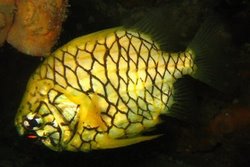
Aquarium Fish Of The Month - Spotted Cardinalfish


Still Can't Find The Fish You Are Looking For? Search For It Below Or Send Us An E-Mail!

Fish Index Followers