





























Showing posts with label Deep Sea Fish. Show all posts
Showing posts with label Deep Sea Fish. Show all posts
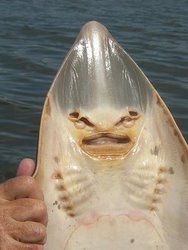
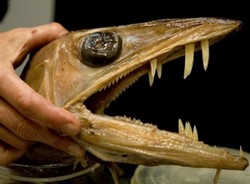
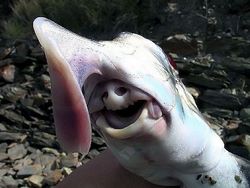
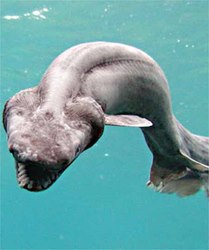
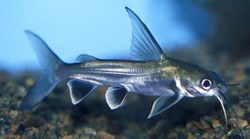
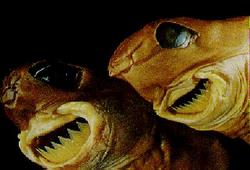
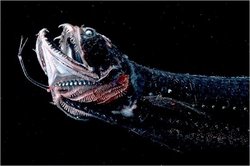
Viper Shark (Trigonognathus kabeyai)


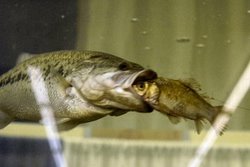
Black Swallower (Chiasmodon niger)

The Black Swallower or Chiasmodon niger is a rarely seen deep sea fish found in the mesopelagic and bathypelagic zones at a depth of 2,300-9,000 ft (700-2,745 meters). This fish is known for its ability to swallow a fish up to THREE times its size! It accomplishes this by using its highly stretchable jaw and stomach. The Black Swallower will grab its prey from behind by the tail and then coil it into its stomach where it will be slowly digested. It also has sharp interlocking teeth which keep the prey from swimming away. Meals come few and far between in the dark depths of the ocean and this adaptation keeps the Black Swallower alive even when days goes by without eating.

Black Swallowers are a relatively small saltwater fish, only growing to about 10" (25cm) in length. They are black in color with a blunt snout and a large mouth with canine teeth. They have two dorsal fins and an anal fin that contains a single spine. Their caudal fin or tail is forked. These fish have never been caught on camera, and what species have been collected are due to the fish swallowing more then it can handle. If the fish is unable to digest its prey quick enough gases will build up in the decomposition process, and force the Black Swallower to the surface where it dies. You can learn more about the amazing creatures that live in the deep sea in the video below, including Barreleyes and the Deep Sea Angler Fish!
If you have any additional information about the Black Swallower please leave us a comment below.


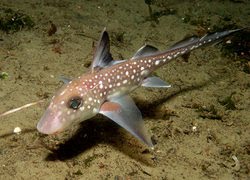
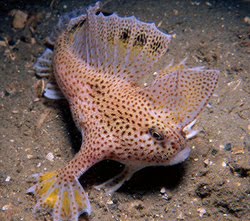
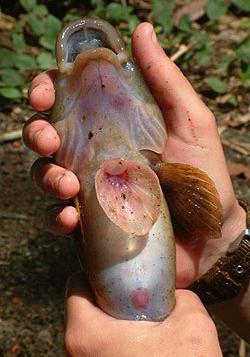
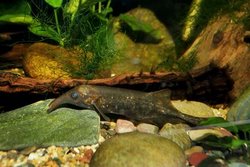
Spotted Ratfish (Hydrolagus colliei)


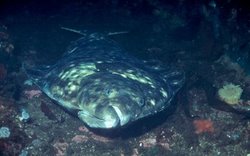
Spotted Ratfish feed on shrimp, worms and other small fish. They fall prey to Pacific Halibut and some small to medium sized sharks. If you have any questions or comments about the Spotted Ratfish please share!


Arctic Alligatorfish (Ulcina olrikii)
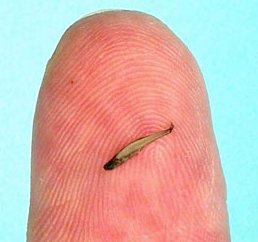
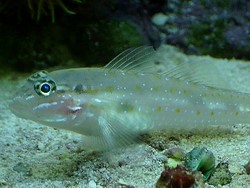
 The Arctic Alligatorfish or Ulcina olrikii is one of the over 200 different species of fish that can survive the frigid temperatures of the Arctic Ocean. Arctic Alligatorfish are not very large only growing to 3.4 inches (8.6 cm) and are also found in the extreme Northern Parts of the Atlantic and Pacific Oceans. These Deep Sea Fish are brown in coloration with dark spots on their bodies and only one dorsal fin. They have a short body with a broad head and short barbels on their upper jaw. As you can see they have relatively large eyes for their body size, this helps them see at such great depths in murky waters.
Arctic Alligatorfish are found in a great variety of depths up to 500 meters deep! They are often found close to a sandy bottom where they feed on polychaete, worms, amphipods and ostracods. They often become prey themselves to the much larger Halibut.
 There is little known about the sexual reproduction of this species of saltwater fish, but scientists have confirmed that they only lay about 250 eggs maximum at a time, which is small compared to many other species. If you have any additional information or pictures of the Arctic Alligatorfish please leave a comment!

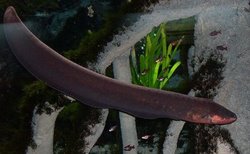
Jellynose Fish (Ateleopodidae)
 The Jellynose Fish or Ateleopodidae is a deep sea fish that is rarely seen by the human eye, and sometimes simply referred to as a tadpole. There are about 12 different species of Jellynose Fish in the world. Jellynose Fish can reach lengths of about 6' long and weigh in at over 100lbs. They have very long tails and small teeth, which they use to scrounge off the bottom. This deep sea creature has no scale and is made of a gelatinous material that is mostly fat. This strange body makeup is perfect for surviving the crushing force of the water at these extreme depths. Since they are found so deep in the ocean, often at depths of over 1000 feet there is not a lot more known about this strange species of fish.
 Recently in Brazil a possible new species of Jellynose Fish was discovered. Below you can see some extremely rare footage of a Jellynose Fish underwater...
If you have any additional information about Jellynose Fish that you would like to add please leave us a comment...


Giant Megamouth Shark (Megachasma pelagios)
 The Giant Megamouth Shark or Megachasma pelagios is an extremely rare deep sea shark! This species was only discovered in 1976 in Hawaii, and since then there have only been a handful of sightings! It is the lone member of the family Megachasmidae, and has been reported only in the deep, cold waters of the Indian, Pacfic and Atlantic Oceans.
  Much like the Whale Shark and the Basking Shark, the Megamouth Shark simply swims around with its mouth open, which is full with over 50 rows of very small, hooked teeth. It collects food by filtering out the water with its gills, what's left after the water is drained out is its dinner. Like a lot of other deep sea creatures, they actually have photophores that give off light and attract the plankton and small shrimp right into their mouths! You can check out the Giant Megamouth Shark underwater in this rare footage...
This next video shows a variety of shark species and then an indepth look at the 6th Megamouth Shark ever captured at the 2 minute mark in the video below.
Giant Megamouth Sharks are brownish black in coloration and can reach impressive lengths of 6 meters (20 feet) and weigh in at 1500kg (3300lbs)! They are not considered to be very fast swimmers, but this doesn't really matter because they don't have very many nature predators due to their large size. Like other sharks, the Giant Megamouth Shark gives live birth.
If you have any more information about the Gian Megamouth Shark please share it with us below.


Prickly Shark (Echinorhinus cookei)
The Prickly Shark or Echinorhinus cookei is a shark that is covered in modified teeth called dermal denticles or "skin teeth". They are often found at the bottom of the Pacific Ocean at depths of exceeding 425 meters! This rarely seen deep sea creature is said to often inhabit submarine canyons where it waits for its prey to swim by. The Prickly Shark often dines on squid, octopus and other small fish.


Prickly Sharks can reach length of about 4 meters (13 feet). They have a very similar appearance to the Bramble Shark, only without the thorny denticles. Prickly Sharks have no anal fin and only have two small dorsal fins that are located way back by the tail. Prickly Sharks are ovoviviparous, which means that they carry their young eggs inside them until they are close to, or ready to hatch. They can have over 100 pups in a single litter! If you have any additional information about the Prickly Shark that you would like to share please do so in the comments below...


Cow Shark (Hexanchus griseus)
 The Cow Shark or Hexanchus griseus is a one of the largest sharks in the world growing to more than 5.4 m (18 ft) in length. This massive creature can appear to be sluggish, but once this fish starts swimming it can easily chase down its prey which includes Hagfish, mollusks and crustaceans. Also known as the Bluntnose Sixgill Shark they are often found at depths of up to 1,875 m (6,150 ft). This deep sea fish is not considered to be a threat to humans simply because they never run into each other in the oceans.
 Cow Shark have a brownish coloration that sometimes appears to be black. It has six gills which separates them from most other sharks that only have five. This characteristic links them to sharks from the Triassic period.
They have small eyes that are bluish green. Females of this species tend to be larger than the males, but they both grow to an impressive size. Just check out this Cow Shark in close up action below...


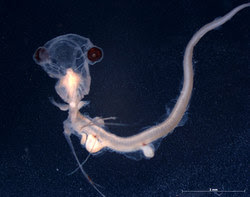
Barreleyes (Macropinna microstoma)
 Barreleyes or Macropinna microstoma is arguably the weirdest fish in the world. This stranger creature has a translucent head that you can see right through! Their eyes rotate upwards in their heads giving them the ability to actually see the area above itself! That's right, these deep sea creatures actually keep an eye on potential predators or food that is swimming in waters above them.
 These pictures were taken off the coast of California, but little more is know about the habitat of this rarely seen fish. Barreleyes can grow to only about 4.4 cm and are also known as Spookfish. They are found in waters of 16 to 1015 meters deep. Check out this strange fish in action in the video below...
If you have any information you would like to share about the Barreleyes fish leave it in the comments below...


Blobfish (Psychrolutes marcidus)
 The Blobfish or Psychrolutes marcidus is without a doubt in one of the ugliest fish in the ocean. These saltwater fish have what resembles a large nose in between two eyes and almost seem to be frowning! I guess with an ugly mug like that you would be frowning too. This deep sea fish is often found at extreme depths off of the coasts of Tasmania and Australia. For this reason the Blobfish is rarely seen by the human eye.
 The Blobfish has the ability to withstand the high pressure of these depths because its body is actually mostly a gelatinour mass that has a density just less than water. This gives the Blobfish the ability to float right above the bottom floor without using much energy.
  As you can imagine, with the name like the Blobfish they aren't extremely active. In fact, most of the food that they eat simply floats right by them. This deep sea fish simply picks and chooses what to eat. Blobfish are often caught by fisherman that bottom trawling with nets.
One weird fact about the Blobfish is that when reproducing they will actually sit on their eggs until hatching. If you have any more information about the Blobfish that you would like to share please do so in the comments below...


Deep Sea Hatchetfish (Argyropelecus Gigas)
 The Deep Sea Hatchetfish or Argyropelecus gigas has large sunken eyes that are permanently looking upwards towards the surface. These creepy eyes help them find the food that is floating downwards towards the bottom. As you can tell from the pictures though, these eyes also make them look like the ghosts of the ocean!
 Known in some areas as the Greater Silver Hatchetfish, this is just one of the about 45 different species of Hatchetfish. As you can see, these deep sea fish get their names from their strange shape, which almost seems to resemble that of a hatchet. They are often found between the depths of 200-6000 meters in the Atlantic, Pacific and Indian Oceans. The Deep Sea Hatchetfish can grow to about 1/2' in maximum length.
 Like some other creatures of the deep they use counter illumination as a form of camouflage to avoid potential predators. They have organs called photophores on their undersides. These photophores actually produce light that makes it much more difficult to be spotted by predators. They can adjust the intensity of light on their underside which makes them nearly invisible from below! This light is also said to play a role in the mating process of the Deep Sea Hatchetfish. You can check out the Deep Sea Hatchetfish along with some other Deep Sea Fish in the video below...
 Little more is known about this strange deep sea creature, but if you have anything you would like to share please do so in the comments below...
Frilled Shark (Chlamydoselachus anguineus)
 The Frilled Shark or Chlamydoselachus anguineus looks like a creature from the times when dinosaurs ruled the world. Believe it or not, this prehistoric looking shark was actually spotted and filmed last year in Japan in very shallow waters. (see video below) Normally these deep sea creatures are found only in depths that range in between 50 m and 1,500 m!
 Simply known in some places as the Frill Shark, it has the six gill slits that identify it as a shark. They get their name because the gill tissue that sticks out more than most other sharks. Frilled Shark will grow to almost 7' in maximum length.
  Found worldwide in deep waters the Frilled Shark feeds on squid, small deep sea fish and even other smaller sharks that are found in the depths. They have sharp and jagged teeth that look quite intimidating. This shark is not considered a danger to humans simply because they are found so deep in the ocean. To check out the Frilled Shark in action watch the video below...
Coffinfish (Chaunacops melanostomus)
 The Coffinfish or Chaunacops melanostomus is one very odd looking deep sea fish. It has a weird flabby body and a long tail that are both covered with small spines! The Coffinfish has a black mouth that almost looks like it is frowning. This deep sea species is quite small only growing to about 10 cm in length.
The Coffinfish has been caught at depths of 1320m to 1760 meters in the Central and Eastern Indian Ocean. The name melanostomus comes from the Greek melanos meaning black and stoma meaning mouth.
 Little more is known about this deep sea creature, if you have anything to add to this post please do so in the comments below...
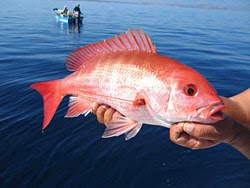
Orange Roughy (Hoplostethus atlanticus)
 Orange Roughy or Hoplostethus atlanticus has a few names including Red Roughy or Deep Sea Perch. This fish is often found in cold waters at very deep levels, even up to 1,800 meters deep! The Orange Roughy has an amazingly long lifespan. It can live up to 150 years old! Even though they can be one of the oldest fish in the ocean it will only grows to about 16" (40cm) long and 11lbs in weight.
The Orange Roughy was first discovered in the early 1970's in New Zealand. To this day New Zealand remains the worlds main suppler of Orange Roughy. They are often a little more pricey then some fish and are comparable in taste to the Orea Dory.
 Often bright red while it is alive, this deep sea fish is said to fade to an orangish yellow after it dies. They have a large round head and huge eyes which they use to search the depths of the ocean for mysid shrimp, euphausiids, amphipods, squid and other small fish.
The Orange Roughy fish will release fertilized eggs into the water that will rise to about 200 meters. As the fish hatch and begin to develop they will slowly descend into deeper water where they will live out their lives. It reaches sexual maturity in almost 25 years so this combined with the fact that Orange Roughy is one of the most popular fishes to eat makes this fish very susceptible to overfishing.
 Know for its firm flesh with a very mild flavor this fish is normally filleted and served fresh or frozen. If you have a recipe or tips for catching the deep sea Orange Roughy please leave them below in the comments...
Tube Eye (Stylephorus chordatus)
 The Tube Eye fish or Stylephorus chordatus is a rarely seen deep sea fish. This fish is very long! Its body grows to about 28cm in length, but it has a strange pair of tail fins that triple its length! Like some other deep sea fish, the Tube Eye fish has unbelievably large telescopic eyes that jut out of its head. This fish is a nocturnal feeder, that comes up from the depths everyday to feed on plankton.
  They have a very strange method of feeding. The Tube Eye uses its balloonable mouth cavity to expand to 38 times its original size as the fish sucks in seawater through its tubular mouth, as if through a straw. Once filled, the mouth closes and the fish forces the water back out through its gills, leaving behind just the plankton.
Subscribe to:
Posts (Atom)
Aquarium Fish Of The Month - Spotted Cardinalfish