Find Your Fish

Showing posts with label Invasive Species. Show all posts

Mozambique Tilapia (Oreochromis mossambicus)


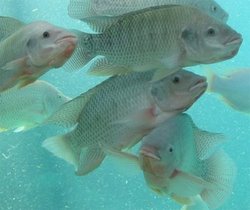
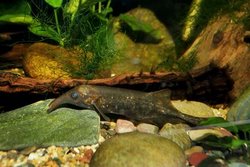
The Mozambique Tilapia or Oreochromis mossambicus is just one of the 100s of different Cichlid species of fish known as Tilapia. This particular species goes by a couple different names including Blue Kurper, Tilapia Kafuensis, Kafue Bream and the Three Spotted Tilapia. This species is native to Southern Africa and is found in many tropical areas around the world, where it is used for aquaculture. Like other Tilapia, they are able to survive in very harsh conditions compared to many other freshwater fish. It can adapt to temperatures below 50 °F (10 °C) and above 100 °F (38 °C), and can also tolerate brackish waters. They also will eat a large variety of foods, which not only makes them a perfect candidate for fish farming, but also difficult to get rid of when introduced to the wrong area.  These fish are considered to be an invasive species in parts of the world where they have been introduced to control mosquitoes.

These fish are not particular large, only grow to about 14" (35cm) in length and weighing in at 2-1/2 lbs (1.13KG). They can live for about 11 years.  Like other species of Cichlids, these fish are mouth brooders, which means that after the eggs are laid and fertilized the female will then scoop them up into her mouth for protection until they hatch.  You can check out the Mozambique Tilapia underwater in the video below.


If you have any additional information about the Mozambique Tilapia please leave us a comment below.


Red Lionfish (Pterois volitans)


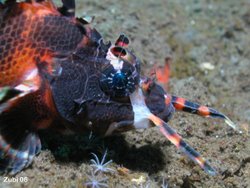
The Red Lionfish or Pterois volitans is a venomous saltwater fish from the Scorpaenidae family that is found primarily in the Indian and Pacific Oceans. This species of Lionfish has been introduced into the Atlantic Ocean and due to the fact that it has no natural predators, it is considered to be an invasive species.

As you can see in the pictures, the Redlionfish has series of venomous dorsal spines that it uses to defend itself from those unlucky enough to get too close. Although the venom from this fish is not considered deadly to humans, it is recommended that you seek medical attention and soak the area in hot water. Those stung can experience difficultly breathing as well as vomiting, headaches and extreme pain. You can learn more about the dangers on the Red Lionfish in the video below. 


There are not many predators of the Red Lionfish, but Nassau and Tiger Groupers have been reported to be able to ingest them. This Lionfish will feed on almost anything they can fit their mouths around. These fish will swallow their prey whole after they corner them with their large fins. This species of Lionfish is nocturnal, feeding from dusk till dawn.  They can grow to about 15" in length and live for 10 years. 

 If you have any additional information about the Red Lionfish please leave us a comment below.

Round Goby (Neogobius melanostomus)

The Round Goby or Neogobius melanostomus is a freshwater fish that is found in Lakes Michigan, Huron, Erie and Superior in the state of Michigan but originated in Europe. This fish has a gray body with blotches of black and brown scattered across it. Round Goby are not very large only growing to about 10 to 25 cm in length.  As Round Goby grow they will eat a variety of foods including small fish, eggs, insect larvae, zebra mussels and clams.
These fish are often confused with Sculpins, but can be differentiated by their pelvic fin. The Round Goby has a fused pelvic fin, while Sculpins have a split pelvic fin. Like other Gobies they can reproduce quickly, producing about 5,000 eggs multiple times throughout the summer months. Male Round Goby will guard the nest fanning the eggs to keep them oxygenated and protecting them from potential predators. Their quick reproduction rate combined with the fact that they can survive in brackish and low quality water makes them an invasive species.  You can check out a bunch of Round Goby fish attacking a Smallmouth Bass nest in the video below...


If you have any additional information about the Round Roby please leave us a comment below...

Rainbow Smelt (Osmerus mordax)


The Rainbow Smelt or Osmerus mordax is a rather small fish that is found in many places in North America including the Great Lakes and many coastal rivers. Rainbow Smelt have slender bodies that have an iridescent look to them with shades of blue, pink and purple on their sides, a silver back and a light underside.  Like other Smelt, they are not particularly large only growing to about 12" in maximum length and weighing in at about 3 oz maximum.

These fish go by a couple different names including American Smelt, Leefish, Freshwater Smelt, and Frost Fish.  Rainbow Smelt fall prey to a few different species of fish including Walleye, Yellow Perch, Coho Salmon, Burbot and Trout. This species of Smelt will often dine on small invertebrates, zooplankton, Whitefish, sculpins and are even known to eat other Smelt!

Rainbow Smelt are caught both commercially and for recreation.  They are edible, but are often used as animal feed and are not considered to be one of the tastiest fish.  Rainbow Smelt are considered an invasive species that can cause serious damage when introduced in the wrong locations.  While they do provide food for larger fish, they also reproduce quite quickly and can easily become overpopulated in a rather short period of time.

Some Rainbow Smelt are anadromous which means that they can live in salt water as well as fresh water near the coastline.  This fish spends much of its summer around the coast line only a mile or so inside the ocean.  In the wintertime this fish has a special anti-freeze protein that helps it survive the harsh winters.  Once Spring comes Rainbow Smelt will spawn at night in small streams.     

You can check out these Rainbow Smelt with your own eyes in the video below...


If you have any additional information about the Rainbow Smelt please leave us a comment...

Silver Carp (Hypophthalmichthys molitrix)

The Silver Carp or Hypophthalmichthys molitrix is one of the species of Asian Carp that is threatening to invade and devastate The Great Lakes.  The Silver Carp along with the Bighead Carp where introduced by Catfish farmers in the 1970s to help control algae.  Floods in the 1990s overflowed the ponds that kept these freshwater fish secured and they made their way into the Mississippi River basin.  They have since traveled up the Mississippi and have reproduced so much that they have even become the most abundant species in several areas!  Silver Carps also known as Flying Carp are now considered an invasive species, and should be reported to the DNR if caught anywhere near The Great Lakes.
The ravenous appetite of the Silver Carp along with its ability to reproduce quickly makes it all the more dangerous.  These fish are not small either, growing to over 4' long and weighing in at over 100lbs!  One rather strange, but even more dangerous attribute of these invasive monsters is the fact that they like to jump out of the water when a boat passes by.  This can be very bad for the fishermen and the boats alike!  Just take a look at these videos below to see the Silver Carp jumping like maniacs out of the water!


Another odd characteristic of the Silver Carp is the fact that they have no stomach!  They feed on phytoplankton, zooplankton and detritus.  As you can imagine with these fish, it is in one end and out the other!  Some think that these Carp can be use to control some forms of algae, while other worry about the side effects of introducing this species of Carp.

If you have any additional information or questions about the Silver Carp just leave us a comment.

Northern Snakehead (Channa argus)

The Northern Snakehead or Channa argus is a species of Snakehead that is just like something out of a science fiction novel. This fish has even had a couple movies made about it including, Snakehead Terror and Frankenfish! After you take one look at the Northern Snakehead you might think, sure it's got razor sharp teeth, but what's the big deal. Well, this fish actually has the ability to walk on land! If that wasn't enough, they can live up to 3 days WITHOUT water! All of this along with the fact that they reproduce like rabbits makes the Northern Snakehead a dangerous invasive species. If you ever catch on of these fish in The United States kill it and report it to the DNR immediately!The Northern Snakehead isn't hated all over the world though, in places like Russia, China and Korea this species is kept in check by other predators. They are actually an important food source in these locations. Here in the states though, this fish is nothing but a ticking time bomb. These fish are on the top of the food chain here, and will easily decimate an entire ecosystem!As with other Snakeheads this fish can be identified by its long dorsal and anal fin. They also have very large jaws with razor sharp, shark like teeth. The bodies of these freshwater fish are brown with dark blotches on their sides and back. When these fish are first born their coloration is almost identical to when they grow up. This is a characteristic that is only found in this species of Snakehead. The largest Northern Snakehead on record was 60" (1.5 Meters) in length and weighed in at about 15lbs (7 kg). You can learn a little more about this species and the effects on the Potomac River in the video below...


If you have any additional information about the Northern Snakehead that you would like to share leave us a comment! You can also learn more about all the species of Snakeheads here!

Nile Perch (Lates niloticus)

The Nile Perch or Lates niloticus is a massive freshwater fish that can grow to over 6' (2m) in length and can weigh up to 530lbs (200kg)! These fish can be identified by their dark black eyes that have a yellow outer ring. Their bodies are silver with a bluish tint.Nile Perch are found in a few different places including Lake Maryut, Lake Chad, Lake Turkana, Lake Nasser, Volta, Nile, Congo, Senegal and Niger. They go by a few different names depending on where in the world you are. Victoria Perch, African Snook, Capitaine, and Luo are just a few. Nile Perch are vicious predators that will dominate and potentially destroy an ecosystem. For this reason, they are considered an invasive species and should never be released into a foreign ecosystem.
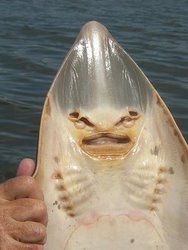
Nile Perch will often feed on Cichlids, crustaceans, insects, small fish and even their own kind! That's right, like the Northern Pike, these fish are cannibals! As you can imagine with this fish's amazing size and strength, they are a favorite among anglers and are considered to be one of the hardest trophy fish to catch. You can check out these edible fish for yourself in the video below...

If you have any additional information about the Nile Perch please leave us a comment.

Ocellated Snakehead (Channa pleurophthalmus)

The Ocellated Snakehead or Channa pleurophthalmus is one of the over 28 different species of Snakeheads. This fish has a long body with a series of patches on the sides of its body, as well as on its head and tail. They can grow to about 16 inches (40cm) in length. Found in Indonesia and Sumatra, these fish are often eaten and considered to be quite good. Snakeheads are amazing fish that can actually survive outside of water for hours and sometimes days! They can also walk on land, much like the Mudskipper and the African Lungfish. These fierce predators can survive in many different kinds of freshwater, but generally between these following conditions 22-28˚C, 72-82˚F, and pH 6-7.5. They are also kept in aquariums, but should only be housed with fish of similar aggressiveness. The Ocellated Snakehead prefers to be fed live food whenever possible. Like most other fish, they should be provided with some hiding spots to keep them happy. One last thing to note if you are thinking of buying a Ocellated Snakehead is that you need to give them access to the surface, because they are air breathers that will suffocate without access.

Note: These fish are considered an invasive species and should never be introduced into the wild. Check out more information about just how dangerous Snakeheads can be in the video below...

For a look at the softer side of the Ocellated Snakehead take a lot at this HD underwater footage...


If you have any more information about Ocellated Snakehead leave us a comment.

Red Snakehead (Channa micropeltes)

The Red Snakehead Fish or Channa micropeltes is considered a dangerous and invasive species that can grow to 7 feet and 22lbs. Snakeheads can even crawl on land and have the ability to survive outside water for 3 to 7 days! As the Snakehead fish grows older, they lose their stripes and turn a bluish black and white pattern on their upper body.
Vietnam, Indonesia, Laos, Thailand, Malaysia, India, and Myanmar are all place that you can find the Snakehead Fish. They have even been recently reported in Britain, Wisconsin and Maryland! To find out more about these dangerous creatures check out the video below...


Aquarium Fish Of The Month - Spotted Cardinalfish


Still Can't Find The Fish You Are Looking For? Search For It Below Or Send Us An E-Mail!

Fish Index Followers