
Find Your Fish

Showing posts with label Nocturnal. Show all posts

Spotted Drum (Equetus punctatus)

The Spotted Drum or Equetus punctatus is a saltwater fish that has quite the transformation as it grows older. When this fish is a juvenile they have a long dorsal fin and tail that changes as the fish thickens up, and developes spots on their tail and 2nd dorsal fin. Pictured below is a juvenile Spotted Drum, you can really appreciate the amazing transformation this fish undergoes by comparing the two pictures.

Spotted Drum fish occasionally make their way into the aquarium trade and are said to be a great addition to a reef tank. They are healthy eaters and will also hold their own against other potentially aggressive tankmates. These fish can grow to about 10" in length and are found in the Western Atlantic Oceans tropical waters, in and around reefs.  They are nocturnal feeders who hide most of the day and come out to feast during the night hours.  You can watch a Spotted Drum swimming in the video below.


If you have any additional information about the Spotted Drum including tips for keeping them in an aquarium please share in the comments below.

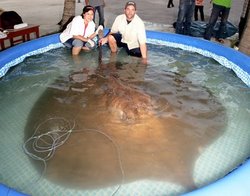
Electric ray (Narcine brasiliensis)


The Electric Ray or Narcine brasiliensis has gray elongated spots with dark brown coloration in the dorsal region and a white belly. They measure on average 34cm (13") in width and 1 kg(2lbs), but can reach 54cm (21") in width, and total weight of 5kg (11lbs). These saltwater fish occur in tropical and temperate waters of the Western Atlantic. These animals are benthic and live in coastal waters with sandy or muddy bottoms.

Electric Rays will bury themselves in the substrate with only their eyes out waiting for unsuspecting prey to wander by.  They are nocturnal, carnivorous and viviparous.  As a defense they can release an electrical discharge from 14 to 37 volts, which is also used to communicate between individuals of the same species.  It is also used as a kind of radar much like the Hammerhead Shark to find prey in the murky waters.  You can check out an Electric Ray in the video below.

If you have any additional information about the Electric Ray please leave us a comment below.

Courtesy of Ellano J. Silva - Fisheries engineering student (UFERSA- Brazil)

Glassy Sweeper (Pempheris schomburgki)


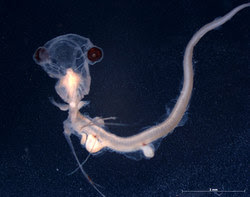
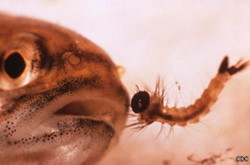
The Glassy Sweeper or Pempheris schomburgki is a small saltwater fish with a tall, long body. They have a big head with large eyes and a very wide mouth. These fish are quite the sight to be seen when they are younger.  Their bodies are so transparent that the backbone can be seen in the living fish.  As they grow older, their bodies become more solid reaching lengths of about 15cm in length.

Also known as the Copper Sweeper, their color varies from tan-yellow to silver. They are found in Western Atlantic, southeastern Florida, USA, from Bahamas to Santa Catarina (south of Brazil) and Brazilian oceanic islands.  They are a nocturnal species found in clear water with coral bottom, forming aggregations in dark crevices and caves.   Glassy Sweepers can be kept in an aquarium plenty of hiding spaces.  This fish will feed on zooplankton and invertebrate larval in the wild.  You can check out a large school of adult Glass Sweepers in the video below.   

If you have any additional information about the Glassy Sweeper please leave us a comment below.

Courtesy of Ellano J. Silva - Fisheries engineering student (UFERSA- Brazil)


Blind Shark (Brachaelurus waddi)

Blind Shark (Brachaelurus waddi) is one of the two species of Carpet Sharks from the Brachaeluridae family. Despite their name, these sharks are not blind, but instead get their name from the fact that they tend to close their eyes when outside of water.

Blind Sharks are found off the Eastern coast of Australia in waters of up to 460' (140 m). These sharks are nocturnal feeders and are often found in seagrass beds or around rocky formations. They will normally dine on any and all invertebrates and a variety of bony fishes. This species can live for up to 18 hours out of water, allowing it to survive being stranded by the outgoing tide.
Like other sharks they are ovoviviparous and normally give birth during the summer months.  They will produce a litter of up to eight pups.  You can check out the Blind Shark in action in the video below...


If you have any additional information about the Blind Shark please leave us a comment below.

Flashlight Fish (Anomalops katoptron)

The Flashlight Fish or Anomalops katoptron gets its name from its glowing smile that is cause by bio-luminescent bacteria in organs below each eye. This glow will often be white, but will also turn a blue or yellowish coloration depending on the fish. The Flashlight Fish actually has the ability to turn this light on and off when needed! They will use their light to attract prey, to communicate with one another, and to cause a diversion for potential predators. This remarkable attribute makes this saltwater fish a favorite for advanced aquarium owners.
Also known as the Lantern Fish and the Twofin Flashlight Fish they have a black body with a blueish tint on their caudal and dorsal fins. Growing to about 9" in length, this fish requires an aquarium of at least 125 gallons with the following water conditions, 72-78° F, dKH 8-12, pH 8.1-8.4, sg 1.020-1.025. They can be kept with other nocturnal fish including Pinecone Fish, Squirrelfish and Cardinalfish. They need plenty of hiding spaces and low lighting to set the mood.  You can check out the Flashlight Fish underwater in the video below.


If you have any additional information about the Flashlight Fish please leave us a comment below.

European Conger Eel (Conger conger)

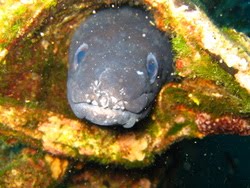
The European Conger Eel or Conger conger is the the largest known Eel in the ocean measuring 2.87 m (9.5 ft) in length and weighing in at an impressive 60.6 kg (133¼ lb)!  Like other Eels, this saltwater fish has a snake like body and is found at a great range of depths.  When the European Conger Eel is young it is often inhabits shallow coastal waters, but as it grows older they make their way to deeper waters of up to 1000 meters.  This species is just one of the many different kinds of Conger Eels and goes by a couple different names including Sea Eel, Southern Conger, Koiro, Ngoio and the Silver Eel. 

European Conger Eels are found in a few different places around the world including the Black Sea, Mediterranean Sea and the eastern Atlantic Ocean.  They are nocturnal predators that feed on mollusks, small fish and crustaceans.  This type of Eel can be caught with a hook and line and is not raised on fish farms.  They are edible and are said to have a sweet taste with a firm texture.  Eels are often served smoked, canned, fresh or jellied.  As with all other fish, they are best served fresh.  You can check out some Conger Eels in action in the video below...
 

If you have any additional information about the European Conger Eel please leave us a comment below!

Black Bullhead (Ameiurus melas)

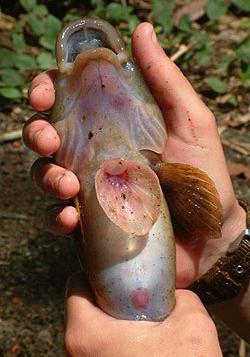
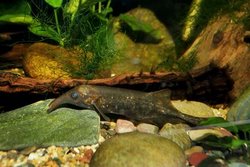
The Black Bullhead or Ameiurus melas is a species of Catfish that is found in many places in North America including The Great Lakes, Ontario, New York, Arizona and California just to name a few.  This species of freshwater fish goes by a few different names depending on where you are including Horned Pout, Yellow Belly Bullhead and the Black Catfish.

Despite its name, this fish is actually normally green, olive and even has some yellowish shades.  The only time this fish is black is when the male is spawning or when they are first born.  Their underbellies are white or yellow in coloration.  The barbels of the Black Bullhead are often spotted or just black altogether, and these fish have a rather square tail.
Growing to just over 2' in length, they can live to about 10 years old and reach weighs of over 7lbs.  Black Bullhead are nocturnal and will feed on fish, clams, snails and even some plants.  When they spawn the female will prepare the nest.  Each time the eggs are released both parents will actually fan the eggs until they hatch.  Then they will guard the fry until they leave in groups into the great unknown.

If you have any additional information about the Black Bullhead that you would like to share please drop us a comment.
NEXT

PREVIOUS

Black African Knifefish (Xenomystus nigri)

The Black African Knifefish or Xenomystus nigri is an odd looking fish with no dorsal or caudal fins. Instead, like other species of Knifefish they have an elongated anal fin that they use to maneuver around. They have a long slender bodies that can reach lengths of about 12" (30cm). As their name states they are gray, black or brown in coloration with a knife shaped body.  You can check out their rather unique way of swimming in the video below...

This species of Knifefish is found in many coastal river basins in Africa including the Congo, Nile, Chad and Niger basins. They go by a couple different names including the African Brown Knife Fish or simply the African Knife Fish. These fish are mostly nocturnal, and will often stay in hiding during the day. Take this into consideration if you are thinking of purchasing a Black African Knifefish for your freshwater aquarium. They get along well with most other species of fish, but shouldn't be kept with fast moving aggressive fish. Black African Knifefish should be fed a variety of food including snails, brine shrimp, worms and other meaty preparations.
One odd fact about the Black African Knifefish is that they are able to produce barking sounds. No one is really sure of the exact purpose of this strange habit.

If you have any additional information about the Black African Knifefish please leave us a comment. 

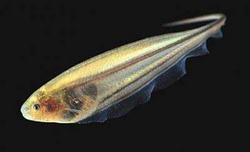
Glass Knifefish (Eigenmannia virescens)

The Glass Knifefish or Eigenmannia virescens is clear freshwater fish that originated from South America.  Even though these fish can grow to about 1-1/2' long, they are still kept in large aquariums.  One over 100 gallons is recommended with the following water conditions, 73-82° F, KH 2-15 and pH 6.0-7.0.  These fish lack dorsal fins and are quite the sight to be seen when swimming.  You can see for yourself in the video below...
     

Glass Knifefish are peaceful fish that prefer a low light aquarium with plenty of hiding places and plants.  Also known as the Green Knifefish, they sometimes have a very slight green tint.  Like other Knifefish, they have the ability to emit a weak electrical signal from one of their organs that helps them maneuver in the dark.  As you can imagine, this means that they are very active during the night more so than the daylight hours.  They also use this weak electrical current during courtship.    
You can keep mulitple Glass Knifefish in the same tank, they will get along just fine and will even breed in an aquarium setting.  These fish will often lay their eggs on plants.  Once the fry hatches you should switch them into another tank.  


The Glass Knifefish is an omnivore that can be fed tubifex, pellets, flakes, shrimp and other live and frozen foods.
Photo Credit: Kirk, Fortune, Roth, (c) 2007
Eigenmannia virescens


Swellshark (Cephaloscyllium ventriosum)

The Swellshark or Cephaloscyllium ventriosum is a Catshark with the amazing ability to inflate its body to twice its size, much like the Pufferfish. This helps them from falling prey to seals and other sharks that want to make a quick meal of these small saltwater fish.
Swellsharks only grow to about 39" (100cm) in length and are one of the smallest sharks in the world. These sharks are from the Scyliorhinidae family, and are normally found in the subtropical waters of the eastern Pacific Ocean. They have been spotted as deep as 460 meter down. The look of the Swellshark makes it easily confused with the Leopard Shark, because they both have distinctive spots, but the Leopard Shark grows much longer to almost 8'. Younger Swellsharks will also tend to be a bit lighter in color then their more mature counterparts.
This species of shark is nocturnal, spending most of the day sleeping in continental shelves. At night they become active and hunt for small bony fish, crustaceans and mollusks. Like many other sharks, the Swellshark is oviparous. The female with lay her egg sacks and attached it to a reef. The embryo will feed on the egg yoke for 7-12 months before hatching! You can see the Swellshark with your own eyes underwater in the video below...

If you have any additional information about the Swellshark please share!

Glass Eye Squirrelfish (Heteropriacanthus cruentatus)

The Glass Eye Squirrelfish or Heteropriacanthus cruentatus is a strange looking saltwater fish that was fish discovered in Hawaii. It has very larges eyes which it uses to hunt in the cover of darkness. This fish has a color changing body that becomes brighter as it grows older. When this species of Squirrelfish is young its body is covered by brown and red patches. As the fish ages they become a striking solid bright red.

Glass Eye Squirrelfish are sometimes called Blotched Bigeyes and can be kept in a saltwater aquarium. A tank of at least 80 gallons is recommended because this fish can grow to about 1' in length, and therefore requires plenty of swimming room. Live rock is also recommended with the following water conditions, 72-78° F, dKH 8-12, pH 8.1-8.4 and sg 1.020-1.025.This fish is nocturnal and will normally hide when the lights are on. For this reason, you should provide your fish with hiding spots to rest in during the day. When you feed them try to use serpent stars, crustaceans, freeze dried shrimp and worms. You can also use live feeder shrimp as a nice treat or to get them to eat when you first receive your fish.

If you have an tips for keeping a Glass Eye Squirrelfish please share!

Western Blue Devil (Paraplesiops meleagris)

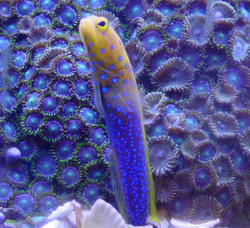
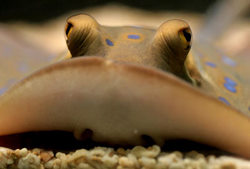
The Western Blue Devil or Paraplesiops meleagris is a saltwater fish that is found around Australia, normally in or around reefs/caves. This fish has very large eyes with light blue spots that cover its entire body. There is also a bit of light blue that can be found on their fins and tail. They have elongated pelvic, anal and dorsal fins, which gives them the look of a Betta fish. Because this fish is so hard to find, the Western Blue Devil is one very expensive fish to house in an aquarium setting.If you have got the money burning a hole in your pocket though this fish requires an aquarium of at least 70 gallons with the following water conditions, dKH 8-12, pH 8.1-8.4, sg 1.020-1.025 and 64-72° F. This fish is quite large for an aquarium, growing to just over 1' in length. As you can see the Western Blue Devil body becomes more blue as it grows older. It can also be quite territorial, so it should be kept alone in a tank or with others similar fish in a very large aquarium. You can check out the Western Blue Devil underwater in its natural habitat in the video below...

Also known as the Blue Betta, these fish are nocturnal and like to have a few hiding spots during the days to hide from the bright lights. As you can imagine they become much more active at night. Western Blue Devils are carnivores that should be fed a variety of meaty foods including feeder shrimp.

European Flounder (Platichthys flesus)

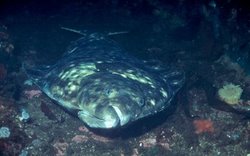
The European Flounder or Platichthys flesus is just one of the five different species of Flounder. This flatfish is known best for its delicious flavor and strange appearance. The European Flounder can actually change its color to match its surroundings. This along with the fact that this salt water fish is very slim, and often found on the bottom makes the Flounder one hard fish to spot.European Flounder are found in the Northern European coastal waters and are oval in shape and usually right-eyed. When the European Flounder is first born they have an eye on each side of its head, but as they grow older one eye migrates to the other side of their bodies. This makes the eyes face upwards which helps them spot potential prey swimming by. They can grow to about 50cm in maximum length (20 inches) and weight of 2.7 kg (6 pounds). When not blending into their surroundings they are a brownish coloration with a white underbelly.The European Flounder can survive in brackish waters with soft bottom. They will often burrow into the bottom and lie and wait for an easy unsuspecting meal to swim by. They are nocturnal, feeding often under the cover of darkness. Spawning for the European Flounder occurs during the months of February through June. You can check out the European Flounder underwater in the video below...

If you have any additional information about the European Flounder including recipes or fishing tips please let us know.

Aquarium Fish Of The Month - Spotted Cardinalfish


Still Can't Find The Fish You Are Looking For? Search For It Below Or Send Us An E-Mail!

Fish Index Followers