Find Your Fish

Showing posts with label Bass. Show all posts

Kelp Bass (Paralabrax clathratus)

The Kelp Bass or Paralabrax clathratus is a saltwater fish that is found in the eastern North Pacific Ocean. This fish is also called the Calico Bass, and is found in and around kelp beds. They are also seen in rocky, shallow waters.  You can check out the Calico Bass in action in the video below.

Kelp Bass can reach lengths of about 28-1/2" (72cm), and can live to be about 34 years old. These fish are quite edible and are also fun to catch, with a decent fight for their size. This fish will feed on crustaceans, squid and small fish. They will spawn in the warmer summer months in deep water. Once the babies are developed they will take shelter in the kelp. They are known to become quite territorial while spawning and there are even a few storied of these fish biting humans.
If you have any additional information about the Kelp Bass please leave us a comment below.

White Perch (Morone americana)

The White Perch or Morone americana is a species of freshwater fish that is sometimes referred to as the Silver Perch. Even though this fish is called a perch, it doesn't belong to the same family as the Yellow Perch, and is actually closer to a Bass. This fish is medium sized only growing to about 20" in maximum length and weighing in at nearly 5lbs.

White Perch have large scales and a white underbelly with a gray-green coloration on its back and sides that fades to a silver as you move downward. As you can see in the pictures this fish has a serious dorsal spines so be careful when handling them.   They are found in freshwater as well as brackish waters in places like Maine, and other coastal areas.

White Perch are known to eat small Walleye, Yellow Perch, minnows and fish eggs. They can reproduce rather quickly, with the female producing 140,000 eggs in a single spawning session. These eggs will hatch in about a week.

In some places White Perch are loved for their great fight and tasty meat, but other places they are looked upon as a nuisance that destroys other species by their quick breeding and appetite for small fish and eggs.  The have been discovered in the Great Lakes and are thought to cause serious troubles for the Walleye population.  

If you have any additional information about the White Perch please leave us a comment below...

Butterfly Peacock Bass (Cichla ocellaris)


The Butterfly Peacock Bass or Cichla ocellaris is a freshwater fish that is considered to be one of the strongest pound for pound fighters in the world!  Like the Smallmouth and Largemouth Bass, these fish strike hard and have a never say die attitude!  Despite their name these fish are actually Cichlids, not Bass, and are just one of the several species of Peacock Bass.   

Also known as the Peacock Cichlid, Tuncunare and Mariposa these fish have been introduced in Hawaii as well as Florida, Panama, Guam, the Dominican Republic and Puerto Rico.  Their coloration can vary quite a bit, but they are generally a yellowish green with three dark blotches.  When breeding, much like many species of Salmon, they develop a hump on the backs of the males.   You can check out this beautiful species as well as their fry in the video below...

These fish are not the biggest, but make up for that with their fight.  The record Butterfly Peacock Bass was 12lbs 9oz and was caught in Venezuela.  If you have any fishing tips please share!

Guadalupe Bass (Micropterus treculii)


The Guadalupe Bass or Micropterus treculii is a freshwater fish that is often found in flowing waters almost exclusively in the state of Texas where it is the official state fish.  Also known as the Black Bass, this fish is green in color and can be differentiated from its close relative the Smallmouth Bass by the lack of vertical bars across its body.  You can tell the difference between this fish and the Largemouth Bass by its jaw.  The jaw of the Guadalupe Bass doesn't extend beyond the eyes like the Largemouth Bass.  It can be particularly tricky to tell the difference between the Spotted Bass.  Just watch the coloration, the Guadalupe Bass's colors extend much lower on their bodies than the color of the Spotted Bass.

This species of Bass does not grow very large because of their habitat.  Often caught in small streams these fish can only grow to about 4lbs.  They reproduce rather quickly though, becoming sexually mature at just one year old.  Guadalupe Bass will spawn in the months of March through June.  Building a gravel nest, they will lay up to 9,000 eggs in shallow waters. The males will keep guard of the nest until the eggs hatch.  You can see the Guadalupe Bass underwater in the video below...    


If you have any additional information or questions about the Guadalupe Bass please leave us a comment!


White Bass (Morone chrysops)

The White Bass or (Morone chrysops) is also called the Sand Bass, Barfish, Streaker and Silver Bass. It is found in freshwater lakes and rivers in the United States. This fish can be identified by its narrow dark incomplete stripes running horizontally down its body. It has white sides and underbelly, while its back is much darker. They are not related to the Largemouth Bass or the Rock Bass, which are part of the Centrarchidae family. You can learn more about White Bass in the video below...

White Bass look very similar to Striped Bass, but can be differentiated by the fact that they only have one sharp point on their gill covers and one tooth patch, where the Striped Bass has two of each. They are also very quick growers and only live to about 4 years old maximum.

White Bass grow to about 18" in maximum length and weigh up to 6lbs. They are fished for in many places in the United States including Virginia, Texas, The Great Lakes, and the Mississippi and Ohio Rivers. This fish is also the state fish of Oklahoma.If you are fishing for White Bass remember that they travel in schools, so if you catch one chances are that there are more. Popular lures include spoons and spinners, as well as bottom fishing with live bait at night. Like other Bass, they provide one of the best fights pound for pound and are good to eat as well.

Do you have any fishing tips for the White Bass? Share your expertise in the comments below...

Spotted Bass (Micropterus punctulatus)

The Spotted Bass or Micropterus punctulatus is often confused with the much more common Largemouth Bass. Their bodies and coloration are similar, but the Spotted Bass can be distinguished by its smaller mouth, and a rough patch of teeth on the tongue.  A sure way to tell the difference between the two though is the fact that the Spotted Bass's mouth DOES NOT extend past it's eye like the Largemouth Bass. Also known as the Kentucky Bass, Spotty, Leeman and Spots, they also tend to have more spots on their bodies than the Largemouth. 

This freshwater fish is from the Sunfish family of Centrarchidae.  This species of Bass is only found in a few places in the world including the Mississippi River Basin, Texas, Florida, North Carolina, Virginia and they have also been introduced in Southern Africa. The Spotted Bass prefers waters with rocky bottoms where they feed on insects, small fish, frogs, worms and crustaceans.
Spotted Bass can grow to about 25" (64 cm), and weigh in at about 10lbs (4.6kg). They are not a very long-lived fish, only living to about 7 years max. When they reach sexual maturity at around three or four, the female will lay between 1,150 and 47,000 eggs. After this, the male Spotted Bass will guard the eggs for about 4 weeks to ensure that nothing eats the young fry. If you are fishing for Spotted Bass be ready for their fight which is said to rival it's close relative the Smallmouth Bass!

If you have any fishing tips or recipes about the Spotted Bass please leave them in the comments below...

Rock Bass (Ambloplites rupestris)

There are actually three different kinds of Rock Bass, Ambloplites rupestris, Ambloplites Ariommus and Ambloplites Constellatus. A Rock Bass is often confused as a Smallmouth Bass due to its similar coloration and habitat. They are small, only about 10" in length fully grown. This freshwater fish is found in lakes throughout the United States and Canada and is also referred to as the rock perch or goggle-eye. Living to about 10 years, this fish is often found right under floating docks and seem to have no real fear of humans like most other sensible fish. Rock Bash are edible, but are not considered to be very good when compared to Bluegill or Perch. The Rock Bass is a carnivore that feeds on smaller fish and insects. They have the unique ability to change their skin tones to blend in with their surroundings, this is one of the reasons why they are so widespread through Canada and The United States. In the spring, Rock Bass moves to very shallow water to spawn. The Males build circular nests of about 8-10 inches in diameter much like the Bluegill by fanning out debris with their fins. A female will then release only a few eggs at a time, which the male fertilizes. Spawning may last as long as an hour. Females leave the nest immediately after spawning, but males remain to guard the eggs. Hatching occurs within about 3-4 days.

Smallmouth Bass


The Smallmouth Bass or Micropterus dolomieui is one of the best pound for pound fighters in the world. It is also called the Bronzeback, Brown Bass, or Bronze Bass and is sometimes confused with the Largemouth Bass.  This freshwater fish is found throughout North America and is a extremely popular sporting fish, known for its jumping ability and never say die attitude.  They get their name from the fact that the rear end of the lower jaw does not extend past its eye unlike that of the Largemouth.The Smallmouth Bass is often found in rocky areas or other locations where it can lay in cover. It prefers temperature that are cooler than that of the Largemouth Bass. This fish feeds on smaller fish, crayfish and unlucky insects trapped on the waters surface. Not only is the Smallmouth Bass a great catch, but it is very tasty too! Most people considered it to be much better than the bigger Largemouth Bass. The Smallmouth Bass can live up to 13 years and the largest Smallmouth ever caught was 11lbs 5oz! I bet that was one hell of a fight.  If you have any Smallmouth tips or recipes feel free to leave us a comment.


Largemouth Bass

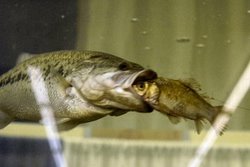
The Largemouth Bass or Micropterus salmoides is one of the most popular sporting fish in North America. These fish go by a few different names including the Green Bass, Oswego Bass, Black Bass, and the Green Trout just to name a few.  They feed on crayfish, sunfish, aquatic insects, frogs and other small freshwater fish. In the picture above they are feeding on a Rock Bass. Most of the time you won't find these type of fish over 20 feet below the surface, so they tend to be fairly easy for fishermen to hook. Catching them is another story, they are known as great fighters! They reach around 40" in maximum length and weigh up to 26lbs. The Largemouth Bass can only live into their early 20's. This fish is found in ponds, lakes and reservoirs throughout Southern Canada and The United States. Unlike the Smallmouth Bass, the Largemouth prefers swallower, warmer water. You can check out the Largemouth Bass underwater in the video below...

Largemouth Bass will spawn in the late winter to early spring or once the water temperatures reach about 60F.  Male Largemouth will make up a nest for the female in waters from 1' to 4' deep.  Once the female lays her eggs she leaves and the male stays to guard the nest. 

Any fishing tips? Leave them below...

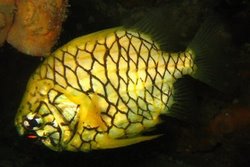
Aquarium Fish Of The Month - Spotted Cardinalfish


Still Can't Find The Fish You Are Looking For? Search For It Below Or Send Us An E-Mail!

Fish Index Followers