
Find Your Fish

Showing posts with label Carnivorous. Show all posts

Broadnose Sevengill Shark (Notorynchus cepedianus)


The Broadnose Sevengill Shark or Notorynchus cepedianus is part of the Hexanchidae family and gets its name from the seven gill slits along the sides of its head. Most sharks have only five gill slits, with the exception of a very small few with six. This species of saltwater fish can grow to about 9-1/2 feet (2.9 meters) and has a large, thick body, with a broad head and blunt snout. Their teeth are jagged on top, with comb-shaped teeth on the bottom. The body and fins have small white and black spots scattered throughout.

Like many other species of sharks, the sevengill is counter-shaded which means its dorsal surface is silver-gray to brown in order to blend with the dark water and substrate when viewed from above. In contrast, its ventral surface is very pale, blending with the sunlit water when viewed from below. These sharks are ovoviviparous and can give birth to over 80 pups in a single litter! Broadnose Sevengill Sharks are not picky eaters and will feed on smaller sharks and fish, rays, chimaeras, cetaceans, pinnipeds and carrion.

You can swim with the Broadnose Sevengill Shark in the video below.


If you have any additional information about the Broadnose Sevengill Shark please leave us a comment below.

Black Piranha (The Fish With The Most Powerful Bite)


The Black Piranha or Serrasalmus rhombeus is a freshwater fish found in the Amazon and Orinoco river basins in South America.  This predator is known for its amazing bite!  In fact, the Black Piranha has the most powerful bite of any animal in history, even a T-Rex!  Their highly developed jaw muscles allow the black piranha to exert bite force equivalent to 30 times its bodyweight!  This is more then the Great White Shark and even more then it's prehistory cousin the Megalodon!  You can check out their powerful bite in the video below.   


Black Piranhas are light colored when they are young with black spots, but as they mature their bodies turn black and their eyes turn red.  This fish does is not a swarm hunter like is close relative the Red-bellied Piranhas, but it is still considered to be a dangerous fish.

They are sometime kept in an aquarium of at least 100 gallons and can grow to about 16" in length.  Dim lighting is said to make the Piranha feel at home.  As you can imagine they are a carnivore that needs plenty of live foods. 

If you have any additional information about the Black Piranha please leave us a comment below.


Cyclops Shark (Carcharhinus obscurus)

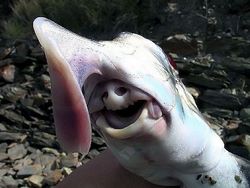
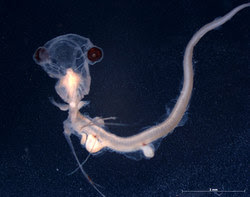
Like something out of a science-fiction film this first photo is from the fetus of a Dusky Shark or Carcharhinus obscurus. This species is actually rather common is oceans worldwide, but rare one-eyed versions of this shark have popped up in several places in the world including Mexico.  Please watch the video below for more information.

It is thought that this these Cyclops Sharks don't live very long in the wild and that is why they are almost never seen.

Adult Dusky Sharks can grow to 4.2 m (14 ft) in length and weight in at 347 kg (765 lbs). They are often caught by fisherman and used it shark fin soup and also for their skin and liver oil.  Unfortunately their slow reproductive rate makes them very susceptible to overfishing. 

If you have any additional information about the Cyclops Shark please leave us a comment below.


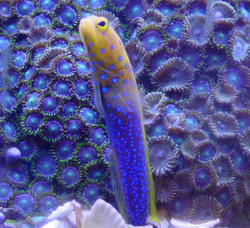
Clown Goby (Gobiodon atrangulatus)

The Green Clown Goby or Gobiodon atrangulatus is a true guardian of the ocean. This saltwater fish bodyguard has been known to come to the aid of a certain type of coral. The coral will emit a chemical when under attack by the killer seaweed Chlorodesmis fastigiata. Within minutes these Clown Gobys will start biting away at the encroaching seaweed, saving the coral from the fast growing seaweed. 

This species of Goby is also kept in an aquarium setting. They are considered to be very easy to care for and can live under the following water conditions, 72-78° F, dKH 8-12, pH 8.1-8.4, sg 1.020-1.025. Growing to just under 2", an aquarium of 10 gallons or more is acceptable. They are carnivores that can eat brine shrimp, table shrimp and other frozen meaty foods. Also known as the Earspot Coral Goby, Green Gumdrop Goby or Green Clown Goby, they are found in the Indo-Pacific in and around coral reefs.  You can check out the Clown Goby in the video below.

If you have any additional information about The Clown Goby please leave us a comment below.

Electric ray (Narcine brasiliensis)


The Electric Ray or Narcine brasiliensis has gray elongated spots with dark brown coloration in the dorsal region and a white belly. They measure on average 34cm (13") in width and 1 kg(2lbs), but can reach 54cm (21") in width, and total weight of 5kg (11lbs). These saltwater fish occur in tropical and temperate waters of the Western Atlantic. These animals are benthic and live in coastal waters with sandy or muddy bottoms.

Electric Rays will bury themselves in the substrate with only their eyes out waiting for unsuspecting prey to wander by.  They are nocturnal, carnivorous and viviparous.  As a defense they can release an electrical discharge from 14 to 37 volts, which is also used to communicate between individuals of the same species.  It is also used as a kind of radar much like the Hammerhead Shark to find prey in the murky waters.  You can check out an Electric Ray in the video below.

If you have any additional information about the Electric Ray please leave us a comment below.

Courtesy of Ellano J. Silva - Fisheries engineering student (UFERSA- Brazil)

Majestic Snapper (Symphorichthys spilurus)

The Majestic Snapper or Symphorichthys spilurus is a beautiful saltwater fish from the Lutjanidae family of Snappers.  They can be easily identified by their extremely long dorsal and anal fins.  They also have horizontal blue and yellow stripes that run down their bodies.  Another distinguishing characteristic of this species of Snapper is a black blotch that is found near their tail and two black bars crossing their heads.
Majestic Snappers are found in the Pacific ocean and can grow to about 12" in length.  They make a very good aquarium fish due to their peaceful temperament and brightly colored bodies.  Like other Snappers, they are carnivores that should be fed a variety of meaty foods. These fish are very fast growers and should be kept in a large aquarium of at least 180 gallons.  They are also known as Hifin Snapper, Blue-lined Sea Bream and the Sailfin Snapper.  You can check out the Majestic Snapper in the Pacific Ocean in the video below.


If you have any additional information about the Majestic Snapper please leave us a comment below.

Sabre-toothed Blenny (Aspidontus taeniatus)

The Sabre-toothed Blenny or Aspidontus taeniatus is the trickster of salt water fish. This species of Blenny will actually mimic the "dance" of the Cleanerfish or Cleaner Wrasse which is a fish that will clean parasites and scales of other fish from their underbellies. When the Sabre-tooth Blenny gets it unsuspecting victim to expose their underbelly it will will attack with its sharp teeth and then run away as if to just teach a lesson not to trust other fish. This odd trait gives them the nickname False Cleanerfish and Cleaner Mimic. You can check out the Sabre-tooth Blenny attacking a Yellow Tang in the video below.

As you can imagine this fish should only be kept in a solitary tank. It can be distinguished from the Cleanerfish from its shark like mouth. They are found in the Indo-Pacific Oceans and can grow to about 4" (100mm).

If you have any additional information about the Sabre-tooth Blenny please leave us a comment below.

Flashlight Fish (Anomalops katoptron)

The Flashlight Fish or Anomalops katoptron gets its name from its glowing smile that is cause by bio-luminescent bacteria in organs below each eye. This glow will often be white, but will also turn a blue or yellowish coloration depending on the fish. The Flashlight Fish actually has the ability to turn this light on and off when needed! They will use their light to attract prey, to communicate with one another, and to cause a diversion for potential predators. This remarkable attribute makes this saltwater fish a favorite for advanced aquarium owners.
Also known as the Lantern Fish and the Twofin Flashlight Fish they have a black body with a blueish tint on their caudal and dorsal fins. Growing to about 9" in length, this fish requires an aquarium of at least 125 gallons with the following water conditions, 72-78° F, dKH 8-12, pH 8.1-8.4, sg 1.020-1.025. They can be kept with other nocturnal fish including Pinecone Fish, Squirrelfish and Cardinalfish. They need plenty of hiding spaces and low lighting to set the mood.  You can check out the Flashlight Fish underwater in the video below.


If you have any additional information about the Flashlight Fish please leave us a comment below.

Cocinero (Caranx vinctus)

The Cocinero or Caranx vinctus is relatively small saltwater fish from the Jack Family (Carangidae). Sometimes referred to as the Barred Jack or Striped Jack, this fish is found in the tropical waters of the eastern Pacific Ocean in coastal waters.

Cocinero fish can be identified by the 8 or 9 dark stripes that run along their sides. Theses fish can grow to about 15" (38cm) in length. They are carnivores that prey on smaller fish and crustaceans.

Cocinero are considered to be a great fish to eat in South America and are served fresh, dried or salted and caught with nets and spears.  If you have any additional information about the Cocinero please leave us a comment below.

Queensland Lungfish (Neoceratodus forsteri)

The Queensland lungfish or Neoceratodus forsteri is one of the eight remaining species of Lungfish on the planet.  Like other Lungfish it has the ability to survive outside of water for days.  Not quite as impressive as the African Lungfish which can survive outside of water for years!

Also known as the Australian lungfish, Dala, Burnett salmon or the Barramunda, this ancient freshwater fish is the last surviving member of the family Ceratodontidae and order Ceratodontiformes. These fish are found exclusively in the following river systems, Mary, Burnett, Albert, Brisbane, Coomera and the Stanley rivers.

Queensland Lungfish can grow to about 5' in length and can weigh as much as 95lbs with females tending to be a bit larger then their male counterparts. If you manage to catch one of these fish you will notice that they are covered in a slime when they are out of the water.

Like other Lungfish this fish actually has to ability to breath air from the surface when the water levels become low or with poor oxygen levels, often during the dry season. This odd characteristic makes them a favorite in an aquarium setting where they can be fed earthworms, frogs and other kinds of meat to feed their carnivorous appetite.  You can learn more about the Queensland Lungfish in the videos below... 


If you have any additional information about the Queensland Lungfish please leave us a comment below.

Tassled Scorpionfish (Scorpaenopsis oxycephala)

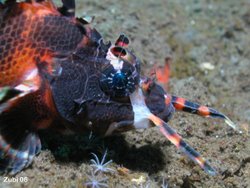
 The Tassled Scorpionfish or Scorpaenopsis oxycephala is a dangerous saltwater fish that is found in the Indian and Pacific oceans. This carnivorous fish has venomous spines that will cause serious pain to the unsuspecting victim that may step on them. This fish are often found in shallow waters in and around reefs.

Tassled Scorpionfish is just one of the over 100 different species of Scorpionfish. This particular species grows to about 14" (36 cm) and can vary in coloration a great deal depending on it surroundings. This fish will have "tassles" or beards below their jaws, hence their name. They mainly feed on smaller fish and crustaceans. This fish will feed by opening its mouth wide and using their gills to create a suction that literally sucks the fish right into their mouths. They will lie in wait on the bottom for an unsuspecting fish to swim to close and then snatch them up with amazing speed.

If you have any additional information about the Tassled Scorpionfish please leave us a comment or watch the Tassled Scorpionfish and other amazing creatures in the video below...


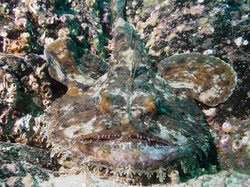
Crocodilefish (Cymbacephalus beauforti)

The Crocodilefish or Cymbacephalus beauforti is a very odd saltwater fish that gets it name from its crocodile like appearance as you can see in the pictures.  Also known as the Crocodile Flathead, and the De Beaufort's Flathead, these fish are members of the Scorpaeniformes order which makes them close relatives to Stonefish and Scorpionfish.  These strange creatures are often found on the muddy bottom in the Western Pacific in places like Indonesia, the Philippines and around the Great Barrier Reef as well.
Crocodilefish are green or grey in color with blotches that help them look nearly invisible on the ocean floor.  Like the Stonefish, this fish is an ambush predator that lies in wait, when an unsuspecting fish or crustacean wanders by it gobbles it up with impressive speed.  Lucky for us these fish are not very large only growing to about 20" (50cm) in length.
You can check out the Crocodilefish in action in the video below... 

If you have any questions or additional information about the Crocodilefish leave us a comment!

Weeksii Bichir (Polypterus weeksii)

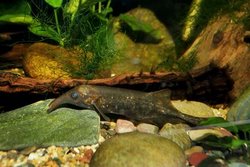
The Weeksii Bichir or Polypterus weeksii is a rather odd looking creature that looks more like a snake than a freshwater fish.  Originating in the Congo in Africa, this fish from the Polypteridae family has since made its way into the aquarium trade.  As you can see in the pictures, they have a large head and black banding on their bodies.   
Also known as the Mottled Bicher and the Fatheaded Bicher, this fish has a long skinny body that can reach lengths of over 1-1/2'.  Like the Snakehead and the African Lungfish, the Weeksii Bichir has the ability to survive OUTSIDE of water for short periods of time.  Even though they aren't the prettiest fish to look at, many people still keep them as pets.  An aquarium of at least 70 gallons is recommended with the following water conditions, 77-83° F, KH 1-12 and pH 6.5-7.5.  Make sure you have a nice tight lid and plenty of hiding spots or caves.  Weeksii Bichir are carnivorous fish that should be fed live feeder fish as well as other meaty foods including beef heart.   You can see these fish in an aquarium setting in the video below...

If you have any additional information or questions about the Weeksii Bichir please leave us a comment.

Aquarium Fish Of The Month - Spotted Cardinalfish


Still Can't Find The Fish You Are Looking For? Search For It Below Or Send Us An E-Mail!

Fish Index Followers