Welcome To The Fish Index! We Are Maintaining A Growing Encyclopedia Of Fish Species Listed From A-Z! Choose From Our Categories Or Browse The Fish Featured Along The Sides By Clicking Their Pictures. Each Fish Includes Detailed Information, Pictures, Video And User Comments! With Over 30,000 Different Species In The World, Our Team Of Fish Experts Are Constantly Being Challenged To Discover New Species. Sample "The Fish Of The Day" Or Browse Our Impressive Selection Of Aquarium Fish!
Don't forget to Like Us On Facebook!
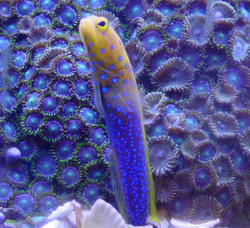
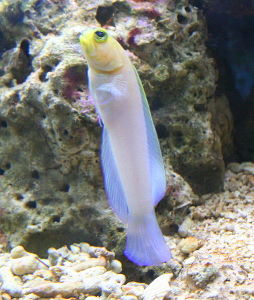
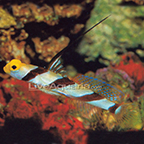
The Yellow Watchman Goby or Cryptocentrus cinctus is a very entertaining aquarium fish. Like it's close relative the Hi Fin Red Banded Goby, this species can have a symbiotic relationship with a Pistol Shrimp. The Pistol Shrimp will spend the day hard at work burrowing a hole in which the Yellow Watchman Goby and the shrimp live together in harmony. Pistol Shrimp have terrible eyesight, so the Watchman Goby's job is to stand watch at the end of the hole, keeping an eye out for any potential predators. If a predator happens to get too close the Watchmen will signal the pistol shrimp and they will both going into hiding. At night, the Goby will go into the burrow, and the shrimp will collapse the entrance to close it off, apparently three is a crowd in this relationship. The next day they start the whole process over again. These two creatures have even been known to share food with each other! You can see this amazing relationship in the video below.
Yellow Watchman Goby have several different names including Yellow Prawn Goby, Yellow Shrimp, Prawn Goby, Midas Goby, Iga Tubumata, Watchman Gold, and Yellow Spotted Blenny. These saltwater fish are native to the Western Pacific Ocean. In an aquarium the following water conditions are acceptable, 72-78° F, dKH 8-12, pH 8.1-8.4, sg 1.020-1.025. They are considered to be a peaceful fish, but can become territorial with other species of Gobies. Growing to only about 3" in length, an aquarium of 30 gallons or more is acceptable. They are carnivorous and should be fed a variety of mysis shrimp, brine shrimp, table shrimp, and other frozen meaty treats.
If you have any additional information about the Yellow Watchman Goby please leave us a comment below.
The Green Clown Goby or Gobiodon atrangulatus is a true guardian of the ocean. This saltwater fish bodyguard has been known to come to the aid of a certain type of coral. The coral will emit a chemical when under attack by the killer seaweed Chlorodesmis fastigiata. Within minutes these Clown Gobys will start biting away at the encroaching seaweed, saving the coral from the fast growing seaweed.
This species of Goby is also kept in an aquarium setting. They are considered to be very easy to care for and can live under the following water conditions, 72-78° F, dKH 8-12, pH 8.1-8.4, sg 1.020-1.025. Growing to just under 2", an aquarium of 10 gallons or more is acceptable. They are carnivores that can eat brine shrimp, table shrimp and other frozen meaty foods.
Also known as the Earspot Coral Goby, Green Gumdrop Goby or Green Clown Goby, they are found in the Indo-Pacific in and around coral reefs. You can check out the Clown Goby in the video below.
If you have any additional information about The Clown Goby please leave us a comment below.
The Round Goby or Neogobius melanostomus is a freshwater fish that is found in Lakes Michigan, Huron, Erie and Superior in the state of Michigan but originated in Europe. This fish has a gray body with blotches of black and brown scattered across it. Round Goby are not very large only growing to about 10 to 25 cm in length. As Round Goby grow they will eat a variety of foods including small fish, eggs, insect larvae, zebra mussels and clams.
These fish are often confused with Sculpins, but can be differentiated by their pelvic fin. The Round Goby has a fused pelvic fin, while Sculpins have a split pelvic fin. Like other Gobies they can reproduce quickly, producing about 5,000 eggs multiple times throughout the summer months. Male Round Goby will guard the nest fanning the eggs to keep them oxygenated and protecting them from potential predators. Their quick reproduction rate combined with the fact that they can survive in brackish and low quality water makes them an invasive species. You can check out a bunch of Round Goby fish attacking a Smallmouth Bass nest in the video below...
If you have any additional information about the Round Roby please leave us a comment below...
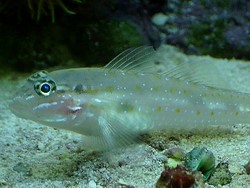
The Cave Transparent Goby or Coryphopterus glaucofrenum is a saltwater fish that makes a great addition to most aquariums. This fish is considered to be very easy to take care of, and is certainly interesting to watch. As you can imagine with a name like the Cave Transparent Goby, this fish has a body that is partially transparent, along with a series of orange spots that cover its entire body including its head, fins and tail.
This species of Goby is native to Maldives, where it is found around reefs. In an aquarium setting this fish only requires about a 10 gallon tank with the following water conditions, 72-78° F, dKH 8-12, pH 8.1-8.4, sg 1.020-1.025. Like most other Gobies, this fish is quite small, only growing to about 3" in maximum length. Make sure you don't keep similar Gobies in the same tank unless they have plenty of room. They will attack each other if not given enough space. These fish should be fed brine shrimp, table shrimp, mysis shrimp and other frozen meaty foods. If you provide them with branching coral you don't need to feed them quite as much. Cave Transparent Goby fish are known to spawn in an aquarium setting. Giving them a cave will increase your chances of success. This saltwater fish will lay its eggs on the ceiling of the cave and before you know it, you will have little Cave Transparent Gobies swimming around.
If you have any additional care tips for the Cave Transparent Goby please leave us a comment below.
The Jeweled Goby Cichlid or Tanganicodus irsacae is a very easy to care for aquatic pet. This combined with the fact that they have a unique body that is covered with blue spots, along with a few stripes makes them a perfect starter fish for a freshwater aquarium. The eyes on this fish are large, and set towards the top of their head giving them a "cute" appearance. They have a smaller than normal swim bladder which makes them have a funny way of swimming. Very fun to watch!
Also known as the Spotfin Goby Cichlid, this is just one of the many species of Cichlid that comes from a place in Africa called Lake Tanganyika. Kept in an aquarium of 40 gallons or more the Jeweled Goby Cichlid should bring given many hiding places, especially if they are kept with other fish. This fish is not considered to be overly aggressive, but they can be territorial if not given enough room to swim. They are often found near the bottom of the aquarium, so mixing them with some top level or mid level aquarium fish shouldn't be too much of a problem. This Goby will only grow to about 2-1/2" in maximum length which makes it one of the smallest of the Gobys. The Jeweled Goby Cichlid is an omnivore that prefers a water temperature of 72-82° F, KH 12-20, and a PH level of 8.0-9.0. If you manage to get this species of Cichlid to spawn you will notice that they are mouth brooders which simple means that the females carry their eggs in their mouths until hatching. After this the males will actually protect them in his mouth while they are very small. What makes them a bit different from other Cichlids is the fact that they are completely monogamous which means that they stay with the same mate. Once the fry hatch they can be fed brine shrimp along with flake foods. As they grow older you should feed them vegetable flake food along with meaty foods on occasion. You can also but pellets special designed for Cichlids here!
The Sleeper Gold Head Goby or Valenciennea strigata is a saltwater fish with a very colorful fish. It is also known as the Pennant Glider, Golden Head Sleeper, Bluestreak, or the Yellowheaded Sleeper Goby. These fish have a white body with a yellow head and a stunning blue stripe directly below it eye. They only grow to about 6" in maximum length.
Their striking appearance makes this species a very popular aquarium fish. Water conditions of 72-78° F, dKH 8-12, pH 8.1-8.4, sg 1.020-1.025 in at least a 60 gallon aquarium is recommended. The Sleeper Gold Head Goby is normally a peaceful fish, but like so many other Gobies they can become aggressive towards other Sleeper Gold Head Gobies.These fish will feed directly off the bottom, sifting through the sandy bottom finding food in the sands. This type of Goby is also said to have the ability to communicate with each other by producing signals with their mouths. Besides this ongoing activity of "chewing" the sand, these gobies can communicate with each other by producing signals with their mouths. In an aquarium setting the Sleeper Gold Head Goby can be fed brine shrimp, black worms, and other meaty food for carnivores. Live sand is highly recommended for these fish as they are constantly sifting the sand looking for their next meal. You can check them out in action in the video below...
In the wild these fish are found in the Western Pacific and Indian Oceans.
The Sirajo Goby or Sicydium plumieri is an amazing freshwater fish that has actually developed the ability to climb steep waterfalls, and even artificial dams! It has a suction cup like pelvic fin that allows it to accomplish these unbelievable acts. These Gobies also have modified ventral fins that helps to move up and down wet surfaces. These fish are quite small, only reaching lengths of 10.9 cm. Like the Salmon, this fish changes color when spawning. The male Sirajo Goby becomes a striking blue color during the mating season. The Sirajo Goby feeds on algae off of rocks found in the streams and rivers it inhabits. These fish are found in places like Cuba, Jamaica, Puerto Rico, Martinique, Guadeloupe, St. Vincent and Barbados.
If you have any other information you would like to share about the Sirajo Goby, please leave it below in the comments...
The Hi Fin Red Banded Goby or Stonogobiops nematodes is a small colorful fish. Sometimes referred to as the Striped Goby, Watchman Goby or Blackray Shrimp Goby this fish can form a strange symbiotic relationship with a Pistol Shrimp. The Pistol Shrimp will spend the day burrowing a hole in which the fish and the shrimp live together. Since the Pistol Shrimp has poor eyesight the Hi Fin Red Banded Goby stands watch for potential predators. At night, the Hi Fin Red Banded Goby will go into the burrow, and the shrimp will collapse the entrance to close it off. The next day they start the whole process over again. These two creatures have even been known to share food with each other! You can see this for yourself in the video below...
This popular saltwater aquarium Goby is normally found in western Indo-pacific. Being that this fish only grows to 2" in length, it will work well in a small tank. This fish will feed on Spirulina, marine algae, mysid shrimp and meaty foods. To purchase this fish just click the picture below...