Find Your Fish

Showing posts with label Cichlid. Show all posts

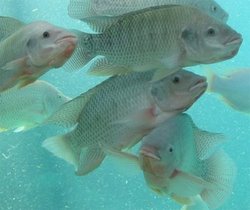
Mozambique Tilapia (Oreochromis mossambicus)


The Mozambique Tilapia or Oreochromis mossambicus is just one of the 100s of different Cichlid species of fish known as Tilapia. This particular species goes by a couple different names including Blue Kurper, Tilapia Kafuensis, Kafue Bream and the Three Spotted Tilapia. This species is native to Southern Africa and is found in many tropical areas around the world, where it is used for aquaculture. Like other Tilapia, they are able to survive in very harsh conditions compared to many other freshwater fish. It can adapt to temperatures below 50 °F (10 °C) and above 100 °F (38 °C), and can also tolerate brackish waters. They also will eat a large variety of foods, which not only makes them a perfect candidate for fish farming, but also difficult to get rid of when introduced to the wrong area.  These fish are considered to be an invasive species in parts of the world where they have been introduced to control mosquitoes.

These fish are not particular large, only grow to about 14" (35cm) in length and weighing in at 2-1/2 lbs (1.13KG). They can live for about 11 years.  Like other species of Cichlids, these fish are mouth brooders, which means that after the eggs are laid and fertilized the female will then scoop them up into her mouth for protection until they hatch.  You can check out the Mozambique Tilapia underwater in the video below.


If you have any additional information about the Mozambique Tilapia please leave us a comment below.


Auratus Cichlid (Melanochromis auratus)


The Auratus Cichlid or Melanochromis auratus is a freshwater fish from Lake Malawi in Africa.  Also known as the Malawi Golden Cichlid, this fish is born a bright yellow color with the juveniles having two black stripes on their sides, and one on their dorsal fin.  As the fish begins to mature these lines will turn more blue.  The males of this species will become black with golden stripes, almost the opposite of their female counterparts.

Auratus Cichlid are often kept in an aquarium setting, but need a lot of room and they can be quite aggressive.  They will accept most aquarium foods and are considered to be quite hardy.

This species of Cichlid is a maternal mouthbrooder, which means that the mother will actually keep the baby fish in her mouth protecting them from potential predators.  The fry will occasionally come out of the mouth, but still stay close to the mother just in case they need to run back in.  This occurs for a period of about 4 weeks.  You can see this mouth brooding in action in the video below.


If you have any additional information about the Auratus Cichlid please leave us a comment below.


Lionhead Cichlid (Steatocranus casuarius)

The Lionhead Cichlid or Steatocranus casuarius is a popular freshwater tropical aquarium fish originally found in Pool Malebo and the Congo River in Africa. This species of Cichlid goes by a few different common names including Blockhead Cichlid, African Blockhead, Buffalohead, Humphead Cichlid, Lionhead, Lumphead and Buffalo Cichlid. As you can see in the pictures, they get their nicknames from the large hump on the top of their heads.  The picture below shows a juvenile Lionhead Cichlid, their heads tend to become more prominent as they grow older.  
Male Lionhead Cichlids can grow to about to about 4 1/2" (11 cm) with the females being a bit smaller in size. When in an aquarium they are said to be found on the bottom and have jerky movement much like that of a Goby. They have a smaller swim bladder then most fish which allows them to stay on the bottom with ease.  You can check them out in an aquarium setting in the video below. 

An aquarium with the following conditions is suitable for the Lionhead Cichlid Hardness: 3 - 17° dH, Ph: 6.0 - 8.0, and Temperatures at 73 - 82 ° F (23 - 28 ° C). These fish are omnivores that should be fed a variety of foods including algae, flake, pellet, live foods and frozen foods. A good trick to keep your water clean is to feed them 2 to 3 times a day in smaller amounts instead of a large quantity once a day.  They normally get a long well with other fish and will be happier if they are provided a few good hiding spots.

If you have any additional information about the Lionhead Cichlid please leave us a comment below.

Butterfly Peacock Bass (Cichla ocellaris)


The Butterfly Peacock Bass or Cichla ocellaris is a freshwater fish that is considered to be one of the strongest pound for pound fighters in the world!  Like the Smallmouth and Largemouth Bass, these fish strike hard and have a never say die attitude!  Despite their name these fish are actually Cichlids, not Bass, and are just one of the several species of Peacock Bass.   

Also known as the Peacock Cichlid, Tuncunare and Mariposa these fish have been introduced in Hawaii as well as Florida, Panama, Guam, the Dominican Republic and Puerto Rico.  Their coloration can vary quite a bit, but they are generally a yellowish green with three dark blotches.  When breeding, much like many species of Salmon, they develop a hump on the backs of the males.   You can check out this beautiful species as well as their fry in the video below...

These fish are not the biggest, but make up for that with their fight.  The record Butterfly Peacock Bass was 12lbs 9oz and was caught in Venezuela.  If you have any fishing tips please share!

Green Terror (Aequidens rivulatus)

The Green Terror or Aequidens rivulatus is one of the most popular cichlid fish in the aquarium trade. This freshwater fish has beautiful blue markings on its face, fins and tail. The male Green Terror generally has a longer tail fin and is outline with red. They can grow to about 8" in maximum length and are peaceful, but can become increasingly ornery as they grow older. As you can see in the picture they also have the distinctive cichlid bump on their heads.

Green Terror fish are not that hard to care for and don't require a huge aquarium, about 50 gallons or so will be fine. Like other cichlid fish, Green Terrors like to have a few hiding spots and a nice sandy bottom. The following water conditions are acceptable, 72-80° F, KH 9-20 and pH 6.5-8.0. If you have live plants watch out they can be dug up by these fish. Simply planted them in pots will avoid this from happening.Green Terrors are very easy to breed in captivity, provide a nice flat rock and the female will lay her eggs. If you remove the fry they will spawn quite often and soon you will have more than you know what to do with. You can check out the Green Terror in an aquarium in the video below...

These fish are omnivores that are not considered to be picky eaters. Freeze-dried bloodworms, tubifex, flake food and Cichlid Pellets work best for these fish. They are quite inexpensive and make a great starter fish!

Blue Peacock Cichlid (Aulonocara nyassae)

The Blue Peacock Cichlid or Aulonocara nyassae is a popular species of Cichlid to keep in an aquarium. These beautiful freshwater fish originate from Lake Malawi in Africa. The male and female Blue Peacock Cichlid are very easy to tell apart, unlike a lot of other fish. The male is bright yellow with metallic blues, while the female is a brown or gray, not nearly as brightly colored. Males will even become brighter when they are spawning. You can check out the Blue Peacock Cichlid's mating ritual in the video below...

If you are thinking of buying a Blue Peacock Cichlid for your aquarium be sure you have one that will house 60 gallons of water or more. This species of Cichlid should be given plenty of hiding spots, as well as rocks and a nice sandy bottom is ideal. The following water conditions are acceptable for this fish, 76-82° F, KH 10-15, and pH 7.8-8.6.
Blue Peacock Cichlids aren't particularly aggressive, but if they are housed with other Cichlids in too small of an aquarium things can get a little testy. If you provide them with a few females per male they will tend to get along better.

When the Blue Peacock Cichlid breeds it will take about three weeks before the fry hatch. Females are mouth brooders, which means that they keep their eggs inside their mouth and can protect the young fry even after they are hatched by allowing them to swim into their mouths for protection. You can feed the young fry crushed flake food and brine shrimp. After they grow larger these carnivores should be fed live and frozen brine shrimp, flake food and Cichlid pellet food. These fish can grow to about 7" when fully grown and can live about 12 years.

Ram Cichlid (Papiliochromis ramirezi)

The Ram or Papiliochromis ramirezi is a species of Cichlid that has many common names including the Blue ram, German Blue Ram, Asian Ram, Butterfly Cichlid, Ramirez's Dwarf Cichlid, Dwarf Butterfly Cichlid and Ramirezi. They have a spiked dorsal fin with brilliant deep blue coloration with bits of pink, red, gold and orange.  These fish are prefect for an aquarium and can only grow to about 3" in length.
Rams are peaceful fish that will get along with most tankmates. If they pair off and mate with another Ram, they will stick with the same mate for all of their lives. Breeding is possible in an aquarium setting.  To encourage spawning you should add peat to the water and provide the female with a flat spot to lay her eggs. Once the fry are hatched both the male and the female participate in mouth brooding.  This means that if they fry are in danger they will stay in the mother or father's mouth.  Once the threat is over they will open their mouths and let them swim out. To check out the Ram Cichlid spawning watch the video below...

If you are thinking of buying a Ram for your aquarium be sure you have the following water conditions, 72-79° F, KH 5-12, and pH 5.0-7.0. This freshwater fish should be kept in an aquarium of at least 25 gallons with plenty of hiding spots, plants and very clean water. This fish can become aggressive if they are not given enough hiding spaces or while they are spawning so be careful. These fish are omnivores that should be fed a variety of foods including bloodworms, brine shrimp, live foods, pellets, and flakes.

Jeweled Goby Cichlid (Tanganicodus irsacae)

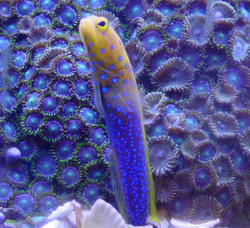
The Jeweled Goby Cichlid or Tanganicodus irsacae is a very easy to care for aquatic pet. This combined with the fact that they have a unique body that is covered with blue spots,  along with a few stripes makes them a perfect starter fish for a freshwater aquarium. The eyes on this fish are large, and set towards the top of their head giving them a "cute" appearance. They have a smaller than normal swim bladder which makes them have a funny way of swimming. Very fun to watch!

Also known as the Spotfin Goby Cichlid, this is just one of the many species of Cichlid that comes from a place in Africa called Lake Tanganyika. Kept in an aquarium of 40 gallons or more the Jeweled Goby Cichlid should bring given many hiding places, especially if they are kept with other fish. This fish is not considered to be overly aggressive, but they can be territorial if not given enough room to swim. They are often found near the bottom of the aquarium, so mixing them with some top level or mid level aquarium fish shouldn't be too much of a problem. This Goby will only grow to about 2-1/2" in maximum length which makes it one of the smallest of the Gobys. The Jeweled Goby Cichlid is an omnivore that prefers a water temperature of 72-82° F, KH 12-20, and a PH level of 8.0-9.0. If you manage to get this species of Cichlid to spawn you will notice that they are mouth brooders which simple means that the females carry their eggs in their mouths until hatching. After this the males will actually protect them in his mouth while they are very small. What makes them a bit different from other Cichlids is the fact that they are completely monogamous which means that they stay with the same mate. Once the fry hatch they can be fed brine shrimp along with flake foods. As they grow older you should feed them vegetable flake food along with meaty foods on occasion. You can also but pellets special designed for Cichlids here!

Convict Cichlid (Amatitlania Nigrofasciata)

The Convict Cichlid or Amatitlania nigrofasciata is an easy fish for beginners. They can be bred in an aquarium setting quite easily as well. Also known as the Zebra Cichlid this species is an omnivore that will accept many different kinds of food including flake food, small fish, insects, worms, plants and algae. You can also feed them specially designed pellets which you can purchase here! Normally these fish are quite calm, but while breeding they can be quite aggressive and should only be kept in pairs.The Convict Cichlid is a smaller fish only growing to about 10cm in length when fully grown. These fish have vertical stripes on their bodies that resemble that of someone in jail, hence the name. Females of this species have more colors in their bodies that include pink or orange in their ventral region and on their dorsal fin. Males are often duller, but will grow a bit larger than the females. Males will also develop lumps on their foreheads like some other Cichlid fish, including its close relative the Frontosa Cichlid. To check out the Convict Cichlid and babies in action watch the video below...

In the wild they are found in Central America from Guatemala to Costa Rica. They are more tolerant to cooler waters about 79-84F is recommended with a PH level of 6.6 - 7.8. If you have more information about the Convict Cichlid that you would like to share please post it in the comments below.

Venustus Cichlid (Nimbochromis venustus)

The Venustus Cichlid or Nimbochromis venustus is a fairly aggressive freshwater cichlid with a blue face and yellow marks on its head and dorsal fin. The female Venustus Cichlid has a bit less coloration then the male and is more silver.
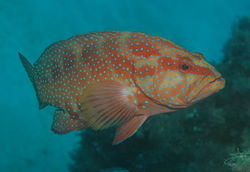
These fish can grow quite large, almost 10" in maximum length so if you are going to house this fish in an aquarium you should have a tank at least 85 gallons. Like most other Cichlids they like lots of hiding spots as well. An aquarium with a sandy aragonite based substrate is recommended as this helps to maintain the high PH and alkalinity that this cichlids require. Water temperatures of 76-82° F and a PH level of 7.8-8.6 is also recommended for these fish.

As you can tell these fish are not the easiest to take care for, they are sensitive to different water conditions so be sure to change the water regularly if you plan on keeping one of these Venustus Cichlid as a pet. Also known as the Giraffe Cichlid this fish can last for over 10 years so make sure you are ready for that kind of commitment as well.
These fish are Mouth Brooders which means that when they spawn the female will keep the eggs inside her mouth until they are hatched. This process normally takes about 3 weeks time. Watch out males of this species can become very aggressive during the spawning season. Make sure to have more females in a tank then males if keeping multiple Venustus Cichlid together.
This fish should be fed a variety of things including bloodworms, small fish, flake and pellet foods and brine shrimp. This fish is an ambush predator, in the wild it will rest itself on the sandy bottom and wait motionless for its prey to swim by. Then with a burst of speed it attacks and makes a meal for itself.
If you have any tips or questions about how to care for your Venustus Cichlid please leave them below in the comments.

Double Full Red Cockatoo Cichlid (Apistogramma cacatuoides)

The Double Full Red Cockatoo Cichlid or Apistogramma cacatuoides has to be one of the fish with the longest names! These fresh water fish are known for their amazing coloration. Red blue and black are almost painted on their dorsal fins and tail. Also known as the Cockatoo Dwarf Cichlid or Big Mouth Apistogramma this Cichlid originates in the streams and rivers of South America. Since then they have become a quite popular aquarium fish.Not the easiest to take care of this fish requires a very good filtration system along with plenty of hiding places. Reaching only about 3-1/2" in maximum length these fish will do well in anything larger than a 40 gallon aquarium. Water temperatures of 72-86° F with a PH level of 5.0-7.0 is acceptable. They are fast growers that should be fed freeze-dried bloodworms, tubifex, flake food, and brine shrimp. There is also some specially designed pellet food available for this Cichlid. The Double Full Red Cockatoo Cichlid is very easy to breed for what I hear.

If you have any tips for keeping these fish in an aquarium setting please comment!


Frontosa Cichlid (Cyphotilapia frontosa)

The Frontosa Cichlid or (Cyphotilapia frontosa) is a small freshwater fish that is considered to be a delicacy in Africa. This carnivorous fish can grow to just over 1' in length and is a popular Cichlid fish to keep as a pet. This is not considered to be a very aggressive fish, but it does require hiding places to live a happy and healthy life. A tank of at least 80 gallons should be used for this large aquarium species. The Frontosa Cichlid should be fed flake food, specially designed Cichlid pellets and freeze-dried ocean plankton or krill. As these fish grow older they will develop a cranial hump (large knob on its head) which makes them easy to identify. This form of Cichlid is very hardy and can live up to 25 years in the right conditions. The Frontosa Cichlid works well in groups of up to 12.

This fish, like other Cichlids is a mouth brooding fish. This means that the mother fish will protect her young by scooping them into her mouth! To see this in amazing fish in action click here!


Hercules Cichlid (Crenicara punctulata)

The Hercules Cichlid or Crenicara punctulata shouldn't really be named after Hercules since it is known to hide in corners and dark places when in an aquarium setting. This species of Cichlid can grow up to 10cm in length. They are native to the upper Amazon and Peru this fish prefers slightly acidic, warm water. The Hercules Cichlid will eat small earthworms, small pieces of beef and regular pellet food. The male of this species is generally more colorful then the female. If you have any care tips for the Hercules Cichlid please share!

Aquarium Fish Of The Month - Spotted Cardinalfish


Still Can't Find The Fish You Are Looking For? Search For It Below Or Send Us An E-Mail!

Fish Index Followers