

Find Your Fish

Showing posts with label Brackish Fish. Show all posts

Leaping Mullet (Liza saliens)


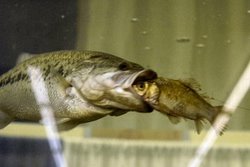
The Leaping Mullet or Liza saliens is a freshwater fish from the Mugilidae family that is found throughout Europe. It can also survive in brackish waters of the Mediterranean Sea, Black Sea, Sea of Azov and the Caspian Sea.  These fish get their names from their ability to jump right out of the water with ease.

The leaping mullet breeds in the summertime months and will produce between five hundred and two thousand eggs at a time. The newly hatched fry will feed on their yolk sac and grow quite quickly. Once they become older they will feed on algae and vegetable matter.  Leaping Mullets can grow to about 40cm in length (16").

If you have any additional information about the Leaping Mullet please leave us a comment below.


Scat (Scatophagus argus)


The Scat fish or Scatophagus argus is one of only four known species in the Scatophagidae family.  This fish has the ability to survive in saltwater, brackish water and freshwater.  Also known as the Spotted Scat and the Argus Fish, they are often kept in an aquarium setting.  Scats have an oblong body that is laterally compressed.  It has a bunch of dark spots on it that become fainter as they grow older.  This fish is greenish brown with younger fish tending to have some red on their fins.   

Scats are found in the Indian and Pacific Oceans and can grow to about 12" (300mm) in length.  In the wild they are scavengers that will eat whatever they can find.  In fact their scientific name actually means excrement eater!  This helps in an aquarium because they are not picky eaters and will help to keep the tank clean.  This fish will eat pretty much anything including green foods such as spinach, peas, flake foods and lettuce.  Triggerfish are said to be a good tankmate for these fish.  You can check out a Scat swimming in the video below.   

If you have any additional information about the Scat including care tips please leave us a comment below.


White Perch (Morone americana)

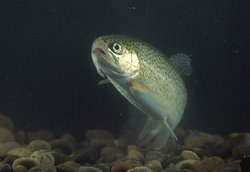
The White Perch or Morone americana is a species of freshwater fish that is sometimes referred to as the Silver Perch. Even though this fish is called a perch, it doesn't belong to the same family as the Yellow Perch, and is actually closer to a Bass. This fish is medium sized only growing to about 20" in maximum length and weighing in at nearly 5lbs.

White Perch have large scales and a white underbelly with a gray-green coloration on its back and sides that fades to a silver as you move downward. As you can see in the pictures this fish has a serious dorsal spines so be careful when handling them.   They are found in freshwater as well as brackish waters in places like Maine, and other coastal areas.

White Perch are known to eat small Walleye, Yellow Perch, minnows and fish eggs. They can reproduce rather quickly, with the female producing 140,000 eggs in a single spawning session. These eggs will hatch in about a week.

In some places White Perch are loved for their great fight and tasty meat, but other places they are looked upon as a nuisance that destroys other species by their quick breeding and appetite for small fish and eggs.  The have been discovered in the Great Lakes and are thought to cause serious troubles for the Walleye population.  

If you have any additional information about the White Perch please leave us a comment below...

Blue Blanquillo (Malacanthus latovittatus)


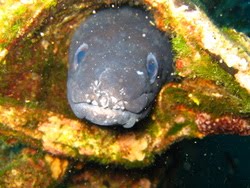
The Blue Blanquillo or Malacanthus latovittatus is just one of the over 40 different species of Tilefish. This particular species gets its name from its bluish coloration. Blue Blanquillo fish are often found in the Indo-Pacific area from the Red Sea to Line Islands, north to southern Japan and south to New Caledonia and Cook Island. They are often seen in areas around reefs near the bottom. These fish are not very large only growing to about 14 in (35 cm) in maximum length. Blue Blanquillo fish are long and slender with elongated dorsal and anal fins. Be careful if you are ever handling these fish as they have spines in their anal fins that can poke you.

When the Blue Blanquillo reproduces their fry have large spines and serrations on their head and large scales in comparison to the size of their bodies. As they grow they tend to stay in water with a temperature range of 72 - 83°F (22 - 28°C). Their diet consists of small invertebrates and zooplankton. Blue Blanquillos are the only known Tilefish that can survive in brackish waters and in saltwater. These fish will often make burrows in the substrate that they hide in when alarmed. They will also seek shelter in caves of even a simple pile of rocks. If you have any additional information about this species of Tilefish let us know in the comments...

Bumble Bee Goby (Brachygobius doriae)

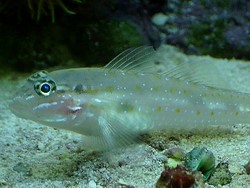
The Bumble Bee Goby or (Brachygobius doriae) is tiny fish that has the colorations of, you guessed it a Bumble Bee. This fish can only grow up to 1-1/2" in length which makes them a great candidate for an aquarium setting. The Bumble Bee Goby is a brackish fish which simply means that this live in any area where salt water and fresh water meet. Adding fresh water to your tank though can increase the chances of breeding. Otherwise water should be kept at 72-84° F with a pH of 8.0-8.2. These fish are carnivorous and can be fed frozen foods, flakes, tubifex worms, bloodworms, brine shrimp and daphnia. The Bumble Bee Goby is native to Western Indoneasia, Thailand and South Vietnam. Don't worry this fish aren't unhappy they just look like that because they are frowning all the time.


Aquarium Fish Of The Month - Spotted Cardinalfish


Still Can't Find The Fish You Are Looking For? Search For It Below Or Send Us An E-Mail!

Fish Index Followers