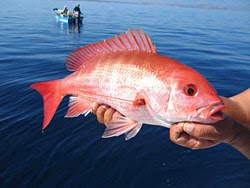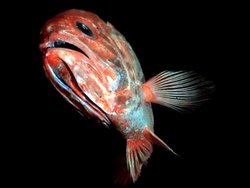





























 The Glass Eye Squirrelfish or Heteropriacanthus cruentatus is a strange looking saltwater fish that was fish discovered in Hawaii. It has very larges eyes which it uses to hunt in the cover of darkness. This fish has a color changing body that becomes brighter as it grows older. When this species of Squirrelfish is young its body is covered by brown and red patches. As the fish ages they become a striking solid bright red.
Glass Eye Squirrelfish are sometimes called Blotched Bigeyes and can be kept in a saltwater aquarium. A tank of at least 80 gallons is recommended because this fish can grow to about 1' in length, and therefore requires plenty of swimming room. Live rock is also recommended with the following water conditions, 72-78° F, dKH 8-12, pH 8.1-8.4 and sg 1.020-1.025.
 This fish is nocturnal and will normally hide when the lights are on. For this reason, you should provide your fish with hiding spots to rest in during the day. When you feed them try to use serpent stars, crustaceans, freeze dried shrimp and worms. You can also use live feeder shrimp as a nice treat or to get them to eat when you first receive your fish.
If you have an tips for keeping a Glass Eye Squirrelfish please share!