Find Your Fish

Showing posts with label Blenny. Show all posts

Sailfin Blenny (Emblemaria pandionis)


The Sailfin Blenny or Emblemaria pandionis is a saltwater fish that is found in the Western Atlantic Ocean including the Gulf Of Mexico. This is just one of the over 700 different species of Blenny in the world.  They are very small, only growing to about 2-1/2" (7cm). This fish gets its name from its impressive dorsal fin which it displays perhaps to make it seem larger, and harder to fit in a potential predators mouth. You can see the Sailfin Blenny with your own eyes underwater in the video below.


The Sailfin Blenny is found in relatively shallow waters of up to 39 feet (12 meters). They make their homes in holes in the coral or empty worm holes. They spend most of their lives in these holes and only come out for brief periods of time.

If you have any additional information about the Sailfin Blenny including tips for keeping them in an aquarium please leave us a comment below.

Midas Blenny (Ecsenius midas)

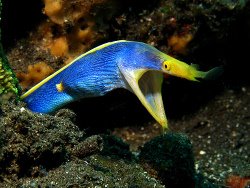
The Midas Blenny or Ecsenius midas is a small saltwater fish found in the Red Sea and Indian Ocean. This species of Blenny is very popular in an aquarium setting and is known to be quite easy to care for.  They are sometimes mistaken for an eel due to their elongated bodies and similar swimming motions. 

Midas Blenny are omnivores that will eat a variety of foods including frozen, live and flake food. They can grow to about 4" in length and require a tank of 30 gallons or more with the following water conditions, 72-78° F, dKH 8-12, pH 8.1-8.4, sg 1.020-1.025.  Like other Blenny, they should be giving lots of hiding spaces to keep they happy and healthy.  They are known to hide with just their head exposed checking out the rest of the tank.  

You can check out the Midas Blenny feeding along with some tankmates in the video below.


If you have any additional information about the Midas Blenny please leave us a comment below.

Canary Blenny (Meiacanthus oualanensis)

The Canary Blenny or Meiacanthus oualanensis is just one of the many different species of Blennies on our planet. These salt water fish get their names from their brilliant yellow coloration. Like other Blennies, they are not very big only growing to about 5" in length, with males normally being a bit larger than their female counterparts.
The Canary Blenny goes by a few different names including the Canary Fang Blenny and the Oualan Forktail Blenny. They are often kept in an aquarium setting and are considered to be fairly easy to take care of. An aquarium of about 40 gallons is acceptable with lots of live rock and the following water conditions, 72-78° F, dKH 8-12, pH 8.1-8.4 and sg 1.020-1.025. These fish are herbivores that should be fed brine shrimp, mysis shrimp and other healthy treats.  You can check out the Canary Blenny in an aquarium setting in the video below.  

One thing to note about the Canary Blenny is that they are venomous, and should be handled with extreme care.  If you have any additional observations about the Canary Blenny please share...


Tompot Blenny (Parablennius gattorugine)

The Tompot Blenny or Parablennius gattorugine is a small fish that only grows to about 15cm in length and is found in shallow, rocky areas. This saltwater fish is just one of the over 800 different species of Blennies in the world!  The Tompot Blenny can be differentiated from most other Blennies by a pair of tentacles that come out over its eyes, almost like horns. Like other Blennies, this fish has a continuous dorsal fin with the beginning spiny and the remainder soft. Compared to their bodies, the Tompot Blenny has very large pectoral fins which it uses to maneuver around. These fish are normally deep brown or orange.

Tompot Blenny fish feeds on small invertebrates that include sea anemones, hydroids, small gastropods, amphipods, decapod crustaceans and brittle stars. They will breed in the spring time like most other fish. The female Tompot will lay her eggs under stones or in crevices where they are fertilized and guarded by the male fish until hatching occurs. This fish is found in the shallow waters of northwest Europe from the British Isles south to the Mediterranean. It can be kept in an aquarium, but is considered to be much more difficult to care for then other species of Blennies. You can check the Tompot Blenny in a territorial dispute with another Blenny in the video below...

Scooter Red Blenny (Synchiropus stellatus)

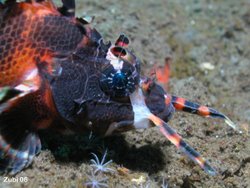
The Scooter Red Blenny or Synchiropus stellatus has the typical elongated Blenny shape with a blotchy red and white coloration throughout their body. The male is normally a bit brighter than the female, and has a larger dorsal fin. This species of Blenny can breed in an aquarium without too much problem, but is considered to be difficult to care for. You can check out the Scooter Red Blenny's mating ritual in the video below...

Also known as the Starry Dragonet and the Stellate Dragonet, this type of salt water fish can be kept in an aquariumof at least 30 gallons. These fish are carnivores that should be fed brine shrimp, bloodworms and glassworms, and small invertebrates. It is also a MUST that they have live rock to graze on and plenty of hiding spots.
Be careful, don't put them with too aggressive feeders as they will not compete for their food and may starve to death. Water conditions in the tank should be as follows, 72-78° F, dKH 8-12, pH 8.1-8.4, and sg 1.020-1.025.

If you have any additional care tips for the Scooter Red Blenny from the Callionymidae family please share.

Leaping Blenny (Alticus saliens)

The Leaping Blenny or Alticus saliens is one amazing saltwater fish! They get their names from their ability to jump from place to place, outside of water. That's right, the Leaping Blenny can actually survive outside of water like you and me. Seeing is believe though, so check out the these blennies in action in the videos below...


Like a lot of other Blennies, they have an elongated dorsal fin that runs the length of their bodies. They are found in Indo-Pacific in moist shallow shady spots often among rocks or coral.  This species of fish can grow to about 10cm (4") in maximum length and is oviparous, which means that they lay eggs that have little or no other embryonic development within the mother.

If you have any more information about Leaping Blennies that you would like to share please leave it in the comments below...

Ember Blenny (Cirripectes stigmaticus)

The Ember Blenny or Cirripectes stigmaticus originates in Fiji and has an intricate design with splashes of orange. yellow and red along with with the typical Blenny shape and "horns". Also referred to as the Red-streaked Blenny, and the Scarlet-spotted Blenny they are found around coastal reef flats, in shallow water of only a couple meters.  You can learn a little more about the many varieties of Blennies in the video below... 


This species of saltwater fish is also quite popular in an aquarium. At least 50 gallons is recommended for the Ember Blenny with plenty of rocks and hiding spots.  Live rock is also needed which they can feed on.  Recommended water conditions are as follows 72-78° F, pH 8.1-8.4, sg 1.020-1.025, and KH 8-12. They are considered to be a peaceful omnivore which should be fed brine shrimp and frozen algae.The male Ember Blenny is almost always larger than the female of this species. During the breeding process the male Ember Blenny will actually change colors! Quite the sight to be seen!  If you have any additional information about the Ember Blenny please share in the comment below.

Horseface Blenny (Ophioblennius atlanticus)

The Horseface Blenny or Ophioblennius atlanticus is one strange looking salt water fish. Also known as the Red Lip Blenny this fish's head has four small horns that protrude outwards. This along with a weird blunt nose gives it the appearance of a horse! These fish are normally black and red with a bit of yellow that helps them blend into their surroundings.

The Horseface Blenny is a quite popular aquarium fish that should be kept at temperatures of 72-78° F, with a PH level of 8.1-8.4. They have an amazing jumping ability which in the wild they use to jump from water pool to water pool. In an aquarium setting though you have to be very careful to keep a tight lid on your aquarium.These fish grow to about 5" in maximum length and are herbivore that works well in an aquarium that has large amounts of natural algae for the fish to feed on. You can also feed them spirulina and other vegetables. This fish is a natural tank cleaner that is a great fit for most aquariums.


Aquarium Fish Of The Month - Spotted Cardinalfish


Still Can't Find The Fish You Are Looking For? Search For It Below Or Send Us An E-Mail!

Fish Index Followers