Find Your Fish

Showing posts with label Sporting Fish. Show all posts

Indo-Pacific Tarpon (Megalops cyprinoides)


The Indo-Pacific Tarpon or Megalops cyprinoides is a fish capable of living in freshwater and saltwater. Also known as the Oxeye, Broussonet Tarpon, Hairen or the Ten Pounder, this fish can grow to about 1 meter (3.3 feet). If you have had the pleasure of hooking one of these fish you probably have noticed that they fight much harder then most fish of the same size. They are also surface jumpers, and will certainly give you a run for your money on light tackle with long runs, and lots of stamina.

This species looks a lot like it close relative, the much bigger Atlantic Tarpon. It's body is covered with large scales with a blue-grey coloration and a silver belly. They have a forked tail and an elongated dorsal fin. These fish have a large mouth compared to their body size with a protruding jaw that is pointing upward, and no real teeth. If you are fishing for Indo-Pacific Tarpon you will generally find them in estuaries and coastal waters, rivers and mangrove forests. The best way to catch these Tarpon are with flies, spinners, sub-surface lures or shrimps.

These fish have made their way into the aquarium trade, but they require a MASSIVE tank so they are only recommended for the advanced aquarium enthusiasts.  You can check out one in an aquarium in the video below.


POP QUIZ: Do you know the names of the other fish featured in the video above?


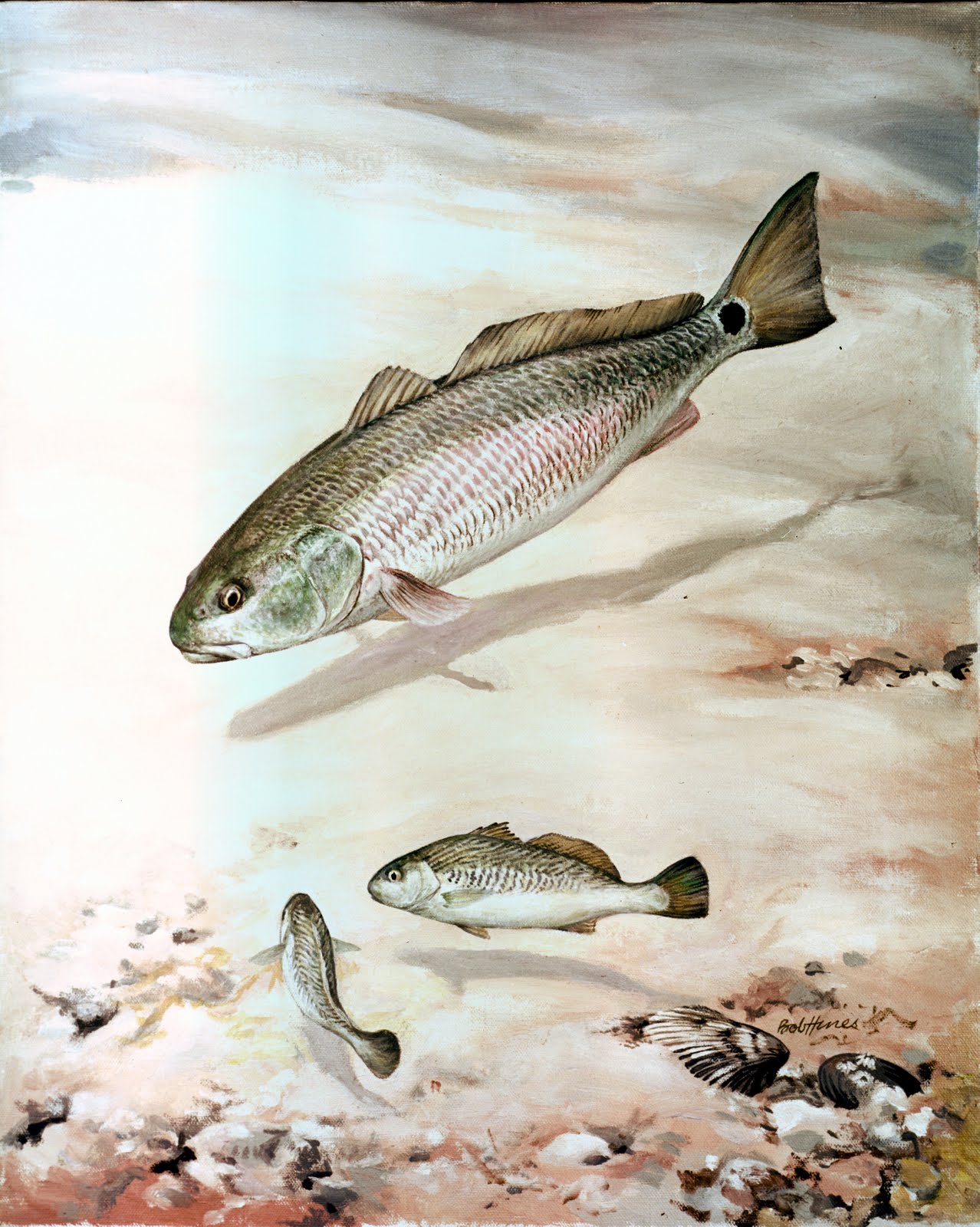
Red Drum (Sciaenops ocellatus)

The Red Drum or Sciaenops ocellatus is a popular sporting fish that is found in the Atlantic Ocean and Gulf of Mexico in coastal waters. This saltwater fish goes by a few different names including Redfish, Spottail Bass, Reds, Bull Reds or Channel Bass. Most Red Drums have a large black dot on its tail which is said to fool potential predators into attacking its back side rather then head on allowing the fish to escape.

In the wild the Red Drum is often found with its close relative the Black Drum and these two species have even been know to breed with one another. They can grow to about 110lbs, but they are commonly only about 5-10lbs. The smaller the fish the better the taste is a general rule for Red Drums, but the big ones sure are fun to catch. They put up a fantastic fight!
When fishing for Red Drum live bait is always best. Crabs, shrimp and minnows are said to be great for catching Red Drum. These fish are bottom feeders so fish on, or just above the bottom is recommended for best results.  You can check out the a school of Redfish in action in the video below... 

Spawning of the Red Drum occurs from August to October during which a female can produce over 2 million eggs! If you have any additional information about the Red Drum leave us a comment below.

Lingcod (Ophiodon elongatus)

The Lingcod or Ophiodon elongatus is a saltwater fish that is found on the west coast of North America from Mexico to Alaska. This fish are often sought after by anglers for their tasty flesh and impressive size. The Lingcod can grow to around 60" (152cm) and weigh in at 130lbs (59kg).  They have large mouths with 18 sharp teeth in them. 

These fish are found in depths of 10 to 100 meters, normally around rocky areas. They will migrate every year starting around October to their spawning grounds close to shore. Lingcod will spawn between December and March in rock crevices or around ledges. Once the females lay their eggs they take off and leave the male to defend the nests until they hatch.
If you have ever caught a Lingcod you know just how tough they are. These fish are serious predators that will feed on anything that swims to close to them including, octopus, herring, invertebrates, salmon and hake.  You can check out a Lingcod in action in the videos below... 


Got some fishing tips or recipes for the Lingcod that you would like to share, please leave us a comment below!

Cutthroat Trout (Oncorhynchus clarkii)

The Cutthroat Trout or Oncorhynchus clarkii is just one of the many species of Trout from the salmon family.  This fish is listed as a threatened species due to lose of habitat and introduction of non-native species to its environment in western North America.  Despite this the Cutthroat Trout is the state fish of Idaho and Wyoming and is sought after by many anglers especially fly fishermen and women. 

Some kinds of Cutthroat Trout are anadromous which means they spend part of their lives in freshwater and part in saltwater.  Most of this species though does spend its time in the freshwater with the exception of those on the coastline.  There are many different sub species of Cutthroat Trout including Alvord cutthroat trout, Bonneville cutthroat trout, Humboldt cutthroat trout, Lahontan cutthroat trout, Whitehorse Basin cutthroat trout, Paiute cutthroat trout, Snake River fine-spotted cutthroat trout, Westslope cutthroat trout, Yellowfin cutthroat trout, Yellowstone cutthroat trout, Colorado River cutthroat trout, Greenback cutthroat trout and Rio Grande cutthroat trout. 
Cutthroat Trout can grow to about 20lbs (9 kg) maximum and can grow as long at 40" (102cm).  There are a few sub species of Cutthroat Trout so this fish can range greatly in size, coloration and habitat.  Some are golden while others are more gray in color.  All of them have red, pink or orange marks on the underside of their jaws, this is a sure way to tell if you have caught a Cutthroat Trout.  You can check out some amazing footage of Cutthroat Trouts underwater in the video below...          

If you have any additional information about the Cutthroat Trout including recipes and fishing tips please leave us a comment below.

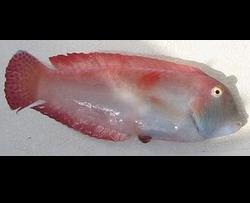
Tautog (Tautoga onitis)

The Tautog or Tautoga onitis is a saltwater fish that is often sought after by anglers from Nova Scotia to Georgia in the Atlantic Ocean. This fish from the Wrasse family is often found in a bottom that has structure, like ship wrecks, rocks or mussel beds. This rough territory make it easy for a Tautog to tangle the anglers line and break free.

Also known as the Blackfish, they are brown or dark olive with white blotches. Tautog can grow to about 3' (1m) and can weigh up to 25lbs. These fish have powerful jaws and two sets of teeth, one in the front and one in the back of their throat that helps them to crush crustaceans and mollusks of all sorts. They also have a slime of sorts that covers their bodies, much like some Northern Pike. This helps them glide off sharp rocks that they may encounter while swimming.

When fishing for a Tautog it is critical that you wait a moment to set the hook as you almost need to wait for the Tautog to swallow the bait before you can hook them. Popular baits for Tautog include crabs, clams, shrimp, sandworms and even lobster. Spearfishing is another way to catch the elusive Tautog. They are said to be quite calm around scuba divers. You can check them out underwater in the video below...

Spawning of the Tautog will often happen in the late spring or early summer in an offshore location. Once hatched the little ones will often take shelter in seaweed until they are large enough to venture out on their own into the big water. Because of the relatively slow reproduction rate of the Tautog, these fish are very vulnerable to overfishing. Please practice catch and release when possible.

If you have any additional information about the Tautog please leave us a comment below.

Butterfly Peacock Bass (Cichla ocellaris)


The Butterfly Peacock Bass or Cichla ocellaris is a freshwater fish that is considered to be one of the strongest pound for pound fighters in the world!  Like the Smallmouth and Largemouth Bass, these fish strike hard and have a never say die attitude!  Despite their name these fish are actually Cichlids, not Bass, and are just one of the several species of Peacock Bass.   

Also known as the Peacock Cichlid, Tuncunare and Mariposa these fish have been introduced in Hawaii as well as Florida, Panama, Guam, the Dominican Republic and Puerto Rico.  Their coloration can vary quite a bit, but they are generally a yellowish green with three dark blotches.  When breeding, much like many species of Salmon, they develop a hump on the backs of the males.   You can check out this beautiful species as well as their fry in the video below...

These fish are not the biggest, but make up for that with their fight.  The record Butterfly Peacock Bass was 12lbs 9oz and was caught in Venezuela.  If you have any fishing tips please share!

White Marlin (Tetrapturus albidus)

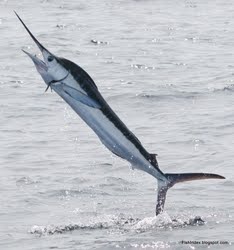
 The White Marlin or Tetrapturus albidus is one of the most sought after sporting fish in the world!  These Billfish can reach lengths of over 8' and can weigh over 160lbs!  Like other Marlins they have a bill that they use to stun fast moving fish. After it successfully hits a fish it will quickly devour them.  You can check out the White Marlin's never say die attitude in the video below... 

White Marlins are found throughout the Atlantic Ocean and in the Caribbean. They are normally found at depths exceeding 300 feet, but are often caught in shallower waters as well. If you are lucky enough to have hooked one of these White Marlins you know just how exhilarating it can be to battle these impressive saltwater fish. Not only are they very large, but they also will make fantastic runs and jumps adding to the excitement of the catch. Be extremely careful with these fish as their bill can cause some serious damage!

These fish can be identified by their dark blue to chocolote brown bodies and white underbellies. White Marlin with almost always have spots on the dorsal fins. Their bodies are covered with embedded scale that have a single sharp point. The dorsal, pectoral and the first anal fin is all rounded.

If you have any additional information or questions about the White Marlin please leave us a comment!

Red Snapper (Lutjanus campechanus)


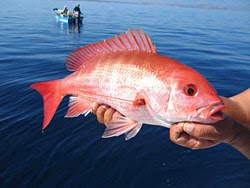
The Red Snapper or Lutjanus campechanus is a popular sporting fish in places like the Gulf Of Mexico and the southeastern Atlantic Ocean. These saltwater fish are found in waters of 30 to 300ft around reeds, rocky bottoms and many other places that provide potential shelter like shipwrecks. As you can imagine, these fish are reddish in color and can grow to about 40 lbs (18 kg) in maximum weight.
Also known as the Huachinango, and the Pargo, the body shape of this fish is much like that of other Snappers. They also have the razor sharp teeth that give them their Snapper name, handle with care. If you do manage to catch one of these fish there will most likely be more, because they are almost always found in schools. Once caught, this fish's flesh is considered to be one of the finest in the world to eat.  You can check out a large school of Red Snapper fish in the video below... 

If you have any additional information including fishing tips or questions about the Red Snapper please leave us a comment.

Golden Dorado (Salminus brasiliensis)

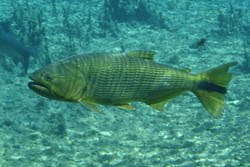
The Golden Dorado or Salminus brasiliensis is a species of trophy fish that is considered to be one of the hardest fish to catch pound for pound.  Also known as the River Tiger, they have the ability to leap out of the air with ease and have unmatched fighting power and stamina.  Anglers from all over the world come to places like Argentina, Paraguay, Uruguay, Bolivia and Brazil to seek out these tasty fish!  The warm waters of the Plate and Amazon systems are the best places to find these freshwater fish.  It is also the national fish of Argentina where it is illegal to catch one. 
Golden Dorado have a distinct golden coloration with large heads.   They can grow to about 3' (1M) in length and can weighed up to 70lbs!  They are vicious predators with powerful jaws and a mouth filled with sharp teeth.  They go by a few different names including Dourado, Dorado, Harritetra and Jaw Characin. 

These fish are carnivores that will often dine on Sabalo, but they will eat frogs, birds and even some mammals as well.  You can check out the Golden Dorado in the video below...

If you have any additional information including recipes and fishing tips for the Golden Dorado please leave us a comment.

Nile Perch (Lates niloticus)

The Nile Perch or Lates niloticus is a massive freshwater fish that can grow to over 6' (2m) in length and can weigh up to 530lbs (200kg)! These fish can be identified by their dark black eyes that have a yellow outer ring. Their bodies are silver with a bluish tint.Nile Perch are found in a few different places including Lake Maryut, Lake Chad, Lake Turkana, Lake Nasser, Volta, Nile, Congo, Senegal and Niger. They go by a few different names depending on where in the world you are. Victoria Perch, African Snook, Capitaine, and Luo are just a few. Nile Perch are vicious predators that will dominate and potentially destroy an ecosystem. For this reason, they are considered an invasive species and should never be released into a foreign ecosystem.

Nile Perch will often feed on Cichlids, crustaceans, insects, small fish and even their own kind! That's right, like the Northern Pike, these fish are cannibals! As you can imagine with this fish's amazing size and strength, they are a favorite among anglers and are considered to be one of the hardest trophy fish to catch. You can check out these edible fish for yourself in the video below...

If you have any additional information about the Nile Perch please leave us a comment.

Coral Trout (Plectropomus leopardus)

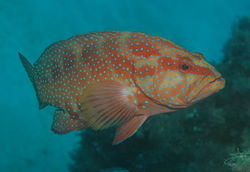
The Coral Trout or Plectropomus leopardus is part of the family known as Serranidae. This family is characterized by having three spines on their gill covers and large mouths that have more than one row of teeth. Both Groupers and Cods are part of this family as well.

Also known as the Leopard Coral Grouper, Strawberry Trout and the Leopard Coral Trout these fish are found in the Indian and Pacific Oceans normally around reefs, including the Great Barrier Reef. These saltwater fish come in a variety of colors including red, green, brown, pink and orange. They can be identified by the numerous blue spots on their bodies and the blue rings that surround their eyes. When it comes to reproduction the Coral Trout is quite strange. If you can believe it, these fish will actually change sexes over the course of their lives. They start their lives as females and as they become larger, normally around 40cm, they turn into males. They also have a rather elaborate mating ritual in which the male will flip sideways shaking his head from side to side trying to entice the female into courtship.

Coral Trout will often feed on small fish like Damselfish at dusk or in the early mornings. Like the Pike and Muskie, these fish are ambush predators that lie in wait for an unsuspecting fish to swim by. They strike with lighting quickness and are even said to have the ability to change the color of their skin when feeding. They can grow to about 70cm (2') and weigh 6kg (13lbs). You can learn more about the Coral Trout including how to fillet them in the video below...

If you have any additional information about the Coral Trout please leave us a comment.

Shortfin Mako Shark (Isurus oxyrinchus)

The Shortfin Mako Shark or Isurus oxyrinchus is one of the two different species of Mako Sharks, the other being the Longfish Mako Shark (Isurus paucus). These sharks are found in many places around the world including the Pacific, Atlantic and Indian Oceans, normally from the surface down to depths of 490 ft (150m). They are medium sized sharks growing to about 13 feet (3.96m) in length, and weighing in at 1750lbs (794kg) maximum. You can check out the Shortfin Mako Shark underwater in the video below...

Shortfin Mako Sharks have a bluish black and white underbelly with the classic shark features. These sharks teeth are curved inward, and visible even when the sharks mouth is closed. They are extremely fast and tend to jump out of the water, there have even been reports of Makos jumping into fishing boats! They have be differentiated from other sharks by their short pectoral fins, crescent tail and caudal keel on the caudal base.


Feeding on Mackerel, Tuna, Swordfish and Sailfish can be a dangerous game for the Shortfin Mako Shark. In fact, many Shortfin Makos have been found impaled by the Swordfish or Sailfish's bill. They will also prey on smaller sharks, sea turtles and small porpoises. If you have any additional information about the Shortfin Mako please share...

Rainbow Runner (Elagatis bipinnulata)

The Rainbow Runner or Elagatis bipinnulata is a fish that is found in many places around the world, at various depths in tropical, and subtropical waters. They go by several different names depending on your location including the Spanish Jack, Hawaiian Salmon and the Rainbow Yellowtail. This species of saltwater Jack can become quite large, growing to almost 6' (180cm) in length and weighing in at 101lbs (46kg).

As you can see in the video above, Rainbow Runners are often found in schools and have long compressed bodies with a pointed head and snout. They have two dorsal fins and small eyes for the size of their bodies. This fish is a close relative of the Amberjack, but can be differentiated by their vivid coloration. Rainbow Runners upper half is a dark blue or green, which fades to white as you reach their underbellies. These fish have two blue stripes that run horizontally down their sides. In between these two stripes is another stripe, this one yellow or olive in color. These fish are quite the sporting fish, offering fantastic runs displaying their speed and strength. Various fishing methods are used, but trolling is said to work best for these quick movers. Once caught these fish are edible and have a pleasant flavor, not the best in the ocean, but certainly far from the worst.

If you have any additional information about Rainbow Runners, including fishing tips or recipes please leave us a comment.

Aquarium Fish Of The Month - Spotted Cardinalfish


Still Can't Find The Fish You Are Looking For? Search For It Below Or Send Us An E-Mail!

Fish Index Followers