Welcome To The Fish Index! We Are Maintaining A Growing Encyclopedia Of Fish Species Listed From A-Z! Choose From Our Categories Or Browse The Fish Featured Along The Sides By Clicking Their Pictures. Each Fish Includes Detailed Information, Pictures, Video And User Comments! With Over 30,000 Different Species In The World, Our Team Of Fish Experts Are Constantly Being Challenged To Discover New Species. Sample "The Fish Of The Day" Or Browse Our Impressive Selection Of Aquarium Fish!
Don't forget to Like Us On Facebook!
The Cutthroat Trout or Oncorhynchus clarkii is just one of the many species of Trout from the salmon family. This fish is listed as a threatened species due to lose of habitat and introduction of non-native species to its environment in western North America. Despite this the Cutthroat Trout is the state fish of Idaho and Wyoming and is sought after by many anglers especially fly fishermen and women.
Some kinds of Cutthroat Trout are anadromous which means they spend part of their lives in freshwater and part in saltwater. Most of this species though does spend its time in the freshwater with the exception of those on the coastline. There are many different sub species of Cutthroat Trout including Alvord cutthroat trout, Bonneville cutthroat trout, Humboldt cutthroat trout, Lahontan cutthroat trout, Whitehorse Basin cutthroat trout, Paiute cutthroat trout, Snake River fine-spotted cutthroat trout, Westslope cutthroat trout, Yellowfin cutthroat trout, Yellowstone cutthroat trout, Colorado River cutthroat trout, Greenback cutthroat trout and Rio Grande cutthroat trout.
Cutthroat Trout can grow to about 20lbs (9 kg) maximum and can grow as long at 40" (102cm). There are a few sub species of Cutthroat Trout so this fish can range greatly in size, coloration and habitat. Some are golden while others are more gray in color. All of them have red, pink or orange marks on the underside of their jaws, this is a sure way to tell if you have caught a Cutthroat Trout. You can check out some amazing footage of Cutthroat Trouts underwater in the video below...
If you have any additional information about the Cutthroat Trout including recipes and fishing tips please leave us a comment below.
Bull Trout or Salvelinus confluentus are found exclusively in North America in places like British Columbia, Washington State, Oregon, Montana, Idaho and parts of Nevada. These fish used to be known as Dolly Varden, but around 1980 the Dolly Varden was re-classified as Salvelinus malma. Unfortunately, like many other species on our planet, Bull Trouts are listed as threatened under the Endangered Species Act.Bull Trout are a species of Char that can grow to about 41" (103cm) in length and can weigh up to 32lbs (14.5kg). These fish can be distinguished from other Char by their rather large head and mouth. They also lack the spots on their dorsal fins that their close relative the Brook Trout has. Bull Trout also have yellow or orange spots on their backs and don't have a forked tail fin like the Lake Trout. You can check out a more footage of the Bull Trout as well as some fantastic scenery from Western Canada in the video below...
One of the reasons that the Bull Trout is listed as endangered, is that they have a very specific habitat demand. Water temperatures of below 55F (14C) is required as well as clean gravel beds and nice deep pools. Cold lakes and large rivers are they favorite areas to inhabit. Since these fish will often migrate to spawn, man made dams have severely hampered their ability to reproduce. These freshwater fish begin their lives feeding on zooplankton, but as they grow larger their diet turns mostly to small fish and Salmon eggs. If you have any additional information about the Bull Trout leave us a comment below!
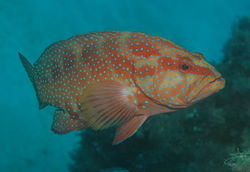
The Coral Trout or Plectropomus leopardus is part of the family known as Serranidae. This family is characterized by having three spines on their gill covers and large mouths that have more than one row of teeth. Both Groupers and Cods are part of this family as well.
Also known as the Leopard Coral Grouper, Strawberry Trout and the Leopard Coral Trout these fish are found in the Indian and Pacific Oceans normally around reefs, including the Great Barrier Reef. These saltwater fish come in a variety of colors including red, green, brown, pink and orange. They can be identified by the numerous blue spots on their bodies and the blue rings that surround their eyes. When it comes to reproduction the Coral Trout is quite strange. If you can believe it, these fish will actually change sexes over the course of their lives. They start their lives as females and as they become larger, normally around 40cm, they turn into males. They also have a rather elaborate mating ritual in which the male will flip sideways shaking his head from side to side trying to entice the female into courtship.
Coral Trout will often feed on small fish like Damselfish at dusk or in the early mornings. Like the Pike and Muskie, these fish are ambush predators that lie in wait for an unsuspecting fish to swim by. They strike with lighting quickness and are even said to have the ability to change the color of their skin when feeding. They can grow to about 70cm (2') and weigh 6kg (13lbs). You can learn more about the Coral Trout including how to fillet them in the video below...
If you have any additional information about the Coral Trout please leave us a comment.
The Brown Trout or Salmo trutta is a very close relative of the Atlantic Salmon and is just one of the many different species of Trout. Brown Trout have two dorsal fins with a square tongue and large teeth. They have dark, red or orange spots that cover most of their bodies with a much lighter underbelly. Unlike many other freshwater fish their tails are not forked and do not contain spots like the Rainbow Trout. You can check out a Brown Trout for yourself underwater in the video below...
Brown Trout originate from Europe and Western Asia, but were introduced into places like Michigan and New York in the late 1800s. Since then they have become established in all of the upper Great Lakes. Brown Trout are often found in shallow waters around weed beds and rocky areas. When spawning though in September and October they are found in streams and rivers where they spawn in gravel or rocky spots. The female Brown Trout will create a "redd" where they lay their eggs and have the males fertilize them. After the eggs are fertilized the female will cover this "redd" with gravel to protect them.Brown Trout will often feed on insects, larvae, crustaceans, amphibians, and small fish. They can live to about 13 years old and can grow to over 40lbs! In fact, the world record Brown Trout was caught very recently in September of 2009 in the Manistee River. This Brown Trout weighed in at an amazing 41 lb 7 oz! One of the most popular ways to fish for Brown Trout is to fly fish for them is in rivers during the spawning season. If you have any additional information about the Brown Trout including fishing tips and recipes please let us know!
The Lake Trout or Salvelinus namaycush is one of the most popular Trout species and is renowned for its fine flavor. This freshwater fish is found in many deep lakes in the northern parts of North America including the Great Lakes. Lake Trout go by many different names depending on where you are, these include Salmon Trout, Mackinaw, Lake Charr, Touladi, Togue, Grey Trou, Siscowet, Paperbellies and Leans.
These fish can reach weights exceeding 100lbs, but they rarely reach these sizes, because Lake Trout are slow growers that don't reach sexual maturity until about 6 years old, living to over 25 years old. They have two dorsal fins and light spots on their dark gray bodies. The Lake Trout's lower fins have white on their edges. You can check out a large Lake Trout in the video below..
If you are fishing for Lake Trout keep in mind that this species of Charr are found in shallow waters of about 13 feet in the spring and fall, but are found much deeper in the summer and winter. They have even been caught at depths exceeding 150'! Lake Trout will feed on smelt, crustaceans, insects and other small fish depending on where they are in this huge range in depth. If you have any additional information about Lake Trout including fishing tips and recipes feel free to share with the world...
The Arctic Charr or Salvelinus alpinus not only has the ability to survive in both freshwater and saltwater, but it also can survive EXTREME cold. Living farther north then any other known fish, these edible fish are native to the Arctic and Sub-Arctic areas. They have also been reported in deep, cold glacial lakes in Scotland, Iceland and even Siberia, where they are known as Golets. Other names including Charr, Blueback Trout, Ilkalupik, Martson Trout, Quebec Red Trout, Silver Trout, Sunapee Trout, and White Trout. They can weigh in at about 20lbs maximum.
Arctic Charr are part of the Salmon and Trout family Salmonidae sharing a lot of the same characteristics. They are usually dark with a lighter belly. Their tail's are forked, and during spawning these fish will become brightly colored. Turning pink or orange on their bellies, with blue or brown backs. Their fins will also be brightly colored during the spawning process.
Arctic Charr are commercially farmed and easily caught in the wild as well. Once caught or bought it at the store, you will find out that the Arctic Charr has a delicious flavor. The Monterey Bay Aquarium "Seafood Watch" program has recently added farmed Arctic char as an environmentally sustainable Best Choice for consumers, stating: "Arctic char use only a moderate amount of marine resources for feed. In addition, Arctic char are farmed in land-based, closed systems that minimize the risk of escape into the wild." You can watch some Arctic Charr underwater below in the video.
If you have any additional information about the Arctic Charr that you would like to share please leave us a comment below...
Spotted Sea Trout or Cynoscion nebulosus is a quite common fish in the Southern United States that is commonly known as the Speckled Trout along with the Brook Trout (Salvelinus fontinalis) which is known by the same name. This saltwater fish is often found in brackish waters close to the coast. Spotted Sea Trout can be described as having very sharp and large canine teeth with a greyish body and black spots. The inside of the Spotted Sea Trouts mouth is normally orange which help differentiate them from similar species. These fish are often caught with spoons and jigs along with live shrimp. The best time to fish for Spotted Sea Trout is in the early morning when they are the most active.
Also known as the Speckled Weakfish they are a great fish to eat as long as you ice them directly after cleaning. Their white meat is said to be one of the finest in the world. They normally grow to about 22 inches on average and can weigh more than 3lbs. They reach sexual maturity in 2 years or less and can produce over 100,000 eggs at a time. The maximum age that Spotted Sea Trout can reach is about 18 years. Like many fish they grow a lot more in the warmer months and less in the cooler winter months. The Spotted Sea Trout often becomes prey to such fish as the Alligator Gar, Tarpon and Barracuda. If you have any recipes or fishing tips for the Spotted Sea Trout please share them in the comments below...
The Rainbow Trout, Steelhead or Oncorhynchus mykiss is one of the most widely introduced fish in the world. It is in every continent except Antarctica and provides food for many people around the world. The Steelhead version is a salt water fish, but returns to fresh water to spawn. The Rainbow Trout spends its entire life in fresh water. They can grow to over 4' and weigh in at over 40lbs, so there is plenty of meat to enjoy on this fish. The Rainbow Trout normally eats smaller fish, crawfish and small insects. One unique characteristic about the Rainbow Trout is that it is anadromous, which simply means they return to their original birth place to spawn. This trait makes fly fishing in rivers one of the most popular ways to catch Rainbow Trout. Check out this video for more information about the Rainbow Trout...
If you have any fishing tips for Rainbow Trout or recipes please leave them below in the comments...