
Find Your Fish

Showing posts with label Eel. Show all posts

New Zealand Longfin Eel (Anguilla dieffenbachii)

The New Zealand Longfin Eel or Anguilla dieffenbachii is a freshwater fish that can be distinguished from other Eels by the length of its fins. The dorsal fin of the New Zealand Longfin Eel extends further towards the head then the anal fin. This is in contrast to the Shortfin Eel which fins are both of similar lengths.     

Like some species of Trout, this fish will spend their lives in freshwater, but migrate to saltwater to breed. Longfin Eels are from the Anguillidae family and are quite large measuring in at up to 53lbs (24kg). This impressive size doesn't happen overnight though, in fact they are the slowest growing of all Eel species. They are also one of the longest lived, managing to make it to the ripe old age of 106! 

New Zealand Longfin Eels are omnivores that are not considered to be picky eaters. They will chow on insect larvae of all kinds and small fish as well. Some folks even think they might attack a human under the right circumstances. Have a look at this video from River Monsters that shows their powerful appetites.


If you have any additional information about the New Zealand Longfin Eel please leave us a comment below.

European Conger Eel (Conger conger)

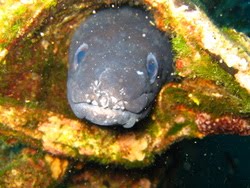
The European Conger Eel or Conger conger is the the largest known Eel in the ocean measuring 2.87 m (9.5 ft) in length and weighing in at an impressive 60.6 kg (133¼ lb)!  Like other Eels, this saltwater fish has a snake like body and is found at a great range of depths.  When the European Conger Eel is young it is often inhabits shallow coastal waters, but as it grows older they make their way to deeper waters of up to 1000 meters.  This species is just one of the many different kinds of Conger Eels and goes by a couple different names including Sea Eel, Southern Conger, Koiro, Ngoio and the Silver Eel. 

European Conger Eels are found in a few different places around the world including the Black Sea, Mediterranean Sea and the eastern Atlantic Ocean.  They are nocturnal predators that feed on mollusks, small fish and crustaceans.  This type of Eel can be caught with a hook and line and is not raised on fish farms.  They are edible and are said to have a sweet taste with a firm texture.  Eels are often served smoked, canned, fresh or jellied.  As with all other fish, they are best served fresh.  You can check out some Conger Eels in action in the video below...
 

If you have any additional information about the European Conger Eel please leave us a comment below!

Fire Coral Eel (Gymnothorax miliaris)

The Fire Coral Eel or Gymnothorax miliaris is just one of the over 600 different species of Eels in the world. This particular species is black in color, with golden spots that cover its entire body.  This makes it quite easy to differentiate from other species. Fire Coral Eels are a kind of Moray Eel with the typical thick long body and large & powerful jaws.

Fire Coral Eels are found in the Pacific and Atlantic Ocean around reefs and go by a few different names including the Bastard Eel, Goldentail Moray and Conger Moray. Like a lot of other Eels, you will find them hiding in rocks or caves with their large mouths sticking out waiting for food to swim by.Although sometimes kept in an aquarium, the Fire Coral Eel is not considered to be very easy to care for. They require a large aquarium of about 140 gallons and can grow to about 2' in length. Make sure your aquarium has a nice tight lid and provide this Eel with plenty of places to hide. This will keep your Fire Coral Eel healthy and happy. The following water conditions are recommended, 72-78° F, dKH 8-12, pH 8.1-8.4 and sg 1.020-1.025.

These saltwater fish will eat just about anything that they can fit into their mouths including fish and invertebrates. In an aquarium, you can feed them squid, octopus, and live feeder fish. You can check out the Fire Coral Eel with your own eyes in the video below...

If you have any additional information please leave a comment.

Wolf Eel (Anarrhichthys ocellatus)

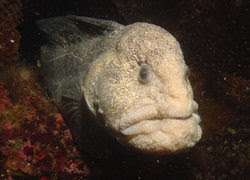
The Wolf Eel or Anarrhichthys ocellatus has a human-like face with powerful jaws that it uses to crush its prey. These saltwater fish are normally found in the northern Pacific Ocean around rocks or reefs. They will often make their homes in a crevice, cave or a pile of rocks. This species is not a true Eel, because it has pectoral fins and is referred to as a Wolf Fish. It is an impressive specimen growing to over 6' long, and weighing in at 40lbs! Wolf Eels tend to eat clams, small fish, crustaceans, sea urchins and mussels. These fish are edible and are sometimes called Ocean Catfish when sold. You can watch some amazing underwater footage of the Wolf Eel in the video below...

When reproducing the male and female will wrap themselves around each other to protect their eggs for a period of several months. It is thought that some males and females only have one partner for their entire lives. They normally reach sexual maturity at about 7 years old.

If you have any additional information about the Wolf Eel that you would like to share leave a comment below...

Garden Eel (Taenioconger hassi)

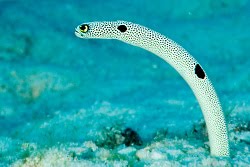
The Garden Eel or Taenioconger hassi is just one of the many different types of Eels that can be kept in an aquarium. Also known as Hass's Garden Eel this creature blends in by disguising itself as sea grass. You see, the Garden Eel will actually bury half of its body in the sand wait for its dinner to float by. If approached by a potential predator it will quickly burrow itself in the bottom substrate. They are also found in groups, so it literally looks like you are looking at a field of sea grass. You can check out the Garden Eel underwater in the video below.

Garden Eels are quite striking with a leopard pattern of spots with two large dark spots on their bodies. They can grow to over a foot long, but most of the time you only see part of their bodies as the rest is buried in the sandy bottom. They have large eyes and a rather large mouth for their body size. If you are thinking of keeping the Garden Eel in an aquarium you should take into account the fact that they are not the easiest to care for. The do require a large tank as well, at least 100 gallons is recommended. A sandy bottom of 7" or more will keep them happy, giving them the feel of the ocean. They also enjoy a nice gentle current and a tight lid is highly recommended to keep this Garden Eel from escaping. Garden Eels should be fed a carnivorous diet consisting of feeder fish, ghost shrimp and other meaty foods. The following water conditions should help to keep this saltwater fish happy, 72-78° F, dKH 8-12, pH 8.1-8.4 and sg 1.020-1.025.

If you have any additional information about the Garden Eel including caring types please let us know.

European Eel (Anguilla anguilla)

The European Eel or Anguilla anguilla was once commonly found in many places in Europe from Scandinavia to Spain, Italy to Greece. Due to pollution and changes in habitat due to human activities this Eel is now critically endangered. This species can grow to about 100 cm (40 in) in length and weigh up to 9 kg (20 lb). The color of the European Eel varies depending on its age, but it is normally brown or silver. They have several life cycles in which they are called a variety of things including Glass Eel, Elver, Yellow Eel and Silver Eel once they are sexually mature. To learn more about these eels and their life cycle check out the video below...

European Eels are normally found in muddy river bottoms or gaps in between rocks. They will normally eat carrion, small fishes and other small aquatic creatures. Over the course of their lives they go from freshwater to saltwater. They use their slimy outer layer to protect themselves from the salt. When the female European Eel gets old enough they migrate to the Atlantic Ocean to lay their eggs. Once the new babies reach about 3 years old they follow the streams and rivers into freshwater Europe. The European Eel can live 30 years or more and is considered to be quite delicious when prepared properly!If you have more information about the European Eel that you would like to share please leave us a comment below...

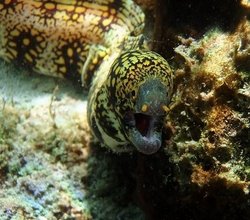
Snowflake Eel (Echidna nebulosa)

The Snowflake Eel or Echidna nebulosa is a relatively easy to care for saltwater eel that is found around Hawaii, and the tropical Indo-Pacific. Also known as the Snowflake Moray Eel, these fish have a great sense of smell which helps to make up for their poor eyesight. They have the typical eel shaped body with blotchy stripes, that can sometimes resemble snowflakes. This species of eel can grow to about 28" in maximum length. You can check out the Snowflake Eel underwater in the video below...

If you do plan on housing a Snowflake Eel in an aquarium setting, be sure that you have a tight lid as they tend to try and escape. The following water conditions are recommended,  temp. 72-78F, sg 1.020-1.026; pH 8.1-8.4; and dKH 8-12. An aquarium of 30 gallons or more is acceptable. Snowflake Eels can be fed clam, crab, shrimp, squid, scallop and fish meat.Please note: These fish can go into hibernation mode and won't be seen or eat for several weeks. Be sure to provide them with plenty of hiding spots to keep them happy. Compatible tankmates for the Snowflake Eel include large semi-aggressive fish, such as Lionfish, Tangs, Triggerfish and Wrasses.

If you have any additional information about the Snowflake Eel including aquarium tips please leave us a comment below. 

Lamprey Eel (Petromyzon marinus)

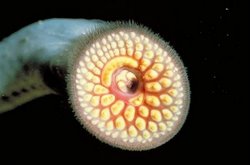
The Sea Lamprey or Petromyzon marinus is a parasitic creature that has an impressive tooth filled mouth that opens attaches the unfortunately host that gets too close. The Sea Lamprey was originally a salt water fish, but over time it colonized in Lake Ontario, Lake Michigan and Lake Huron.

Also known as the Great Sea Lamprey, Lake Lamprey, and the Sea Eel this creature can reach lengths of 20" and weigh up to 13 oz. They are a greyish metallic color with white on their underside.

It is not uncommon to catch fish with one or several of these Lamprey Eels attached to the fish itself. They fasten themselves onto its host and makes a hole with its tongue. They have a special substance in their saliva that serves as a anticoagulant and keeps the wound opens for weeks until the Lamprey Eel lets go or the host dies.Believe it out not these parasites are considered a delicacy in places like Europe! Here is The States though they are considered a nuisance and poison is used to control their spawning. To learn even more about the Lamprey Eel watch the video below...


Chain Eel (Echidna catenata)


The Chain Eel or Echidna catenata is also known as the Chainlink Moray Eel or just the Chain Moray Eel. This Eel has a whitish yellow body with black or brown chain markings, hence its name! Like most Eels it spends a lot of its time in a hiding space so if you are planning on keeping this creature as a pet make sure your aquarium has plenty of nooks and crannies to hide in. This type of Eel requires 2 or 3 live meals (grass shrimp, fiddler crabs) per week. Water temperature of 72-78° F and a PH Level of 8.1-8.4 is recommended. The Chain Eel can grow to about 2-1/2' in length.


Tessalata Eel (Gymnothorax favagineus)

The Tessalata Eel or Gymnothorax favagineus almost resembles a cheetah with its dark honeycomb markings that cover its entire body. This salt water eel is quite easy to take care of as a pet, but it does require a rather large aquarium to house. The Tessalata Eel can grow to about 6' in length, so an aquarium of at least 200 gallons is highly recommended. Live feeder fish, octopus, and squid are a good diet for this type of eel. Water conditions in the tank should be about 72-78° F with a pH of 8.1-8.4. Like most other eels lots of hiding places should be provided in an aquarium setting. This eel is also known as the Honeycomb Moray Eel and is native to Sri Lanka.


To see this creature in action watch the video below...


NEXT

PREVIOUS

American Eel (Anguilla rostrata)


The American Eel or Anguilla rostrata is commonly found on the East coast of North America. This Eel plays a very important part in keeping our oceans and rivers clean by consuming dead fish, invertebrates, carrion, insects and lots of other "garbage". Although not commonly eaten, these fish are quite good from what I have heard. The largest ever American Eel that was ever caught was 9.25 pounds. The female of this species can lay over 4 million eggs. Apparently that takes a lot out of them, because the female will die after the egg laying process is complete. These fish have a strange feeding ritual, they hold the food in their mouths and then spin their bodies to break apart their dinner. The American Eel is a catadromous fish which means the fish is born in the ocean, matures in the fresh water and then returns to the ocean to spawn.

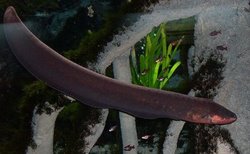
Fire Eel (Mastacembelus erthrotaenia)

The Fire Eel or Mastacembelus erthrotaenia is a freshwater fish that is found in places like Cambodia, Indonesia, Laos, Malaysia, Thailand, Viet Nam. It is also a fairly popular aquarium eel. The Fire Eel is considered to be quite intelligent and has the ability to distinguish its owner from other people. It can also be taught to eat right out of your hand! Fire eels are carnivorous and should be fed tubifex, fish, brine shrimp, mosquito larvae, bloodworms, or mussels. You can check out the Fire Eel feeding from its owners hand in the video below...

These fish will often bury themselves in the sand in the wild so be sure to take this into consideration before purchasing this eel. They have a tendency to dig up plants and rearrange your tank a bit so be aware. They also require a larger aquarium as they can grow to about 2' in length. The Fire Eel should be in a water temperature of 75-82° F, and a PH level of 6.8-7.2. One last thing to note is that you should make sure you have a tight lid on your aquarium, this fish will try and escape!


Tire Track Eel (Mastacembelus armatus)

Tire Track Eel or (Mastacembelus armatus) is not a true eel at all, in fact it is just an elongated freshwater fish. Also known as the Spiny Eel this fish is carnivorous and should be fed bloodworms, earthworms and even some pellet foods. You can even feed these fish right out of your hand! The Tire Track Eel will bury itself so watch out if you have this fish in an aquarium setting, it will dig up your plants. This fish can grow to 90cm and weigh in at about 500 grams. The Tire Track Eel is often found in highland streams to lowland wetlands in places like India, Pakistan, Sumatra, Sri Lanka, Thailand, Vietnam, Indonesia and other parts of South East Asia. In some places of the world this fish is eaten and quite tasty from what I have heard.  You can check out the Tire Track Eel in an aquarium toying with a Blue Lobster in the video below.

If you have any additional information about the Tire Track Eel please leave us a comment.  


Ribbon Eel (Rhinomuraena quaesita)

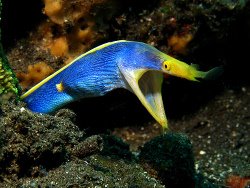
The Ribbon Eel or (Rhinomuraena quaesita) is quite possibles the more bizarre Eels on the planet. This certain kind of Moray Eel will not only change colors throughout its 20 year lifespan, but it will also change sexes! During the beginning of its life the Ribbon Eel is almost all black with a just bit of yellow in its dorsal fin. As they grow older they turn bright blue in color while the lower jaw and nose become a stunning yellow. Soon after the Ribbon Eel reaches 4' in length the blue male turns yellow and actually changes sexes and becomes a female! Like other Moray Eels this creature is often mistaken for a dangerous creature because it has its mouth open all the time in menacing fashion. Don't worry though this is simply how the eels breath. These fishl will bury themselves in the sand or even hide in reefs and rocks waiting for their prey to swim by. Then it will lunge out with impressive speed to catch unsuspecting smaller fish. Even though the Ribbon Eel doesn't do very well in an aquarium setting many people still attempt it because of its brilliant coloration. To see the Ribbon Eel in action check out the video below...


Green Moray Eel

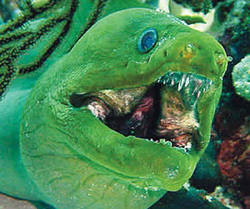
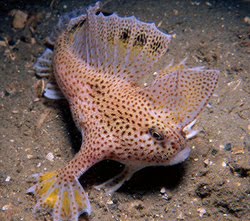
The Green Moray Eel or Gymnothorax funebris is just one of the over 200 different types of Moray Eels. This species is one of the largest morays, growing to over 10 feet and weigh in at over 70 pounds. This creature is a predator, but a very lazy one at that. The Green Moray Eel will sit and wait for its meal to come swimming by before making its move. Moray Eels actually have two sets of jaws which they use to feed on crabs, shrimp, octopuses, small fish and squid. The Green Moray Eel gets a bad rap due to the fact that they aren't exactly pretty to look at and they habitually open and close their mouths. This habit is actually how the Eel breathes. The water passes over the gills and exits through openings in the back of its head. These fish are found in the Atlantic and Pacific oceans normally around reefs at levels of less than 30 meters. They have even been known to locate themselves on the same reef for years! Although the Green Moray Eel is not considered dangerous it will bite with its very sharp teeth if provoked. They also have a very strange jaw called the Pharyngeal Jaw which allows them to open their mouth and swallow large prey. To see the Moray Eel in action take a look at this video below... Or if you would like to buy a Green Moray Eel just click the picture directly below the video!


Aquarium Fish Of The Month - Spotted Cardinalfish


Still Can't Find The Fish You Are Looking For? Search For It Below Or Send Us An E-Mail!

Fish Index Followers