Welcome To The Fish Index! We Are Maintaining A Growing Encyclopedia Of Fish Species Listed From A-Z! Choose From Our Categories Or Browse The Fish Featured Along The Sides By Clicking Their Pictures. Each Fish Includes Detailed Information, Pictures, Video And User Comments! With Over 30,000 Different Species In The World, Our Team Of Fish Experts Are Constantly Being Challenged To Discover New Species. Sample "The Fish Of The Day" Or Browse Our Impressive Selection Of Aquarium Fish!
Don't forget to Like Us On Facebook!
The French Angelfish or Pomacanthus paru is a saltwater fish from the family Pomacanthidae. This species of Angelfish inhabits the western Atlantic from Florida and the Bahamas to Brazil. It is also found in the Gulf of Mexico and the Caribbean.
French Angelfish are most often seen in depths of between 2 and 100 m and can grow up to 16" (41 cm). This species is monogamous, staying with the same partner and defending its territory together against other couples. They are often caught around reefs and are considered to be quite tasty.
When these fish are young they act as cleaner fish, removing parasites and other "food" from the bodies of other fish including jacks, snappers, morays, grunts, tangs, and wrasses. The fish that wants to be cleaned does a dance of sorts to let the French Angelfish know they would like to be serviced. You can check out a Tang fish getting cleaned by a juvenile French Angelfish in the video below.
If you have any additional information about the French Angelfish please leave us a comment below.
The Scribbled Angelfish or Chaetodontoplus duboulayi is a beautiful saltwater fish that is found in the Pacific Ocean in and around reefs. This species of Angelfish can grow to about 8-1/2" (220mm) in length and is a fairly popular aquarium fish. Scribbled Angelfish get their name from the dark blue scribbles that cover the majority of their bodies. A dark bar runs across their eyes and their mouths are yellow. They also can be identified by the vertical yellow bar behind their gills and a yellow horizontal stripe that runs across the top of their bodies.
Scribbled Angelfish are omnivorous grazers that will feed on crustaceans, algae, coral polyps and a variety of foods. They are from the Pomacanthidae family of saltwater fishes are are sometimes referred to as Duboulay's Angelfish. These fish require a large aquarium with plenty of hiding spaces. They are considered to be fairly shy at first, but once they grow accustom to their new environment they will be quite active and can even learn to feed right out of the owner's hand! You can check out the Scribbled Angelfish in an aquarium in the video below.
If you have any additional information about the Scribbled Angelfish please leaves us a comment below.
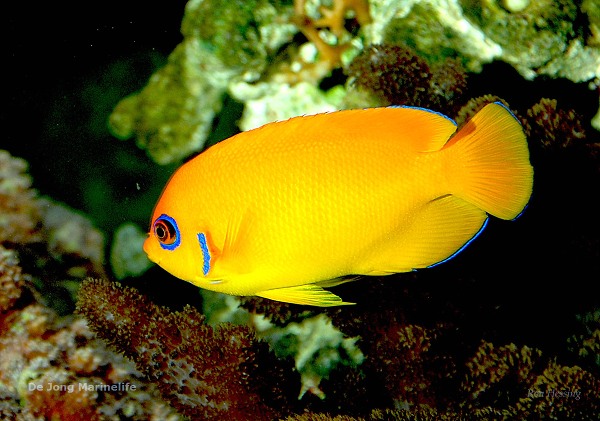
The Lemonpeel Angelfish or Centropyge flavissima is a popular aquarium fish from the Pomacanthidae family of saltwater fish. This species of Angelfish is found in the Indian and Pacific Oceans and can be distinguished from other Angelfish by the blue outlines around its eyes, bottom lip and gill covers.
Lemonpeel Angelfish can grow to about 4" (100cm) in length and are a peaceful aquarium fish that should be fed an omnivorous diet consisting of lots of greens and the occasional meaty snack. Like other Angelfish they are not exactly easy to care for, but their striking appearance still makes them a favorite in the aquarium.
If you check out a Lemonpeel Angelfish in an aquarium in the video below...
If you have any additional information about the Lemonpeel Angelfish including care tips, please leave us a comment below.
The Watanabei Angelfish or Genicanthus watanabei is just one of the many different species of Angelfish in the Pomacanthidae family. This species is one of the few that display sexual dimorphism. (Don't worry I had to look it up too.) This simple means that the male and the female look different from one another. The male Watanabei Angelfish is a pale blue with the lower half of its body highlighted by dark stripes. It also has one orange stripe running horizontally from the middle of its body to its tail. Females are a pale blue as well with a dark dorsal fin and no stripes.
Also known as the Blackedged Angelfish, and the Watanabe's Lyretail Angelfish, these saltwater fish can be kept in an aquarium, but are quite pricey, normally over $100 per fish! They do best in a male/female pair with the following water conditions in a tank of 100 gallons or more, 72-78° F, dKH 8-12, pH 8.1-8.4 and sg 1.020-1.025. Warning: Do not put two males together in the same tank as they will attack each other. A reef aquarium with lots of hiding spaces and live rock should keep them healthy and happy. Feeding the Watanabei Angelfish marine algae, spirulina and frozen shrimp. They can grow to about 6" in maximum length, and are found in the wild in the central and western Pacific Ocean. You can check out a male Watanabei Angelfish in an aquarium in the video below...
If you have any questions about the Watanabei Angelfish or care tips please drop us a line...
The Flagfin Angelfish or Apolemichthys trimaculatus is a bright yellow saltwater fish with blue lips, and a dark spot above its eyes. This species of Angelfish can be kept in an aquarium of at least 80 gallons and is just one of the over 80 different species of Angelfish in the world. Be careful if you are going to house this with other Angelfish, they can become quite aggressive with towards one another.
Also referred to as the Threespot Angelfish, it is not the easiest fish to care for because of its strict diet. They normally feed on sponges, but some people have gotten them to take to brine shrimp, mysis shrimp and various plant life. Flagfin Angelfish should also have plenty of live rock and lots of places to hide. This will help them live longer, stress free lives. The following aquarium conditions are acceptable, 72-78° F, dKH 8-12, pH 8.1-8.4, and sg 1.020-1.025. The Flagfin Angelfish can reach about 10" in maximum length. You can watch the Flagfin Angelfish swimming in an aquarium in the video below...
The Red Stripe Angelfish or Centropyge eibli is a very colorful and popular species of Angelfish from the Pomacanthidae family. They go by many different names including Orangelined Angelfish, Blacktail Angelfish, Eibl's Angelfish, Eibl's Pygmy Angelfish and Eibl's Dwarf Angel. This saltwater fish has vertical stripes that are orange or red. The back of its body and caudal fin are black with a brilliant blue outline. You can check out the Red Stripe Angelfish swimming in this brief video below...
If you are going to keep the Red Stripe Angelfish in an aquarium you should have one that is at least 60 gallons. These fish also require live rock to graze on and need to be given plenty of spaces to hide. Red Stripe Angelfish are omnivores that can be fed a variety of foods including Spirulina, marine algae, brine shrimp, mysis shrimp, flakes and other meaty items. The following water conditions are acceptable, 72-78° F, dKH 8-12, pH 8.1-8.4, and sg 1.020-1.025.In a natural environment this fish is found in places like the Eastern Indian Ocean and above Australia. Red Stripe Angelfish are often seen alone or in pairs around coral reefs normally around 10-82 feet deep. These fish are somewhat reef compatible and can grow to about 6" in length.
If you have more info you would like to share or a question about caring for your Red Stripe Angelfish leave us a comment.
The Blueface Angelfish or Euxiphipops/Pomacanthus xanthometopon is a color changing fish! When this salt water fish is young it has vertical stripes along its body that are black, blue and white. Once this fish is nearly fully mature though it changes to a light yellow with blue scales and a sharp yellow pectoral fin. When it is older this fish almost looks like it is wearing a blue mask around its face! As you can imagine this fish is simply a delight to watch grow up.
Also known as Yellowface Angelfish or Yellowmask Angelfish, these fish can reach over 1' in length so a minimum of 100 gallon tank is highly recommended along with many hiding places. This fish can be somewhat aggressive so be careful! Generally, it is best to keep only one Angelfish in a tank at a time. The Blueface Angelfish will normally be a bit shy at first, but once comfortable it will become one of the boldest fish in your tank!This fish is anomnivoreshould be fed Spirulina, algae, frozen shrimp and other meaty foods. They require a feeding about 3 times a day so be ready for a commitment if you purchase this fish! The Blueface Angelfish has been reported to live over 20 years in the proper aquarium setting.
This saltwater fish requires these water conditions 72-78° F temperature, dKH 8-12, sg 1.020-1.025, and a PH level of 8.1-8.4.
If you would like to see this fish in action check out the video below...