
Find Your Fish

Showing posts with label ovoviviparous. Show all posts

Salmon Shark (Lamna ditropis)


The Salmon Shark or Lamna ditropis is a species of shark that is found exclusively in the Northern Pacific Ocean. This shark is an apex predator that feeds on Sablefish, Herring, Squid, and of course Salmon. Growing to about 10 ft (3m) and weighing in at almost 1000lbs (450kg) these sharks are sometimes confused with the much more dangerous Great White Shark. They have a white underbelly with the rest of their body a grey to black coloration along with some dark patches.  For an in depth look at this species you can watch a 47 minute documentary by National Geographic in the video below.


One characteristic that sets the Salmon Shark apart from other species is their ability to regulate their body temperature. This helps them survive farther north then almost every species of shark with the exception of the Greenland Shark. They have vascular heat ex-changers known as retia mirabilia, that keeps the blood moving toward extremities. When the blood returns it is warmed, which keeps the core of the shark heated.

Salmon Sharks are ovoviviparous, which means the mother carries the eggs in her belly until they are ready to be born.  A litter size of 2 to 6 pups is not uncommon.  Once hatched they will feed off their embryo until they are ready to feed on their own.

If you have any additional information about the Salmon Shark please leave us a comment below.


Longnose Sawshark (Pristiophorus cirratus)

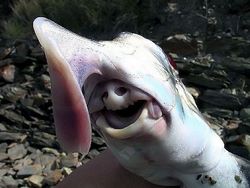
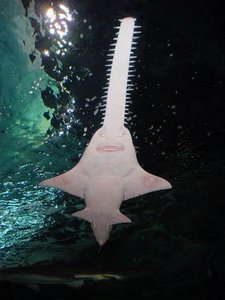
The Longnose Sawshark or Pristiophorus cirratus is arguably one of the strangest looking fish in all of our oceans! Not only does this saltwater fish have an EXTREMELY long snout that is adorned with saw-like teeth, but it also has a set of barbels that hang down and help this fish detect movement on the sandy bottom. This species of shark will cruise the bottom using its rostrum and barbels to search for any vibrations or electrical fields in the water. They use their rostrum to poke around on the bottom and then slash at any potential meals!

Also known as the Common Sawshark, this species is from the family Pristiophoridae, and is found in the eastern Indian Ocean around southern Australia.  Often confused with Sawfish, they can be differentiated by the location of their gills, and the lack of barbels in the Sawfish.  They can reach lengths of up to 4-1/2' (1.4 meters) and are found in depths of between 40 and 310 meters.  Feeding on small fish and crustaceans, these sharks are not considered to be dangerous to humans, despite their frightening appearance.   You can check out the Longnose Sawshark in the video below.

Longnose Sawsharks are ovoviviparous, giving birth to between three and twenty-two pups in each litter. The pups are born with their teeth folded against their snout, which protects the mother from harm while they are developing inside. A new born pup is between 11-15" long.  They can live to the ripe old age of 15.   

If you have any additional information about the Longnose Sawshark please leave us a comment below.


Broadnose Sevengill Shark (Notorynchus cepedianus)


The Broadnose Sevengill Shark or Notorynchus cepedianus is part of the Hexanchidae family and gets its name from the seven gill slits along the sides of its head. Most sharks have only five gill slits, with the exception of a very small few with six. This species of saltwater fish can grow to about 9-1/2 feet (2.9 meters) and has a large, thick body, with a broad head and blunt snout. Their teeth are jagged on top, with comb-shaped teeth on the bottom. The body and fins have small white and black spots scattered throughout.

Like many other species of sharks, the sevengill is counter-shaded which means its dorsal surface is silver-gray to brown in order to blend with the dark water and substrate when viewed from above. In contrast, its ventral surface is very pale, blending with the sunlit water when viewed from below. These sharks are ovoviviparous and can give birth to over 80 pups in a single litter! Broadnose Sevengill Sharks are not picky eaters and will feed on smaller sharks and fish, rays, chimaeras, cetaceans, pinnipeds and carrion.

You can swim with the Broadnose Sevengill Shark in the video below.


If you have any additional information about the Broadnose Sevengill Shark please leave us a comment below.

Blind Shark (Brachaelurus waddi)

Blind Shark (Brachaelurus waddi) is one of the two species of Carpet Sharks from the Brachaeluridae family. Despite their name, these sharks are not blind, but instead get their name from the fact that they tend to close their eyes when outside of water.

Blind Sharks are found off the Eastern coast of Australia in waters of up to 460' (140 m). These sharks are nocturnal feeders and are often found in seagrass beds or around rocky formations. They will normally dine on any and all invertebrates and a variety of bony fishes. This species can live for up to 18 hours out of water, allowing it to survive being stranded by the outgoing tide.
Like other sharks they are ovoviviparous and normally give birth during the summer months.  They will produce a litter of up to eight pups.  You can check out the Blind Shark in action in the video below...


If you have any additional information about the Blind Shark please leave us a comment below.

West Indian Ocean Coelacanth (Latimeria chalumnae)

The West Indian Ocean Coelacanth or Latimeria chalumnae has brilliant blue pigments and flecks of white that covers its body. It was once thought to be extinct along with the rest of the fish in the Coelacanth order. There are only two known species still alive from this sometimes referred to as the Dinofish is sometimes known as the missing link between fish and the tetrapods.As you can tell by their name, the West Indian Ocean Coelacanth are found exclusively in the Indian Ocean. These fish are quite large growing to about 6-1/2' in length and weighing in at over 175lbs! Females of this species tend to be slightly larger than their male counterparts. They can live to about 60 years old and are ovoviparous, much like many sharks. This simply means that they give live birth. These species are listed as critically endangered, only 500 or so left in the entire world. You can check out some amazing footage of a Coelacanth underwater in the videos below...

West Indian Ocean Coelacanth have special hinges in their heads that allow them to swallow large prey. They also have a rosteral organ in the front of their head that helps them detect prey much like the Hammerhead Shark. For this reason, you will often see them doing "headstands" like in the video above. One last weird fact about this saltwater fish is that their bodies continually ooze out a large amount of oil, while their scales let out a mucus of sorts.

Porbeagle Shark (Lamna nasus)

The Porbeagle Shark or Lamna nasus is found in the cooler water of the Northern and Southern Atlantic and Pacific Oceans. These sharks are normally found in coastal waters, but are hardly ever spotted these days. This is because the Porbeagle Shark is critically endangered and some fear that this species will soon become extinct. You can learn a bit more about why these Porbeagle Sharks are so close to extinction in the video below...

Porbeagle Sharks can be differentiated from other sharks by a white patch that in at the back of their dorsal fin. It also has two keels on its caudal fin. These sharks are quite large growing to 12 feet (3.7m) and can weigh as much as 550lbs (250kg)! They will often feed on Mackerel, Herring and even Lancetfish. We reproducing these shark are ovoviviparous and will normally have about 4 pups which take about as long as a human baby to develop.
Considered to be one of the fastest sharks in the world, the Porbeagle can jump all the way out of the water and is considered to be quite social with other Porbeagles. In fact, this shark will actually play tag with others passing around seaweed or driftwood much like dolphins. Even though these fish are edible make sure you don't eat them until they are taken off the endangered species list. Please do your part to keep our oceans healthy and full of life!

Prickly Shark (Echinorhinus cookei)


The Prickly Shark or Echinorhinus cookei is a shark that is covered in modified teeth called dermal denticles or "skin teeth".  They are often found at the bottom of the Pacific Ocean at depths of exceeding 425 meters!   This rarely seen deep sea creature is said to often inhabit submarine canyons where it waits for its prey to swim by. The Prickly Shark often dines on squid, octopus and other small fish.

Prickly Sharks can reach length of about 4 meters (13 feet). They have a very similar appearance to the Bramble Shark, only without the thorny denticles. Prickly Sharks have no anal fin and only have two small dorsal fins that are located way back by the tail.  Prickly Sharks are ovoviviparous, which means that they carry their young eggs inside them until they are close to, or ready to hatch. They can have over 100 pups in a single litter! If you have any additional information about the Prickly Shark that you would like to share please do so in the comments below...

Nurse Shark (Ginglymostoma cirratum)

The Nurse Shark or Ginglymostoma cirratum is a nocturnal shark that is often found resting on the bottom during the days. These sharks will rest in groups of up to 45 sharks! Sometimes they will even pile up right on top of each other! Nurse Sharks are most often found in warmer waters in the Western Atlantic and Eastern Pacific Oceans. These sharks can be quite large at up to 14' (4.3 meters) in length and weigh in at 330 lbs (150 kg). They are rarely dangerous to humans, most cased of Nurse Shark attacks occur when divers accidently step on or provoke these creatures. They have an unusual mouth with very strong jaws that are filled with thousands of tiny, sharp serrated teeth.

These sharks normally feed on shellfish, coral, fish, shrimp and squid. The Nurse Shark is grayish brown in color and have tail fins that can reach 1/4 of their total length. Nurse sharks are ovoviviparous, which means that the eggs develop and hatch withing the body of the female Nurse Shark. They typically have a litter of 21-28 little ones each mating season. One thing that makes the Nurse Shark different from most others is that they are smooth to the touch, although I can say I recommend getting that close!


Atlantic Angel Shark

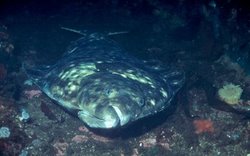
The Atlantic Angel Shark or Squatina dumeril is a very odd shaped shark that is sometimes referred to as the Sand Devil. The Angel Shark is often mistaken for a type of stingray, because of its broad pectoral fins.  An odd eye setup allows them to bury themselves in sand or mud, lying in wait for their prey.  Truly an amazing ambush predator, just watch how quick they strike their prey in the video below...

These sharks can grow to about 5' in length and are not considered aggressive unless accidentally stepped on or aggravated.   The Atlantic Angel Shark is an ovoviviparous shark which simply means that the eggs stay in the mother's body until ready to hatch. When they do, this shark can have up to 30 little sharks running around! This type of salt water fish is found in the Western Atlantic Ocean from the surface to about 5000' deep.


Aquarium Fish Of The Month - Spotted Cardinalfish


Still Can't Find The Fish You Are Looking For? Search For It Below Or Send Us An E-Mail!

Fish Index Followers