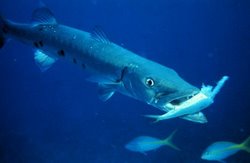
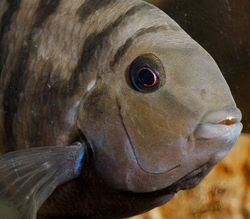
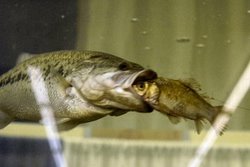
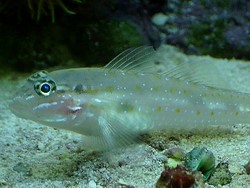
Welcome To The Fish Index! We Are Maintaining A Growing Encyclopedia Of Fish Species Listed From A-Z! Choose From Our Categories Or Browse The Fish Featured Along The Sides By Clicking Their Pictures. Each Fish Includes Detailed Information, Pictures, Video And User Comments! With Over 30,000 Different Species In The World, Our Team Of Fish Experts Are Constantly Being Challenged To Discover New Species. Sample "The Fish Of The Day" Or Browse Our Impressive Selection Of Aquarium Fish!
Don't forget to Like Us On Facebook!
The Cutthroat Trout or Oncorhynchus clarkii is just one of the many species of Trout from the salmon family. This fish is listed as a threatened species due to lose of habitat and introduction of non-native species to its environment in western North America. Despite this the Cutthroat Trout is the state fish of Idaho and Wyoming and is sought after by many anglers especially fly fishermen and women.
Some kinds of Cutthroat Trout are anadromous which means they spend part of their lives in freshwater and part in saltwater. Most of this species though does spend its time in the freshwater with the exception of those on the coastline. There are many different sub species of Cutthroat Trout including Alvord cutthroat trout, Bonneville cutthroat trout, Humboldt cutthroat trout, Lahontan cutthroat trout, Whitehorse Basin cutthroat trout, Paiute cutthroat trout, Snake River fine-spotted cutthroat trout, Westslope cutthroat trout, Yellowfin cutthroat trout, Yellowstone cutthroat trout, Colorado River cutthroat trout, Greenback cutthroat trout and Rio Grande cutthroat trout.
Cutthroat Trout can grow to about 20lbs (9 kg) maximum and can grow as long at 40" (102cm). There are a few sub species of Cutthroat Trout so this fish can range greatly in size, coloration and habitat. Some are golden while others are more gray in color. All of them have red, pink or orange marks on the underside of their jaws, this is a sure way to tell if you have caught a Cutthroat Trout. You can check out some amazing footage of Cutthroat Trouts underwater in the video below...
If you have any additional information about the Cutthroat Trout including recipes and fishing tips please leave us a comment below.
The Rainbow Smelt or Osmerus mordax is a rather small fish that is found in many places in North America including the Great Lakes and many coastal rivers. Rainbow Smelt have slender bodies that have an iridescent look to them with shades of blue, pink and purple on their sides, a silver back and a light underside. Like other Smelt, they are not particularly large only growing to about 12" in maximum length and weighing in at about 3 oz maximum.
These fish go by a couple different names including American Smelt, Leefish, Freshwater Smelt, and Frost Fish. Rainbow Smelt fall prey to a few different species of fish including Walleye, Yellow Perch, Coho Salmon, Burbot and Trout. This species of Smelt will often dine on small invertebrates, zooplankton, Whitefish, sculpins and are even known to eat other Smelt!
Rainbow Smelt are caught both commercially and for recreation. They are edible, but are often used as animal feed and are not considered to be one of the tastiest fish. Rainbow Smelt are considered an invasive species that can cause serious damage when introduced in the wrong locations. While they do provide food for larger fish, they also reproduce quite quickly and can easily become overpopulated in a rather short period of time.
Some Rainbow Smelt are anadromous which means that they can live in salt water as well as fresh water near the coastline. This fish spends much of its summer around the coast line only a mile or so inside the ocean. In the wintertime this fish has a special anti-freeze protein that helps it survive the harsh winters. Once Spring comes Rainbow Smelt will spawn at night in small streams.
You can check out these Rainbow Smelt with your own eyes in the video below...
If you have any additional information about the Rainbow Smelt please leave us a comment...
The Alewife or Alosa pseudoharengus is just one of the over 200 different species of Herring. This fish is anadromous, which means that they can survive in both freshwater and saltwater. Alewife go by a few different names including Grayback, Sawbelly, Kiack, Gaspereau, LY and Gray Herring. They can be differentiated from other Herring by their lower jaw which is longer than their upper jaw.
Alewife are silver or gray with a green or blue tinge. They will normally have at least one small shoulder spot which is darker than the rest of their bodies. These fish are often used as bait fish, because they only grow to about 15" maximum and can weigh about 1/2lbs. This fish is also edible, and is considered to be quite tasty when smoked. These fish are schooling fish that can be caught with nets fairly easily with a little practice. You can learn more about the Alewife in the video below...
Alewife will spawn from April to June and will often make their way into freshwater rivers to lay their eggs. The landlocked Alewife will simply retreat to deeper waters to spawn. Their eggs are left unattended and hatch in about a week. The fry will feed on diatoms, copepods, plants and ostracods. As they grow older, they will begin to eat small fish and shrimp.
If you have any additional information about the Alewife please leave us a comment.
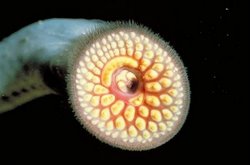
The River Lamprey or Lampetra fluviatilis is a species of Eel that is found in places like Russia, Scotland, Norway, Finland and other European coastal waters and rivers. This ancient saltwater fish is a parasite that has a suckered mouth, rather than jaws. It uses this freakish mouth with sharp teeth to attach to its prey and feed off them.River Lampreys are also known as Lampern or the European River Lamprey and are a very close relative to the Brook Lamprey. These fish are anadromous, much like many species of Salmon they will migrate upstream from the sea and into their spawning grounds. This normally occurs during the the springtime. You can watch the River Lamprey spawning in the video below...
After the baby River Lampreys are born they will spend the first years of their lives in freshwater, before migrating to the saltwater to live out the rest of their lives. The European River Lamprey will grow to about 30cm in maximum length over their 10 year life span.If you have any additional information about the River Lamprey leave us a comment below.
The Striped Bass or Morone saxatilis is an anadromous fish which simply means that they spend most of their lives in saltwater, but return to freshwater to breed. This fish is found in the Atlantic Ocean near the shores of North America. Striped Bass are an extremely popular sporting fish, in fact they are the state fish of Rhode Island, Maryland, South Carolina and Kentucky! The Atlantic Ocean isn't the only place you can find Striped Bass though, they have been introduced to many places across the world including Iran, Russia, Ecuador, Latvia, Russia, Turkey and South Africa as well as on the Pacific Coastline of North America.
Striped Bass go by a few different names including Rockfish, Pimpfish and Stripers. They have long horizontal stripes that run from their gills to the base of their tail. These fish can get quite large reaching lengths of over 6-1/2' and can weigh over 125lbs! They are also quite long lived, reaching the ripe old age of 30. You can check out the Striped Bass for yourself in the video below...
Striped Bass will normally spawn in freshwater, often in rivers, creeks, bays or tributaries that are close to the ocean. After the eggs are hatch they spend a bit of time in the freshwater, but will almost always make their way to saltwater where they spend the rest of their lives. Popular fishing methods for Striped Bass include trolling and surfcasting. The baits to use when fishing for this type of Bass are Eels, Herring, Anchovies, Clams, Nightcrawlers, Sandworms and even Chicken Livers! If you have a fishing tip or recipe for Striped Bass that you would like to share please do so below...